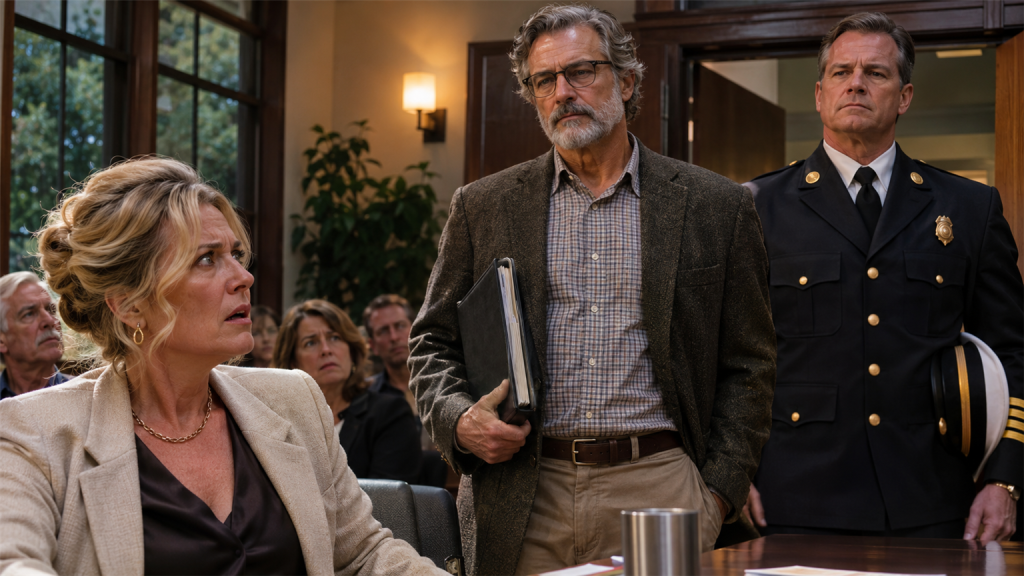
Three months later, I walked into the Brierstone community center carrying a deed, an engineer’s report, and the newsletter Karen did not know still existed.
Beside me walked the county fire chief.
Karen saw us enter.
For the first time, she stopped smiling.
Karen spoke first. For twenty minutes she told residents I was an outside speculator trying to hold 109 families hostage. She said Brierstone had used the bridge since 1988 and that decades of use had created permanent rights.
Then retired county clerk Jean Okoro stood.
“Our petition allows invited relevant parties to present,” she said. “Mr. Hale, please come forward.”
I projected the deed and survey first. The bridge footprint sat entirely inside my parcel.
Then Anand showed photographs of rotted crossmembers, the cracked gusset plate, and water damage at the south abutment.
Finally, Fire Chief Russell Carter stepped forward.
“If the ten-ton restriction takes effect, our engines cannot cross. Depending on conditions, emergency response to Brierstone could increase by fourteen to twenty minutes.”
Nobody moved.
I displayed the easement proposal.
Permanent legal access. Repairs funded from HOA reserves. Five-year inspections. About eleven dollars per household per month.
Karen stood.
“We already own access. This is extortion.”
That was when I put the 1997 newsletter on the screen.
The highlighted sentence filled the wall:
“Ridge View Forestry continues to allow Brierstone residents to use the Tanner Creek bridge as a courtesy.”
The room went silent.
Their lawsuit claimed the use had been hostile and without permission.
Their own newsletter said it was allowed.
Karen called it “out of context.”
A man in the third row said, “Karen, sit down.”
The vote was called.
Ninety households voted to accept the easement and fund the repairs.
Thirteen voted no.
Karen immediately ordered the HOA attorney to seek an injunction.
He slowly closed his briefcase.
“Given the documents now in the record,” he said, “I cannot recommend that.”
That was the moment Karen lost more than the bridge fight.
She lost the room…
The room stayed quiet after the vote.
Not triumphant.
Relieved.
For months, Brierstone residents had been told the dispute was simple: an outsider bought timberland and tried to take away the only bridge into their neighborhood.
Now they had seen the deed, survey, inspection photographs, fire chief, and the HOA’s own newsletter admitting the bridge had always been used with permission.
Karen remained at the front table.
The secretary read the vote again.
“Ninety in favor. Thirteen opposed.”
Karen turned to Martin Caldwell, the HOA attorney.
“File an injunction tonight.”
Martin removed his glasses.
“The membership followed the bylaws.”
“They were manipulated.”
“By documents?”
Her face tightened.
Martin continued.
“Given the newsletter and sworn statements already filed, I cannot recommend trying to block this vote.”
Jean Okoro spoke from the second row.
“We’ve spent months asking one question, Karen. Show us what we actually own.”
Four days later, residents held another special meeting.
Karen did not attend.
The membership recalled her from the board.
Jean became interim president.
A retired accountant became treasurer.
The change was immediate.
Jean’s first email to my attorney, Don Mercer, was six lines long:
We accept that Mr. Hale owns Tanner Creek Bridge. We would like to negotiate the proposed easement and complete necessary repairs as soon as possible.
That was all I had wanted.
The lawsuit was voluntarily dismissed.
No courtroom humiliation.
No dramatic ruling.
The HOA simply withdrew a claim its own records had made difficult to support.
Then we created the document that should have existed in 1988.
The permanent easement precisely described the bridge and approaches.
I retained ownership.
Brierstone received permanent nonexclusive vehicle access.
The HOA accepted responsibility for structural maintenance, inspections, snow and ice treatment, and damage caused by its contractors.
No unilateral widening.
No utility installation without written permission.
Most importantly, if a licensed engineer determined the bridge unsafe, I could restrict or close it temporarily for repairs.
The annual access payment remained $15,000.
Some residents disliked paying for something they had crossed free for decades.
I understood.
But divided among the homes, it was roughly eleven dollars a month.
And half the payment would go into a dedicated bridge reserve.
The easement was recorded in November.
Jean, Don, and I stood at the county recorder’s counter while the clerk stamped it.
Thirty-five years after the first Brierstone home was sold, residents finally had a legal right to reach it.
Then came the harder part.
Repair.
Anand supervised the project.
He wanted to preserve Walter Tanner’s original steel truss wherever possible.
“Old doesn’t mean bad,” he told the contractor. “Neglected means bad.”
The timber deck came off first.
That exposed deterioration we could not see from above.
Two stringer connections had deeper corrosion.
A bearing plate had shifted slightly.



