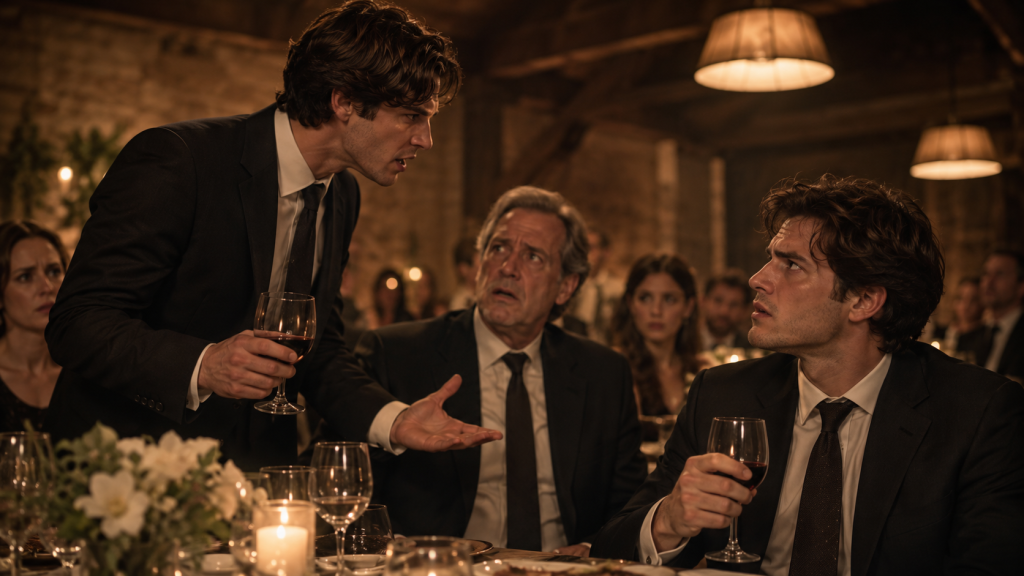
Dad pushed back his chair. “This family doesn’t need a courtroom.”
Caleb took a folded sheet from his jacket and placed it on the table between them. The paper was a copy of the deputy’s incident report, with a time and my name at the top.
“Then explain what you told the deputy when he called you at 12:43 that night,” Caleb said.
Dad didn’t reach for the report. He looked at the tablecloth, where a drop of red wine was spreading slowly beside his plate.
Caleb read the deputy’s note aloud. The officer had reached my parents at home, told them I was safe, and asked them to collect me. Dad had said I could spend the night at the station until I apologized. Mom had refused to come too. The deputy recorded the exchange before contacting Aunt June.
“I was sixteen,” I said. “You knew exactly where I was.”
Dad rubbed his forehead. “We thought a night away would straighten you out.”
“You didn’t tell me it was one night. You didn’t come for me the next morning either.”
June slid her hand onto mine. I remembered her in that hallway ten years earlier, holding a sandwich wrapped in paper, asking whether I wanted mustard. She’d worried about what I needed before asking what had happened.
Mom’s voice shook. “We signed the guardianship paperwork because you wouldn’t come home.”
“You signed it because I had somewhere safe to stay,” I answered. “And I wasn’t willing to return without an apology or a promise you wouldn’t do it again.”
Dad looked toward Caleb. “You can’t let him turn your wedding into a trial.”
Caleb’s fiancée, Hannah, reached for his hand. He didn’t sit down. “I invited Ethan to stand beside me tomorrow. He’s my best man. I’m not asking him to forgive you, and I’m not going to let you call what happened a funny story again.”
Mom stared at him. “Are you choosing him over us?”
“I’m choosing not to lie,” Caleb said.
My father left first. Mom followed him into the parking lot, her napkin still in her hand. I expected Caleb to chase them, and for a moment he looked as though he might. Instead, he sat beside June and asked her whether she wanted more tea. The restaurant kept humming around us. Somebody at the next table was laughing about a lost set of car keys.
The next morning, my parents didn’t attend the ceremony. Caleb checked his phone twice while we buttoned our jackets. I wanted to tell him not to look, but I knew how long a person could keep waiting for headlights that never came.
“Still want me up there?” I asked.
He straightened my tie. “I wanted you there when I asked.”
We stood together beneath the oak trees while Hannah walked down the aisle. When Caleb’s voice cracked during his vows, I slipped him the handkerchief June had ironed for me. He smiled without looking away from Hannah.
In the months that followed, Mom sent a letter saying she regretted the way things had happened. It wasn’t the apology I needed; she still described abandonment as a punishment that went too far. I answered once, saying I wasn’t ready for contact. Dad sent nothing. Caleb kept visiting June and me on Sundays, sometimes bringing Hannah and a pie that was always slightly underbaked.
On their first anniversary, Caleb gave me a photograph from the wedding. In it, we were standing side by side, our shoulders nearly touching. He’d written on the back: Thank you for coming when I asked.
I put it on the shelf beside the old gas-station receipt June had kept with the sheriff’s papers. For years, that faded slip had reminded me of the night my parents drove away. Now, when I looked at the photograph, I remembered someone else had come for me—and someone had wanted me to stay.



