His eyes moved toward the window.
“I wanted to come home.”
On Thursday, Margaret confirmed that the power of attorney had been recorded with the county recorder’s office. Recording it, however, did not prove it was genuine.
She also learned the buyers had paid money under a separate arrangement with my parents before closing. The funds had not gone through the title company’s escrow account.
That explained Ryan’s truck brochure.
Dad called that evening.
“You’ve embarrassed me in front of everyone.”
“Grandpa wants his house.”
“Your grandfather doesn’t understand what’s best for him.”
“Then why won’t you let him speak to the buyers?”
Silence.
Then Dad said, “Come to the closing tomorrow. We’ll settle this face-to-face.”
Margaret advised me not to go alone.
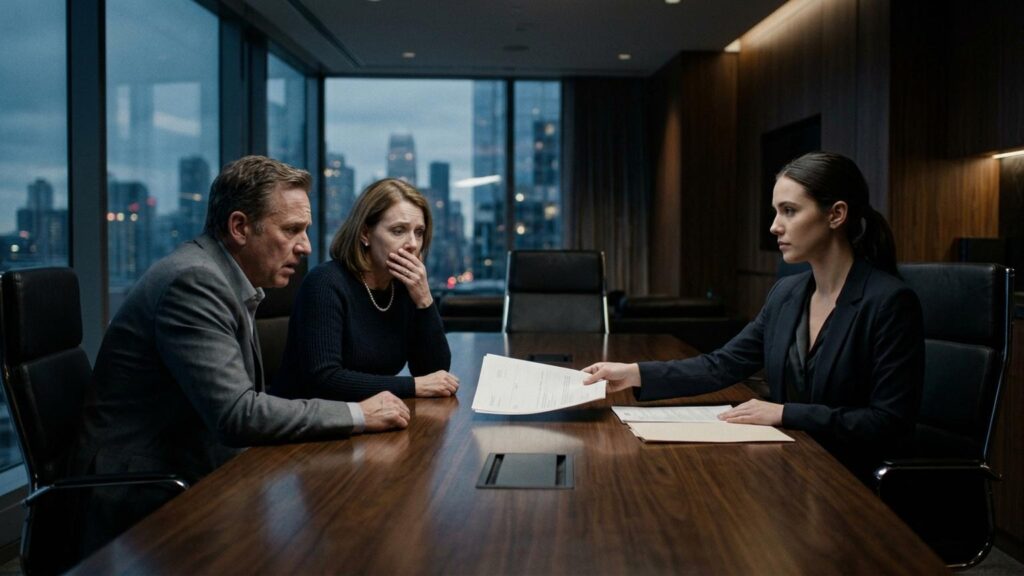
Friday morning, I walked into the title company’s conference room with her beside me.
Mom sat next to Ryan. Dad had already placed a pen beside the seller’s documents.
The buyers looked exhausted.
Dad smiled when he saw me.
“Finally ready to be reasonable?”
Margaret opened her briefcase.
“Before anyone signs,” she said, “we need to address the document your family has been relying on.”
Dad leaned back.
“It’s perfectly legal.”
Margaret placed two certified documents on the table.
“Then perhaps you can explain why your father’s signature appears on both of these, when he signed only one.”
Dad reached for the first document.
Margaret placed her hand over it.
“This is the power of attorney you recorded two weeks ago,” she said. “Your father denies signing it.”
Dad’s face reddened.
“He’s confused. He’s eighty-two.”
“And this,” Margaret continued, “is the revocation of any previously granted financial authority, signed after a private consultation with your father, witnessed and notarized at the hospital.”
Mom stared at the second document.
Margaret explained that Grandpa had also signed a new estate plan, but the important fact was simpler: he was alive, competent when examined, and had expressly refused to sell his home.
The title officer, a woman named Susan, closed the folder in front of her.
“We cannot proceed with this transaction while the seller’s authority is disputed.”
Dad pushed back his chair.
“You’re taking my daughter’s word over mine?”
“No,” Susan answered. “We’re following our closing procedures.”
Ryan leaned forward. “What about the deposit?”
Margaret turned toward him.
“Where is that money now?”
He looked at Mom.
Nobody answered.
The buyers, a young couple named Daniel and Claire, explained that Dad had requested a $24,000 payment directly to an account he controlled, describing it as a deposit that would be credited toward the purchase price.
They showed Susan the transfer confirmation.
Claire’s hands shook as she put her phone away.
“We already gave notice on our apartment.”
For the first time, I saw something other than anger on Mom’s face.
Fear.
Dad tried to leave, but Daniel stood and asked for his money back. Susan explained that the company would preserve its records and that the buyers should seek legal advice.
No police officer burst through the door. Nobody was arrested at the table.
The closing simply stopped.
And for Dad, that was only the beginning.
Margaret referred the disputed power of attorney and supporting records to the appropriate authorities. A review later raised serious questions about the notarization. The matter became a formal investigation, although no one could promise how prosecutors would proceed.
The buyers hired an attorney. Eventually, my parents agreed to a repayment arrangement rather than face a separate civil lawsuit over the money they’d accepted.
Ryan had already spent nearly $7,000 of his share on a truck down payment and accessories. He sold the truck months later, losing money in the process.
Mom called me repeatedly.
“Your father could lose everything.”
I sat at Grandpa’s kitchen table, looking at the faint coffee ring he’d left on the wood.
“He almost lost his home,” I said.
“You’ve always been his favorite.”
I closed my eyes.
For years, I’d listened to that accusation whenever Grandpa thanked me for something as ordinary as picking up his prescriptions.
“He didn’t choose me over Ryan,” I answered. “He chose to keep his own house.”
She hung up.
Grandpa came home eleven days after the canceled closing.
He moved slowly through the doorway with his walker, stopping beside the coat hooks Grandma had installed years earlier.
I carried his overnight bag inside.
He looked toward the living room.
“Did they take her rocking chair?”
“No, Grandpa.”
He nodded and pressed his lips together.
“Good.”
Over the following months, we arranged a visiting home-health aide and made the bathroom safer. Grandpa paid for his own care. I helped with appointments, groceries, and the occasional stubborn jar lid.
His attorney arranged safeguards so nobody could make property decisions for him without proper authorization.



