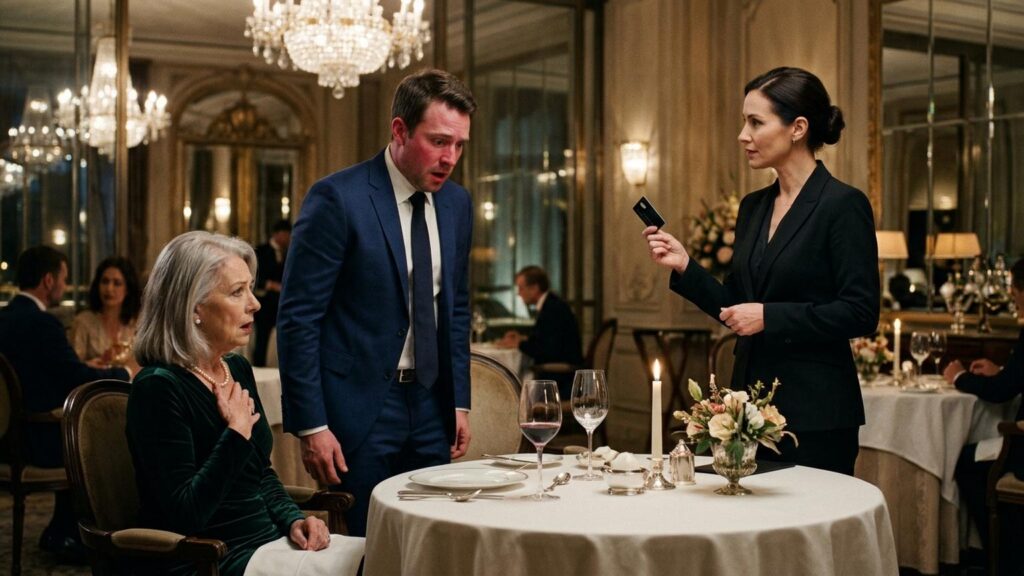
“No,” I said. “It’s a card in my name that you took from my desk.”
He looked at Elena, then at the other tables, where conversations had gone quiet. “She’s lying. She gave it to me.”
I reached into my bag for the thin folder I’d brought from home. On top was a letter from the bank, dated six weeks earlier.
“Then there’s something everyone needs to see,” I said, and laid it beside the check.
The first line of the letter was ordinary enough: Confirmation of account security changes. The second line made Ryan stop talking.
The platinum card he’d taken was no longer active. The bank had canceled that card number six weeks earlier after I reported unauthorized transactions and issued me a replacement. I’d left the old one in my records folder until I could shred it. Ryan had gone into that folder, ignored the statement beneath it, and carried the useless plastic to Bellamy’s like it was a promise I couldn’t take back.
Elena read the date, then quietly pushed the card toward him.
“But she said to try it,” Melissa protested.
“She didn’t agree to pay,” Elena replied. “And this card cannot be charged.”
Ryan’s face turned red. “You planned this?”
“I planned to protect my account,” I said. “You planned dinner.”
Diane leaned across the table. “Claire, don’t be cruel. Your father-in-law is on a fixed income.”
I looked at Frank, who hadn’t spoken all evening. He was folding his napkin into a small, neat square, staring at his hands.
“Frank didn’t invite me,” I said. “None of you did.”
He lifted his eyes. “I thought Ryan was paying for us.”
For the first time, Diane didn’t have a reply.
Ryan tried his debit card. It covered part of the bill, but not the whole amount. Melissa and her husband split the balance, and Frank quietly handed Elena enough cash for the tip. No one was arrested. The restaurant simply expected the people who’d eaten the meal to pay for it. That was all I’d ever wanted.
Outside, Ryan followed me to the sidewalk.
“You’ve humiliated my mother,” he said.
I remembered standing in a grocery aisle three months earlier, returning coffee to the shelf because my account had less in it than I thought. That night Ryan had told me the bank statement could wait until morning. The look on his face now was the same look he’d worn when he moved the paper out of my reach.
“You spent money that wasn’t yours,” I said. “And you expected me to apologize for noticing.”
“Come home. We can talk.”
“We’ve talked,” I said. “I packed a bag before I came.”
He glanced toward the restaurant windows, suddenly more interested in who might be watching than in what I was saying. I got into my car before he could ask again.
The following Monday, I met with the attorney I’d consulted after discovering the charges. We arranged for temporary financial boundaries while the divorce proceeded, including closing our remaining joint account after handling its outstanding bills. I gave the bank the contractor invoice showing Ryan’s name, the statements, and the messages he’d sent about the dinner. The bank’s investigation continued for several weeks; the disputed charges were eventually credited back to me.
Diane sent one message: “Families forgive.” Melissa sent none. Frank called to apologize for believing Ryan had arranged a treat for everyone. I believed him.
Three months later, in my own small apartment, I came home with groceries and set the milk beside a working microwave I’d bought secondhand. Then I opened the kitchen drawer and slipped three twenties into a plain envelope.
The money stayed there.
It wasn’t a fortune. It wasn’t even enough for a good dinner at Bellamy’s. But sometimes peace begins with knowing that the things you set aside for tomorrow will still be yours when morning comes.



