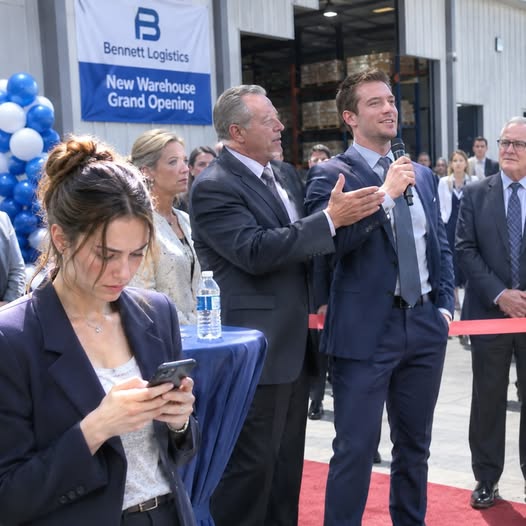
Dad arrived at the office before noon.
“You’ve humiliated your brother,” he said, standing in the doorway where I’d once kept an old space heater because we couldn’t afford proper heat. “You could have corrected this quietly.”
“He sent unauthorized payment instructions to our biggest customer.”
“He was trying to help the company grow.”
“Then why would the customer pay his private business?”
Dad had no answer. I asked him to leave while Allison investigated, and I watched him stare at the framed photograph of our first warehouse before he turned away.
Two days later, the review revealed more. Justin had used the corporate credit card for $18,400 in personal expenses disguised as client entertainment, and several invoice drafts prepared on his laptop were addressed to JCM Advisory.
None of the redirected Evergreen payments had been made. The damage was serious enough without inventing missing millions: a suspended renewal, broken trust, and employees watching their company become the subject of rumors.
Then Allison found an email chain Justin had forwarded to his personal account. It included Dad’s response to the draft announcement, written four days before the gala.
Go ahead and announce it in front of the staff. Hannah won’t challenge you with everyone watching.
A second message from Justin read: I’ll use her signature from the old service agreement. By the time she objects, it’ll be done.
Dad had replied with just three words: “Do what works.”
I read Dad’s reply three times. He’d visited my first storage unit on a freezing morning and brought coffee because I couldn’t afford to leave work for lunch, and I’d carried that kindness for seven years like proof he believed in me.
Now I knew what his belief had become.
At Monday’s board meeting, Allison laid out the customer letter, unauthorized billing instructions, credit-card charges, and emails. Justin had a chance to respond with counsel, but he couldn’t explain why he’d copied my signature or directed Evergreen toward JCM Advisory.
The board voted to terminate his employment for misconduct. We also preserved the evidence for investigators.
At the subsequent shareholder meeting, Dad held the same leather folder he’d brought to the anniversary dinner.
“You can’t fire your own brother,” he said. “I invested in this company.”
“You own sixteen percent,” I answered. “That gives you shareholder rights, not the power to appoint its president, and it doesn’t give Justin permission to take money.”
Mom began to protest, but Marisol spoke before she could. “Hannah signed our first warehouse lease when no bank would lend us a dollar. She worked alongside the drivers and made payroll through two terrible winters.”
I watched Dad’s face as someone who’d worked beside me finally said what I’d once begged my parents to notice. He closed his folder without opening it.
“Justin has bills,” Mom whispered. “What is he supposed to do?”
“Find work and repay what he took,” I said. “I won’t put sixty-one families at risk so he can avoid consequences.”
For three weeks, Evergreen’s auditors reviewed our authorization records and payment accounts. We disclosed the incident, implemented additional controls, and Evergreen signed the $3.6 million renewal after confirming its payments had never been redirected.
Marisol brought the executed agreement into our warehouse office. We stood beside the printer that always jammed on humid days, and she handed me a paper cup of terrible coffee as she had during our first year.
“We did it,” she said.
“We kept everyone employed,” I answered, and that mattered more.
Over the following year, Justin settled the company’s civil claim, agreed to repay the $18,400, and surrendered his access to business records. Following an investigation, he pleaded guilty to charges arising from the forged authorization and received court-supervised conditions and restitution; no Evergreen funds had reached his company.
Dad wasn’t charged, but the emails made it impossible for him to pretend he’d been an innocent spectator. Months later, after an independent valuation, he voluntarily sold me his sixteen-percent stake; Marisol retained her ten percent.
Dad called once afterward.
“I thought giving Justin the title would finally make him responsible,” he said.
“You tried to hand him something he hadn’t earned,” I replied. “And you didn’t even ask what it would cost me.”
The next anniversary wasn’t held in a ballroom. We bought lunch for the warehouse crew, and I stood at the loading dock watching employees carry folding chairs into the sun.
Marisol took a photograph of us in front of the first forklift we’d restored. I kept that picture on my desk beside a faded receipt from the storage unit where everything began.
My father wanted to give my brother the company I’d built. In the end, my brother lost the job I’d given him, Dad sold the shares he’d used to threaten me, and the business stayed with the people who’d actually kept it alive.



