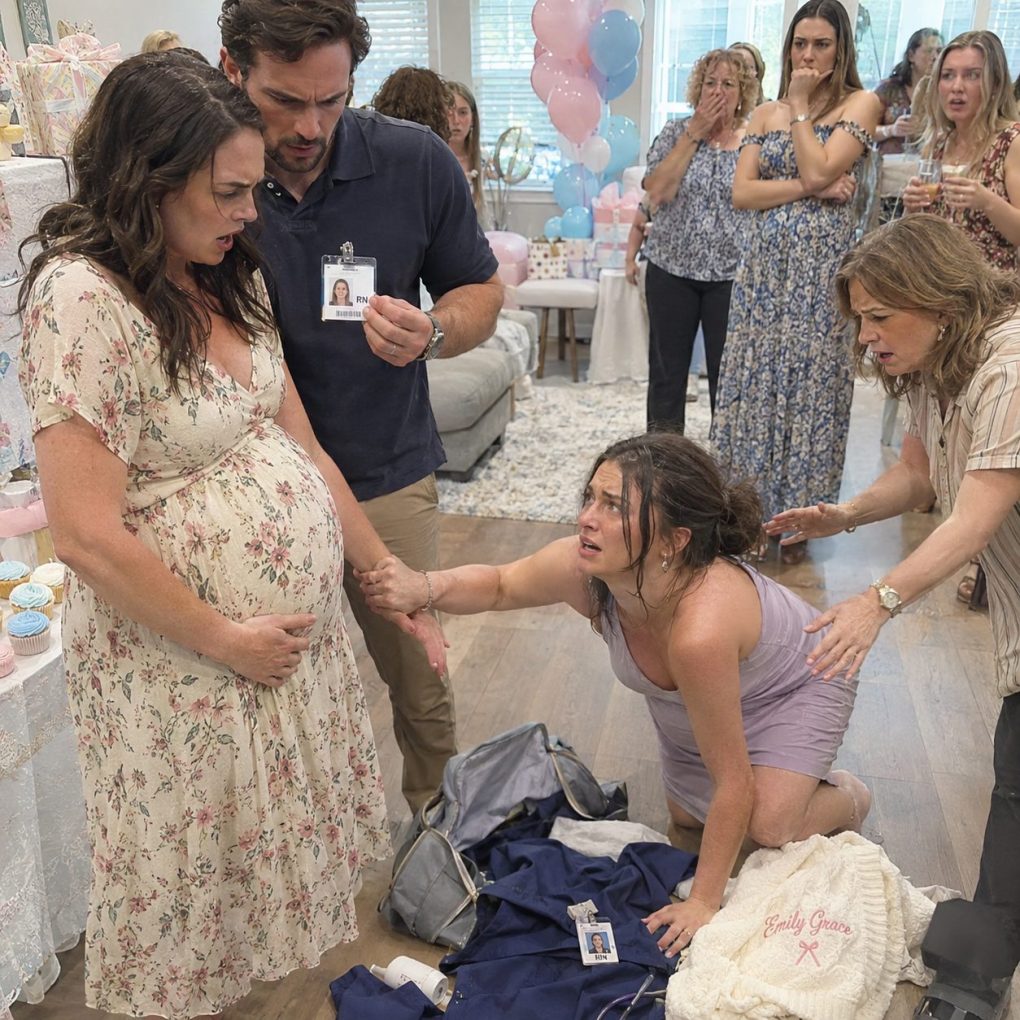
Before we returned home, Ethan drove me to maternity triage because Clara’s movements had felt quieter. The monitoring was reassuring, but I kept my hand on my stomach all the way home.
At home, I found three messages from my sister. The first said I had humiliated her. The second demanded that we tell the family it was all a misunderstanding.
The third read: “You don’t deserve Clara more than I do.”
I sat on the nursery floor with my back against the crib, listening to Ethan speak to a police dispatcher about the threats and the fake badge. The room smelled faintly of the lavender detergent I’d used on the tiny clothes, and I hated that I was suddenly afraid to sleep there.
Near midnight, the hospital’s security supervisor returned our call. She explained that a woman matching Megan’s description had been escorted away from a restricted maternity area the previous Thursday after claiming to be on staff.
Then she paused.
“She wasn’t looking for a job, Mrs. Walker,” she said. “She was asking how she could take a newborn home.”
I didn’t sleep that night. Ethan sat beside me on the nursery floor, his hand on the crib we’d assembled together, and every time the house settled I looked toward the front door.
The next morning we gave police the messages, photographs, and the names of everyone who’d seen the bag spill. The hospital preserved its security reports and footage, put safeguards around my upcoming delivery, and reviewed the incident; we changed our locks because Megan had once kept a spare key.
None of that made me feel brave. I felt like a woman who couldn’t stop picturing her daughter in someone else’s arms.
Mom called twenty-seven times in two days. When I finally answered, she said, “Your sister needs help. She’s grieving.”
“I know,” I said. “But why did you let her pretend my daughter belonged to her?”
Mom admitted that Megan had shown her a nursery weeks earlier, complete with a crib and a wooden sign reading CLARA JUNE. She’d convinced herself it was harmless because admitting the truth meant admitting Megan needed more help than Mom could give.
I remembered handing Megan my birthday bicycle when I was twelve because she’d cried over its blue paint. Mom had called me mature. For years, that word had meant I was expected to surrender whatever my sister wanted.
This time I didn’t.
At a family gathering the following week, Mom asked everyone to stop “judging Megan over a difficult time.” Then she suggested I’d frightened my sister by making a scene at the shower, and I felt the familiar pressure to apologize just to keep the peace.
I put my phone on the table and read Megan’s message: “You don’t deserve Clara more than I do.” Ethan explained what the hospital had confirmed, while Aunt Ruth listened with her hand over her mouth.
“Mom, you helped her pretend she was pregnant,” I said. “You gave away our daughter’s name and kept silent when you saw her nursery. You can love Megan, but you cannot ask us to risk Clara to protect your secret.”
Mom didn’t deny it. For once, she didn’t ask me to make things easier for anyone.
Clara June arrived three weeks early on a rainy August morning. The hospital followed its security plan, Ethan stayed with me, and when the nurse settled our daughter against my chest, she opened her tiny fist and curled it around my finger.
Months later, Megan admitted through her attorney that she’d used a false badge and entered a restricted hospital area without permission. Investigators found no evidence she’d accessed my medical records or taken a child, but her conduct led to a trespass-related charge; she pleaded guilty, received supervised probation, and was required to keep away from us.
I didn’t celebrate. I cried in the grocery-store parking lot after hearing the outcome, because my sister had become someone I needed protection from.
We kept the embroidered blanket with the case materials and wrapped Clara in a soft yellow one Grandma June had sewn years earlier. Mom has met her twice, both times with Ethan present, and understands that further contact depends on respecting our boundaries.
Megan is getting professional help, but we have no contact, and I can’t promise that will change. Sometimes I remember her shouting “Bump buddies!” into the phone and wish those words had meant only happiness.
When I look at Clara asleep in her crib, though, I know protecting her was not a betrayal of my sister. It was the first promise I made as her mother.



