“It’s one bad moment. My family’s hotel employs sixty people, Claire. Your parents pulling out will put the whole project at risk.”
I looked at Mom’s cane leaning against the hallway wall, its rubber tip still sticky from the restaurant floor. “Then your family should have treated its prospective business partner with some respect.”
He became very quiet. Then he asked, “Did your father tell her to do this?”
“No, Nathan. She made the decision herself.”
I called our wedding coordinator and canceled the ceremony. We would lose part of our deposit, and I paid my share without asking Dad to rescue me; it was a painful expense, but cheaper than spending a lifetime apologizing for other people’s cruelty.
Later, the coordinator forwarded the revised seating plan Nathan had approved. My parents were placed behind a floral partition, away from the main aisle, with a note that the location would keep “mobility aids out of the ceremony photographs.” Mom heard the words when I read them aloud and squeezed my hand instead of crying.
That afternoon, our attorney called. The Caldwells’ lender had received her notice withdrawing the unexecuted investment and asked why it conflicted with a document already in its financing file: a signed commitment supposedly binding Mom’s company to provide the full $4.2 million.
Marianne sent us the copy, and Dad read the date aloud. Mom reached for her laptop to check her own records.
“I’ve never approved this,” she said.
At the bottom was my mother’s electronic signature, attached to a certificate with no valid signing-platform verification.
Someone had promised the bank millions of dollars in her name, without her permission.
The next Monday, instead of walking down an aisle, I sat beside Mom at our attorney’s office while the bank’s compliance team asked her questions. The Caldwells had supplied a supposed commitment; the bank halted its review and asked us to verify it.
Mom answered every question herself. When an investigator addressed Dad, she said, “It’s my company and my signature.” He apologized.
Our records showed no executed agreement, no authorized electronic-signature envelope, and no board approval. The financing document contained an image of Mom’s signature copied from an earlier confidentiality agreement, not a commitment she’d signed; the bank’s review confirmed the discrepancy.
Nathan had forwarded the purported commitment to the lender. He insisted his family’s finance officer had prepared it and that he’d assumed it was genuine, but emails later showed he’d been warned that our final agreement was still awaiting approval. The bank referred the false paperwork for further investigation, and our attorney confirmed Mom’s company owed nothing.
Victoria called twice to apologize, but both messages ended with a request for another meeting about the money. Mom declined the first and agreed to the second only when our attorney would be present.
We met at the lawyer’s conference room, not their hotel. Victoria came in wearing pearls and carrying the same practiced smile she’d worn before throwing the wine, while Nathan stood behind her like a boy waiting to be forgiven.
“Eleanor,” she began, “we’ve all said things we regret. Surely you wouldn’t punish sixty innocent employees over one misunderstanding.”
Mom sat straight, her cane beside her chair. “You threw wine in my face because you thought I was beneath your family. Then you asked me to risk millions on a business whose paperwork you couldn’t be honest about.”
Victoria’s smile trembled. “I didn’t know you were the investor.”
“That’s precisely why I know how you treat people you think have nothing to offer,” Mom replied.
Nathan turned to me. “Claire, I never wanted any of this.”
“You watched it happen,” I said. “And you told me to be quiet.”
There was nothing more to negotiate. We walked out together, and her hand on my arm felt like companionship, not something to defend.
The bank declined the Caldwells’ refinancing request after its review, and the family eventually sold its unfinished hotel project to another operator rather than completing the expansion. The new owner retained much of the staff, but Victoria stepped away from the hospitality company’s leadership after the lender’s findings; Nathan lost his role overseeing the financing, and the false document remained under investigation.
I never pretended one phone call had destroyed an empire. It had stopped our money from being used without consent, and the facts the bank uncovered had consequences the Caldwells could no longer talk away.
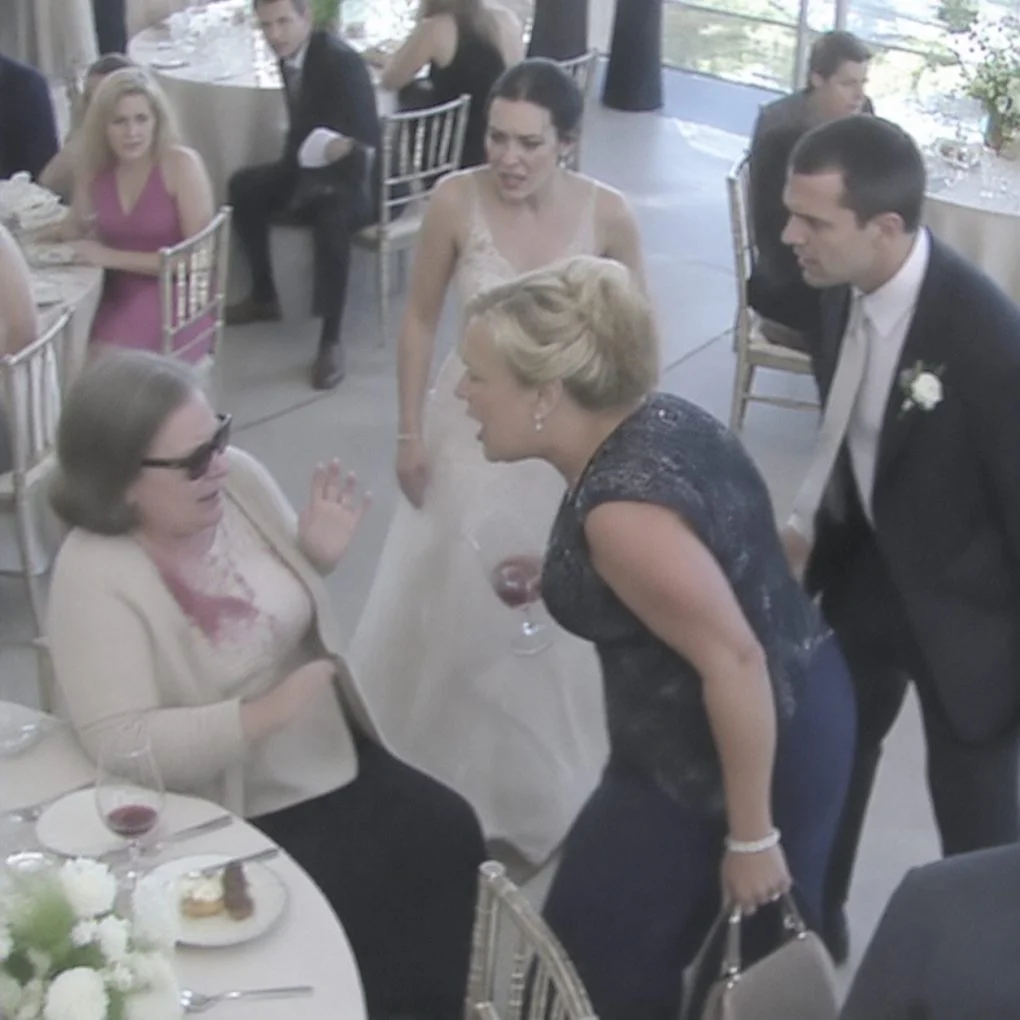
Two months later, the hotel sent us its incident footage. Mom chose to make a police report about the wine-throwing and kept her stained dress as evidence; she didn’t need me to decide what justice should look like for her.
A year after the wedding we never had, Mom and Dad invited me for Sunday dinner. She reached across the table for my hand, found it without hesitation, and asked whether I wanted more potatoes.



