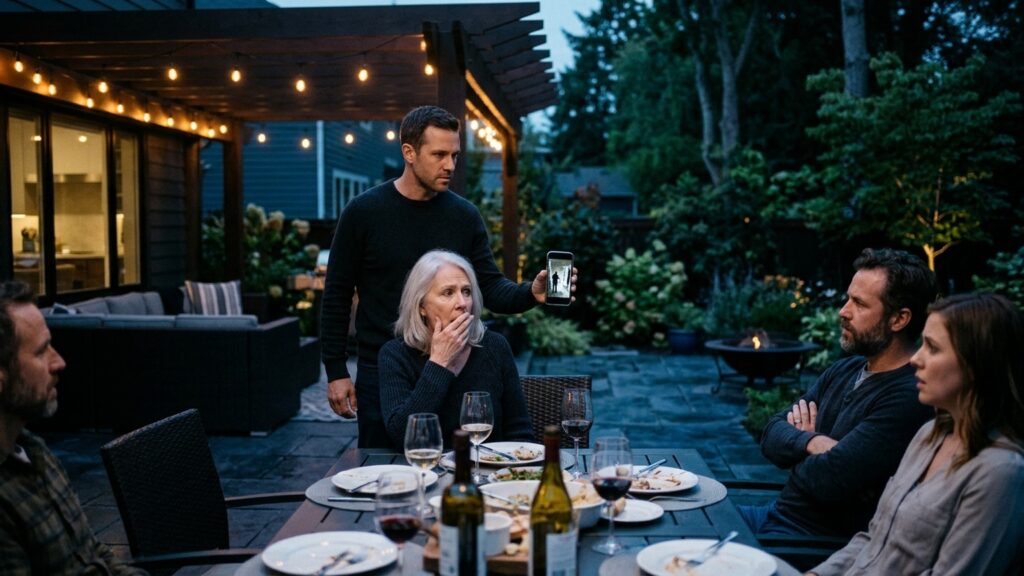
But Daniel had helped install the system. He knew the footage was backed up automatically to an account he could access.
The investigator reviewed the recording privately.
When she returned, she asked Daniel to step into the hallway.
“There’s something else on that video,” she said. “Something your mother told Tyler before the assault.”
Daniel glanced at me.
“What did she say?”
The investigator opened her notebook.
“Your mother may have encouraged him to confront your wife.”
The investigator didn’t show us the entire recording that night. She explained that the footage needed to be preserved properly and reviewed alongside witness statements.
But she told us enough.
Twenty minutes before Tyler attacked me, Patricia had pulled him aside near the patio door.
The camera recorded their conversation.
Tyler was complaining about my refusal to lend him the car. Patricia told him I had become too comfortable disrespecting their family.
Then she said something I would remember long after my jaw healed.
“Sometimes people need to be put in their place.”
Tyler asked whether Daniel would get angry.
Patricia answered, “Your cousin will get over it. He always does.”
The investigator was careful to explain that those words alone didn’t establish that Patricia had ordered an assault. But they contradicted her claim that she had tried to calm Tyler down.
The recording also showed the attack itself.
There was no horseplay. No accidental collision. Tyler approached me after the laughter had stopped, said something the camera microphone barely captured, and punched me while I was standing still.
Daniel watched only a few seconds before turning away.
“I was right there,” he whispered.
I reached for his hand.
“You came to me.”
He shook his head.
“I should have stopped him.”
“You couldn’t have known he’d do that.”
For the first time since the ambulance ride, Daniel cried.
Two days later, I underwent surgery. My jaw was stabilized with small titanium plates, and I went home with swelling, pain medication, and instructions to eat soft foods for weeks.
Daniel made soup, strained it twice, and sat beside me while I struggled through three spoonfuls. He slept on the couch so he wouldn’t accidentally bump my face.
Meanwhile, the investigation continued.
Tyler was charged in juvenile court with an offense arising from the assault. His attorney initially argued that he had reacted impulsively to public embarrassment, but the recording made it difficult to dispute what happened.
Months later, the court ordered juvenile supervision, counseling, community service, and restitution toward my uncovered medical expenses. The consequences were serious, but they did not mean his entire future was over.
Patricia was not criminally charged. However, her statements, the attempted false account, and her efforts to pressure me became part of the documented case.
Robert called Daniel repeatedly.
“Your mother didn’t mean any harm.”
Daniel finally answered.
“Emily needed surgery. Mom tried to make her sign a lie. What part of that are you defending?”
Robert had no answer.
We stopped attending family gatherings. Daniel told his parents that any future relationship would require accountability, an apology without excuses, and respect for our boundaries.
Patricia sent flowers once.
The card read, I’m sorry things got out of hand.
Daniel returned them.
Six months later, I could eat normally again, although one side of my lower lip still felt slightly numb. My surgeon said the sensation might improve with time.
On a quiet Sunday afternoon, Daniel brought home a small lemon cake from the bakery near our house.
I looked at it and remembered the one I had carried to Patricia’s birthday, the one nobody ever cut.
“What’s the occasion?” I asked.
He placed two forks beside the box.
“Nothing. I just thought you’d like some.”
We ate at our kitchen table with the windows open.
For years, I had believed being accepted into Daniel’s family meant swallowing every insult and pretending it didn’t hurt.
But I finally understood something.
A family isn’t defined by how loudly people defend one another.
Sometimes, it’s defined by who kneels beside you when everyone else looks away—and who refuses to call what happened an accident.



