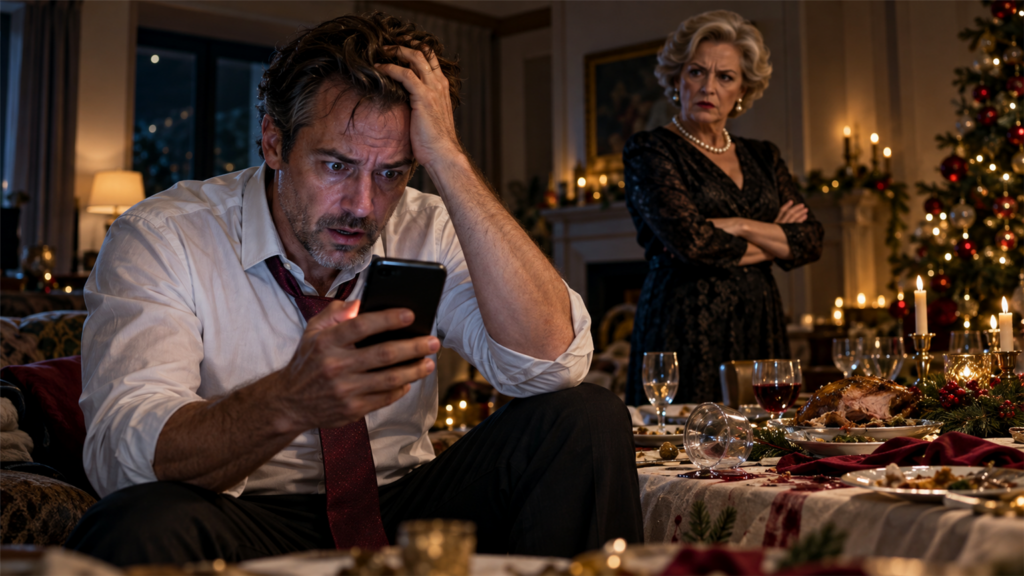
Oh my God.
By 7:10, the family group chat had exploded.
People were asking who had ordered the food.
Who had purchased the gifts.
Who had paid for the tent last year.
And then Uncle Robert wrote something that changed the entire conversation.
Wait. Emily paid for ALL of that? Diane told us Mark paid.
I read it twice.
Then Mark came home.
Not at midnight.
Not after the party.
At 7:46 p.m.
His face was pale.
He shut the front door and stood there holding his coat.
“Emily,” he said, “we need to talk.”
I set my mug down.
“No, Mark. Tonight, you need to listen.”
Mark stood in the hallway for several seconds.
The house was unusually quiet.
No Christmas music.
No crowded dining room.
No relatives shouting over one another.
Just the hum of the refrigerator and the faint sound of snowplows somewhere beyond our street.
“I didn’t know Mom told everyone I paid,” he finally said.
I looked at him.
“You knew I paid.”
“That’s different.”
“How?”
He rubbed both hands over his face.
“I thought people knew.”
“They didn’t.”
He sat at the kitchen table.
For the first time that evening, he looked embarrassed rather than angry.
I opened the drawer beside me and took out a folder.
Inside were copies of credit card statements from the previous three Christmases.
Catering.
Alcohol.
Gifts.
Decorations.
Rental furniture.
Cleaning services.
Even the hotel rooms Diane had insisted we book for two relatives because her house was “too crowded.”
More than $11,000 over three years.
I placed the papers in front of him.
Mark stared at them without speaking.
“This is what your family called me selfish for,” I said. “This is what I paid while being told I ruined everything.”
He looked up.
“I should have defended you.”
“Yes.”
The simplicity of my answer seemed to hurt him more than shouting would have.
He swallowed.
“I’m sorry.”
I didn’t answer immediately.
Sorry mattered.
But patterns mattered more.
“I don’t want an apology because tonight went badly,” I said. “I want you to understand why it went badly.”
His eyes dropped to the statements again.
For years, Mark had allowed his mother to take credit for what I did.
Worse, he had allowed me to become the convenient villain whenever something wasn’t perfect.
That night made it impossible for him to pretend otherwise.
The next morning, something unexpected happened.
Diane called.
I almost didn’t answer.
When I finally did, she didn’t apologize.
Not really.
She said, “Yesterday got out of control.”
Then she added, “But you could have warned us.”
I felt my jaw tighten.
“I warned Mark in November.”
“That’s not the same.”
“It is.”
She became quiet.
Then I heard her breathe in sharply.
“You embarrassed me in front of my family.”
“No, Diane. You told your family you were hosting Christmas. I simply stopped secretly financing it.”
She hung up.
That was the last time I chased her approval.
The family eventually learned what had happened because Rachel told the truth in the group chat.
Not dramatically.
Just facts.
She listed what I had paid for over the years and explained that I had never agreed to fund Christmas that year.
Uncle Robert apologized.
Two cousins did too.
Others stayed silent.
Diane never admitted she had lied about who paid.
But she never took credit again.
As for Mark, things didn’t magically improve.
Real marriages don’t repair themselves because of one dramatic night.
We started counseling in January.
There were uncomfortable conversations.
Some nights, he became defensive.
Some nights, I did too.
But slowly, he started noticing things he had ignored for years.
The way Diane interrupted me.
The way his relatives expected me to organize everything.
The way he stayed silent whenever protecting me meant disappointing his mother.
The following December, something changed.
Mark sent the family group chat a message before anyone could ask me for plans.
We’re not hosting Christmas this year. If Mom hosts, everyone needs to contribute equally. Emily will not be organizing or paying for it.
Diane called him within five minutes.
He didn’t hand me the phone.
He handled it himself.
Christmas that year was smaller.
Everyone brought food.
Everyone paid for their own gifts.
There was no rented tent.
No expensive caterer.
No carefully staged centerpiece.
And somehow, Christmas survived.
After dinner, Rachel raised her glass toward me.
“Funny,” she said. “Nobody ruined Christmas.”
Mark looked at me.
He knew exactly what she meant.
I smiled.
For years, I thought keeping the peace meant absorbing every insult quietly.
It didn’t.
Sometimes peace begins when you stop rescuing people from the consequences of how they treat you.
And that Christmas, for the first time in nearly a decade, I didn’t pay for anyone’s approval.



