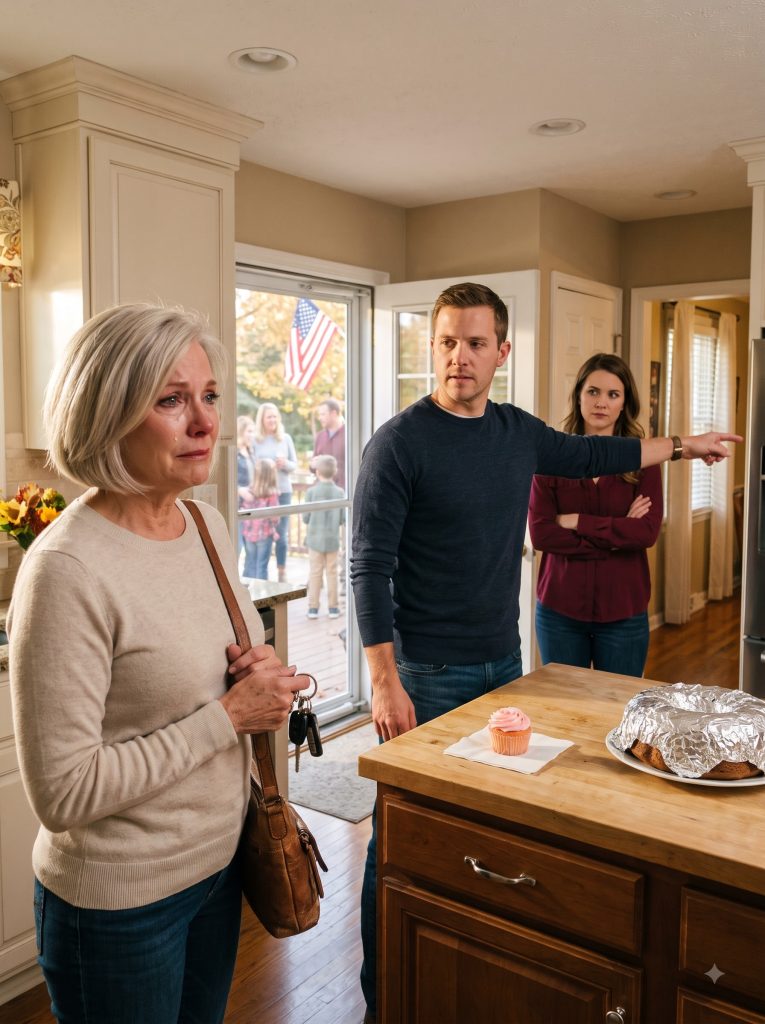
The first thing I did after my son told me to leave was look for my car keys.
They were beneath a stack of paper napkins on his kitchen counter, beside the apple cake he had asked me to make. Through the screen door, I could hear somebody laughing at one of my brother-in-law’s stories. A child called for another hamburger.
Ryan stood between the refrigerator and the back door, waiting for me to apologize to his wife.
“Mom,” he said. “Don’t turn this into something bigger.”
I moved the napkins and picked up my keys.
My name is Diane Whitmore. I had been Ryan’s mother for thirty-two years, and until that afternoon, I had never understood how quickly a familiar house could become somewhere you were no longer welcome.
It was the first Saturday in October, warm enough that people had taken their sweaters off and draped them over folding chairs.
Ryan and Lauren lived about twenty minutes from me, outside Columbus. They had bought the house three years earlier, drawn by the fenced yard and the elementary school within walking distance.
That afternoon, paper lanterns hung from the maple tree. Almost twenty people crowded the patio and lawn: relatives, two neighbors, and a couple Ryan knew from work.
I arrived with three containers of food and a little paper bag for my granddaughter, Lily.
She was six. Inside the bag were washable markers and a sketchbook because she had recently decided she wanted to draw every dog on her street.
“Can I have it now?” she whispered.
“Ask your mom where you should put it.”
Lauren glanced over from the patio table.
“Upstairs, please. We’re about to eat.”
Lily ran inside, and Ryan took the food from me.
“You made the cake.”
“You asked.”
He kissed my cheek. For a few minutes, everything felt easy.
After lunch, my niece brought out plain cupcakes and bowls of frosting. The children gathered around a low table near the kitchen door. Lily tugged at my sleeve until I sat beside her.
She spread pink frosting over her cupcake, then scooped up another spoonful.
“Diane,” Lauren said behind me. “I asked her to keep it to one spoonful.”
I hadn’t heard the earlier instruction.
“She’s having fun,” I said. “It’s just frosting.”
Lauren’s expression closed.
“And I said one.”
Lily stopped with the spoon in the air.
I took the bowl and moved it toward the middle of the table.
“All right, sweetheart. Let’s use the sprinkles.”
Lily reached for them without looking up.
I knew, even then, that I should have answered Lauren differently. I could have said I hadn’t heard. I could have simply moved the bowl.
Instead, I had made her rule sound foolish in front of her daughter.
It was a small mistake. What happened afterward had been building for much longer.
Twenty minutes later, I was in the kitchen helping my niece arrange leftovers when Lauren came in.
“Could you give us a minute?” she asked.
My niece carried a platter outside. Lauren pulled the screen door shut.
“You need to stop undermining me with Lily.”
“I should have backed you up about the frosting,” I said. “I didn’t hear you tell her before, but I should have asked.”
“It isn’t only today.”
I put down the dish towel.
“All right. Tell me.”
She stood against the counter, arms folded.
“You suggest a different bedtime. You bring things after I’ve said we have enough. Last month, you rearranged my pantry.”
“Ryan asked me to put the groceries away.”
“He asked you to put them away. Not move everything.”
I remembered the pantry. I had grouped the baking supplies together because that was how I kept mine.
“I didn’t realize that bothered you.”
“That’s what you always say.”
Outside, someone dragged a folding chair across the patio. I watched the handle of the screen door settle back into place.
“Then I won’t do it again.”
Lauren shook her head.
“You make it sound like I’m complaining about a shelf.”
“I’m trying to understand what you want me to do.”
“I want to stop feeling like a guest in my own house.”
That surprised me enough that I didn’t answer immediately.
I had babysat there, folded laundry there, made soup in that kitchen when all three of them had the flu. I had thought those things made me useful.
Apparently, at least some of them had made Lauren feel watched.
“I don’t want you to feel that way,” I said.
“Well, you do. And helping with the down payment doesn’t give you a vote in everything.”
I looked at her.
“I have never said it did.”
“You don’t have to say it.”
Three years earlier, I had given them $35,000 toward the house. Ryan had offered to pay me back when he could, and I had told him clearly that it was a gift.



