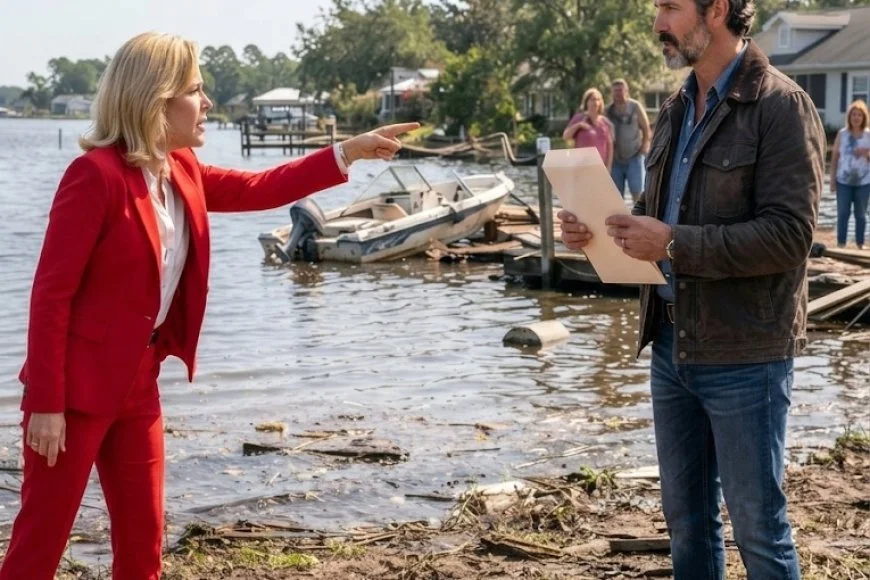
Then Cedar Ridge called Monica.
Her attorney guided her gently.
She said the expansion had been professionally designed.
She said contractors followed approvals.
She said nobody intentionally altered property boundaries.
She said the storm had been extraordinary.
All reasonable answers.
Then he asked:
“Before the storm, did Cedar Ridge have reason to believe its improvements created a dangerous flood condition?”
“No.”
Rachel stood.
“Mrs. Caldwell, did the county warn Cedar Ridge that the western overflow route should remain unobstructed?”
“We received routine engineering comments.”
“That was not my question.”
Monica looked at Judge Hayes.
Rachel repeated it.
“Were you warned that the western overflow route should remain unobstructed?”
“Nothing suggested houses were going to flood.”
“Again, not my question.”
The judge looked toward Monica.
“Answer yes or no if you can.”
Monica swallowed.
“Yes. There was a comment regarding maintaining overflow.”
Rachel nodded.
“Did your board discuss western overflow exposure before the flood?”
“Not in the way you’re suggesting.”
“Did the board discuss whether flood responsibility might be attributed to Walker property?”
“No.”
That was the answer Rachel wanted.
She walked to counsel table.
Not the large boxes.
The smallest one.
Melissa Grant’s original draft minutes appeared on the screen.
Rachel read:
Board discussed western overflow exposure and potential association liability. If western overflow is attributed to Walker property, association exposure may be reduced.
Monica’s expression changed.
Barely.
Enough.
“Were you present at this meeting?”
“I would need to see the full record.”
“You will.”
Then Rachel called Melissa.
She identified her handwriting.
Her draft.
The meeting date.
The attendees.
Rachel asked:
“Why is this paragraph absent from the final minutes?”
“Monica told me to remove it.”
A murmur moved through the gallery.
Judge Hayes looked up.
“Why?”
Melissa hesitated.
“She said the discussion was speculative and would unnecessarily expose the association.”
“Did she ask you to remove anything else?”
“Yes.”
“What?”
“References to the overflow corridor and a possible redesign if expansion altered drainage.”
Rachel returned to Monica.
“Mrs. Caldwell, at the homeowner meeting three weeks ago, were you asked whether Cedar Ridge had received any warning concerning the western berm or drainage changes?”
“I don’t remember the exact wording.”
Rachel played the recording.
Thomas Reed’s voice:
Did anybody warn the HOA that the new berm or drainage work could change the flood path?
Then Monica:
No. We had no such warning.
Rachel stopped the video.
Nobody spoke.
She placed four items side by side on the courtroom screen.
The county warning.
Melissa’s original minutes.
Monica’s historic-map request.
Cedar Ridge’s composite lawsuit exhibit.
“Mrs. Caldwell, after receiving the county warning, after discussing possible western overflow liability, and after requesting historical material connecting drainage toward Walker property, you told homeowners there had been no warning.”
Monica’s attorney leaned toward her.
Judge Hayes waited.
Finally:
“Yes.”
Rachel sat down.
No speech.
No theatrical finish.
The documents had already done it.
Judge Hayes looked at Cedar Ridge’s counsel.
“I have a serious problem with the ownership theory underlying this complaint.”
Then she looked at Exhibit C.
“And an equally serious concern regarding the creation and use of this exhibit.”
The $2.8 million claim did not survive the hearing.
The court found that Walker Bend Ranch ended before the county flood-control corridor.
Cedar Ridge could not impose drainage responsibility on me by labeling public corridor land as private ranch property.
The photograph of my cattle gate did not establish flood causation.
The deputy’s report established the subdivision was already flooding before I opened it.
Judge Hayes denied Cedar Ridge’s claim against me.
For several seconds, I did not move.
Rachel touched my forearm.
“That part’s over.”
Not everything was.
The judge allowed my counterclaims concerning false property representations, damage to my fencing and pasture, and drainage impacts to proceed.
Then she asked one question Cedar Ridge had not expected.
“If this corridor was misrepresented in litigation, what representations were made when Cedar Ridge sought approval for the eighteen-home expansion?”
Richard Caldwell stopped writing.
That question did more damage to the expansion than anything I could have said.
Three weeks later, the county suspended further review of the eighteen new homes.
David’s department reopened the drainage file.
Engineers compared the approved plan to the constructed condition.
The order was clear.
Restore the western extreme-event overflow route.
Remove grading that materially restricted conveyance.
Remove landscaping where necessary.
Submit any future expansion under a corrected drainage design.
Excavators returned.
But this time they removed the berm.
The shrubs came out.
The ground was lowered.
A broad, unimpressive strip of open drainage land reappeared.
Richard’s project financing depended on those eighteen homes.
Without approval, the numbers failed.
The expansion died.
Then Cedar Ridge’s insurer reopened its flood investigation.
That mattered more to residents than my court victory.
The homeowners needed somebody to pay legitimate claims.
Engineering evidence now showed the cause was more complicated than “rancher opens floodgate.”
Rainfall.
Basin capacity.
Restricted overflow.
Grading.
Drainage geometry.
Real factors.
Not a photograph with the wrong caption.



