From that point forward, I documented every instruction and every accusation.
When Amanda gave verbal directions, I followed up with a polite email confirming what she’d requested.
She stopped inviting me into private conversations.
Then she sent a companywide message about employees choosing family priorities over professional commitments.
I was the only visibly pregnant employee in our forty-one-person office.
Everyone knew who she meant.
One coworker, Pria Anand, quietly left coffee on my desk with a small heart drawn on a sticky note.
I appreciated it without understanding how personal that gesture really was.
Amanda later embarrassed me during a Denton meeting, saying that some people actually worked for their paychecks.
Six coworkers heard her.
I wrote down her exact words afterward.
By then, I was six months pregnant, exhausted, and frightened every morning I walked into work.
“Do we have enough?” I asked Tom one evening.
He looked at the folder he’d been building.
“Not yet. We need something that proves why they’re doing this.”
Two days later, another meeting invitation appeared.
Amanda and Gary were waiting.
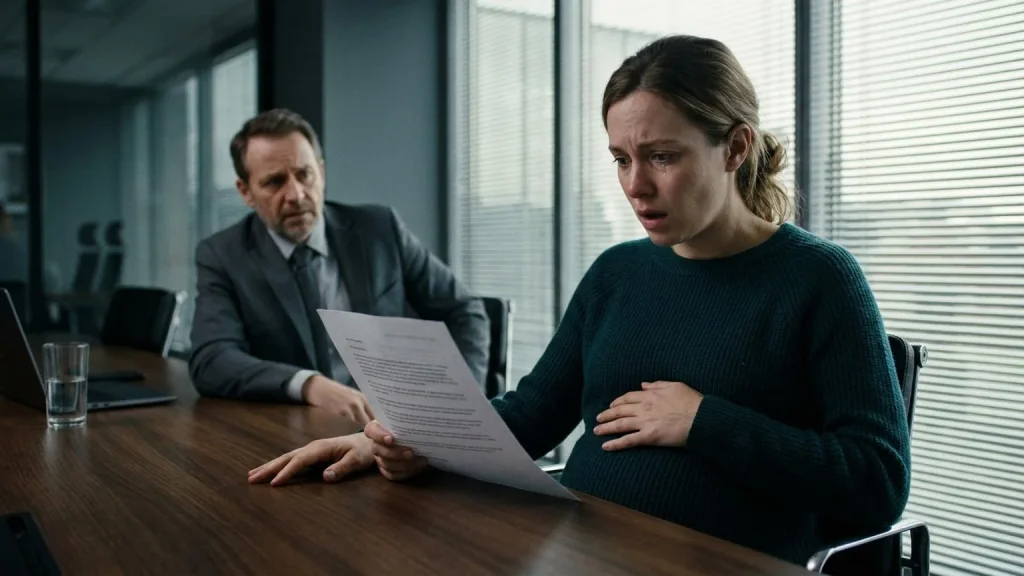
This time, they fired me.
And when I called Tom afterward, he didn’t sound surprised.
He told me to come home.
The next morning, I filed for unemployment while Tom sent Meridian’s general counsel, Rebecca Sloan, a formal letter requiring the company to preserve records related to my employment.
It was the first official indication that my termination might become a legal dispute.
Two days later, Gary called my personal phone.
Twice.
He left a voicemail asking to speak privately.
“There’s something I think you should see,” he said.
His voice sounded nothing like the confident HR director who had fired me.
Tom told me not to return the call immediately.
When I finally spoke with Gary the following morning, he asked me to come back to the office.
No Amanda.
Just the two of us.
Tom drove me there and waited in the parking garage.
Gary met me in a small conference room near finance.
He looked exhausted.
A thick folder sat in front of him.
“I take responsibility for not catching this sooner,” he said.
“Catching what?”
He opened the folder and turned the first page toward me.
It was an email Amanda had sent him three days after I announced my pregnancy.
The subject line read:
“Handling the Claire situation. Need guidance.”
And beneath it was a request that made me grip the edge of the table.
Amanda wanted to remove me before maternity leave and create a documented performance history to justify it.
She also referred to something called the “Denise situation.”
I recognized that name.
Denise Cho had worked for Amanda before me.
I looked at Gary.
“Who is Denise, and why is Amanda using her as an example?”
Gary rubbed his forehead.
His answer revealed that my termination might not have been the first time this had happened.
THE NEXT PART IS BELOW
Don’t forget to switch from “Most Relevant” to “All Comments” to continue reading more
“Denise Cho worked on Amanda’s team two years before you,” Gary said. “She announced her pregnancy, and nineteen days later she was put on a performance plan.”
Denise had resigned before completing that plan. She signed a severance agreement containing a nondisclosure clause and moved to Austin.
I’d heard that she couldn’t handle the agency’s pace.
Now I wondered who had started that explanation.
Gary turned another page.
There was more.
Pria Anand, the designer who had left coffee on my desk, had experienced a miscarriage during her second trimester. When she couldn’t immediately return to her previous workload, Amanda used her absence to begin discussing restructuring her position.
Pria eventually resigned.
I remembered the small heart on the sticky note.
She had understood what was happening to me because she’d experienced something painfully similar.
“Why didn’t anyone stop this?” I asked.
Gary looked down.
He showed me his own response to Amanda’s email.
Instead of telling her that manufacturing performance problems was unacceptable, he had advised her to avoid mentioning pregnancy or maternity leave in writing.
He had suggested making the warnings look specific and credible.
He had helped her.
The most damaging evidence wasn’t something Tom had discovered through a clever investigation. Amanda and Gary had created it themselves on Meridian’s email system.
Rebecca Sloan had found the correspondence while reviewing records after receiving Tom’s preservation letter.
“Rebecca already has copies,” Gary explained. “I wanted you to hear this from me before we meet formally.”
I asked why he was admitting it now.
He didn’t pretend to be noble.
He knew the company’s lawyers had the evidence. He knew his own involvement could no longer be hidden.
For the first time, Gary seemed to understand that following Amanda’s instructions hadn’t relieved him of responsibility.



