That did not help.
The room grew louder.
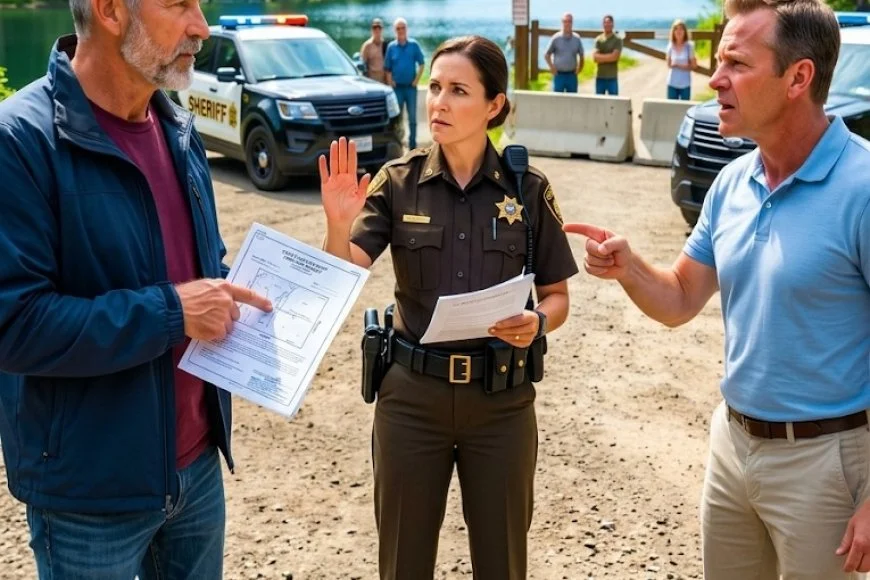
I raised one hand.
“But I did not build this road.”
People quieted.
“I didn’t assess you five million dollars.”
I pointed toward the map.
“And I didn’t tell you the land belonged to Emerald Lake.”
Douglas stepped in.
“Our attorneys believed the association had historic access rights.”
Hannah turned.
“Then let’s discuss 2019.”
The county file receipt appeared on the screen.
Douglas Kessler.
His signature.
Date.
Requested documents:
Western boundary survey.
Josephine timber tract plat.
Marina corridor records.
Hannah asked:
“Why did you request those records?”
Douglas looked toward his attorney.
“Routine due diligence.”
“Before the road project?”
“Yes.”
“Did you see the boundary?”
“I don’t remember every document I reviewed four years ago.”
Then Hannah played the trail-camera video.
A Hatch Marine pickup.
Men removing survey stakes.
Douglas holding the flashlight.
The room went dead silent.
One homeowner whispered:
“Oh my God.”
Douglas’s attorney stood.
“This footage is being presented without context.”
Hannah nodded.
“Then provide the context.”
Nobody did.
Marion spoke next.
She explained that she had questioned the $640,000 land-preparation payment during budgeting.
Douglas had said it covered clearing, grading, stabilization, and “right-of-way resolution.”
“What does that mean?” a resident asked.
“That’s exactly what I asked.”
“And?”
“He told me legal had handled it.”
Hannah looked toward Douglas’s attorney.
“Did your firm obtain a deed or recorded easement from Josephine Ridge?”
The attorney hesitated.
“Our representation concerning the original development documents is under review.”
That was lawyer language for no useful answer.
Then Hal Dorsey stood.
He was eighty-three.
Getting from his chair to his feet took time.
Nobody interrupted.
“I worked these woods when half of you weren’t born.”
His voice shook.
Not from fear.
Age.
“Walter Garrick surveyed that western line.”
He pointed toward me.
“Mitch’s father.”
Hal told them what he remembered.
Thirty years earlier, there had been discussion of improving an old logging path near the lake.
Walter warned that the preferred route crossed timber-estate land.
The project was abandoned.
Later developers built Emerald Lake Estates farther east.
The disputed path remained.
Until Douglas’s board resurrected the marina-road idea.
“I told him,” Hal said.
Douglas looked up.
“You never presented anything formal.”
“I told you where the line was.”
“That’s not a survey.”
“No.”
Hal nodded toward the screen.
“That is.”
Then came the vote.
A homeowner moved to suspend Douglas immediately pending an independent investigation.
Another resident amended the motion.
Remove him.
The bylaws allowed recall at a properly noticed emergency meeting with the required membership threshold.
Hannah whispered that procedural details mattered.
So Marion paused the meeting.
The HOA attorney checked the bylaws.
Notice requirements had been satisfied by the emergency petition circulated after the road closure.
The vote proceeded.
Douglas lost overwhelmingly.
Not unanimously.
A small group still believed he had acted in the community’s interest.
I understood that.
People can do terrible things while insisting they are protecting something.
But when the count was announced, Douglas was finished as president.
Sheriff Ray Don Moore waited outside.
He was not there to arrest Douglas.
Not that night.
He simply wanted to avoid another confrontation on the closed road.
Douglas left through the side door.
The man who had told me I was nobody walked out without his title.
The next morning, the district attorney’s office confirmed it had opened an investigation into the survey-stake removal and financial representations surrounding the road project.
That was not a conviction.
It was an investigation.
Hannah reminded everyone of that.
Marion did too.
The new board’s first job was not revenge.
It was finding out where five million dollars had gone.
An independent forensic accountant reviewed the project.
Most expenses were legitimate.
Paving companies had actually paved.
Electricians had installed lights.
Drainage contractors had worked.
The marina parking area existed.
The problem was the foundation beneath all of it.
Nobody could produce a recorded easement authorizing construction on Josephine Ridge.
The $640,000 Hatch Marine payment became the central question.
Invoices referred to:
Site preparation.
Access stabilization.
Land-right coordination.
Boundary clearing.
None explained what “land-right coordination” purchased.
Hatch Marine’s owner eventually admitted his company had relied on Douglas’s representation that access had been “resolved.”
Paul’s stakes had been removed after Douglas called them “unauthorized obstructions.”
That statement became difficult to defend once everyone saw the trail-camera video.
Then Doris Wayland at the county records office provided certified copies of the 2019 file request.
Douglas had not merely requested the documents.
The sign-out sheet showed he retained them for nearly two hours.
The package included the exact survey identifying the road corridor as part of Josephine Ridge.
Hannah looked at me after reading the certification.
“That makes ‘I don’t recall’ harder.”
“Does it prove fraud?”
“Not by itself.”
That distinction mattered.



