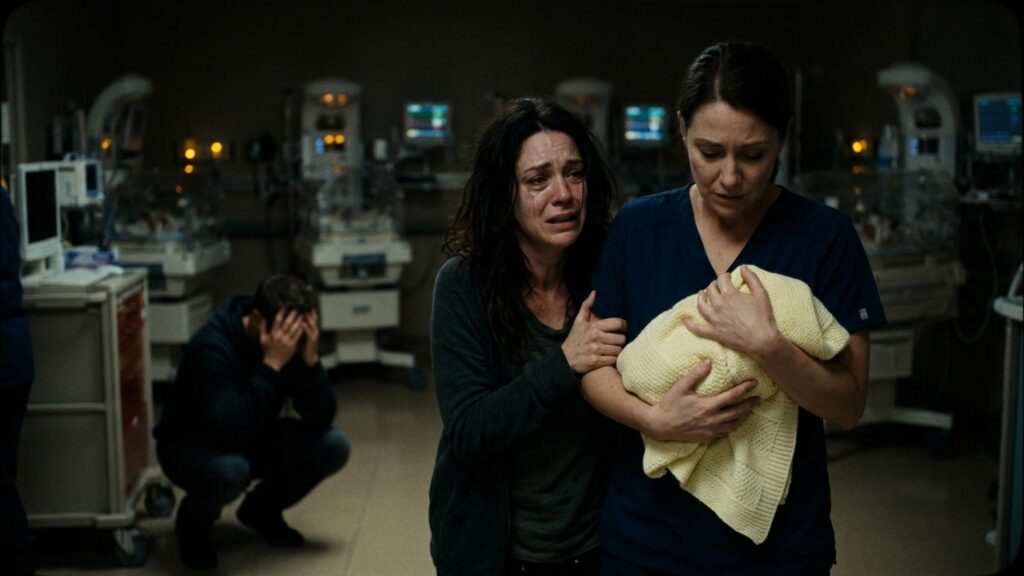
An hour later, we were shown a restricted section of the security recording, with the other babies obscured. At 2:03 a.m., a figure followed a staff member through the nursery door. Diane’s blue coat appeared beneath the fluorescent lights.
Ben made a sound I had never heard from him. He dropped to his knees beside the chair.
On the screen, his mother approached Lucy’s bassinet and reached for the zipper of her sleep sack.
I watched Diane unzip the sleep sack, lift Lucy from her back, and settle her facedown on the yellow quilt. She tucked one thick corner beside Lucy’s cheek, patted her twice, and left. The recording showed her gone a few minutes before a nurse noticed something wrong and rushed to the bassinet.
I couldn’t look away from Lucy’s tiny name stitched on the blanket. Diane had made it while I was pregnant, humming at our kitchen table as if she were giving us something precious.
The doctor was careful when he spoke. The tests hadn’t identified an underlying illness, and the unsafe sleep position could have contributed to Lucy’s breathing crisis. But he couldn’t say that the video alone proved the cause. What it proved was that someone had handled her without permission and placed her in danger.
Ben remained on the floor, one hand pressed against his forehead. “I let her in,” he whispered. “I promised you I wouldn’t.”
He had added Diane as an approved family visitor after I fell asleep following delivery. He claimed he’d meant only to let her visit with us the next morning. Security later found that Diane had followed a nurse through a door that didn’t latch properly after a supply cart passed. Her visitor clearance had never permitted her into the nursery.
When Diane was questioned, she admitted entering. She said Lucy had looked restless and that she’d used the same sleeping position with her own children. Even after watching the footage, she asked whether we really intended to turn a mistake into a family scandal.
I kept my voice level. “You were told not to go into the nursery. You were told not to put blankets in her bed.”
“I was trying to comfort her.”
“You could have called a nurse.”
Diane looked at Ben. For years, that had been enough to make him defend her. This time, he stared at the floor. Then he said, “Mom, you can’t come near Lucy.”
Hospital security barred Diane from returning. Police took statements and reviewed the footage, while the hospital reported the incident through its patient-safety process and examined how the secured door had failed. We consulted an attorney about the lapse. There was no instant courtroom victory, and no one promised us an easy answer about what had caused Lucy’s apnea.
After four more days of observation, we brought her home. Ben slept on the couch for a while. He attended counseling with me, answered every question I asked, and stopped sending his mother photographs. His apologies didn’t immediately restore what he’d broken. Some evenings, I still couldn’t bear to watch him lift Lucy without remembering that monitor.
Three months later, Lucy was healthy and growing. Her pediatrician had cleared her routine follow-ups, and her crib held only a firm mattress and fitted sheet. No pillows. No quilts.
One morning I woke to hear Ben speaking softly in her room. He wasn’t touching her. He was standing beside the crib, waiting for her to finish stretching her fingers toward the window.
“She likes the light,” he whispered when he noticed me.
I stepped beside him. Lucy curled her hand around one of my fingers, just as she had in the delivery room before anyone knew how much we’d have to protect her.
For the first time since that night, I wasn’t counting the seconds between her breaths.
I was watching her open her hand.



