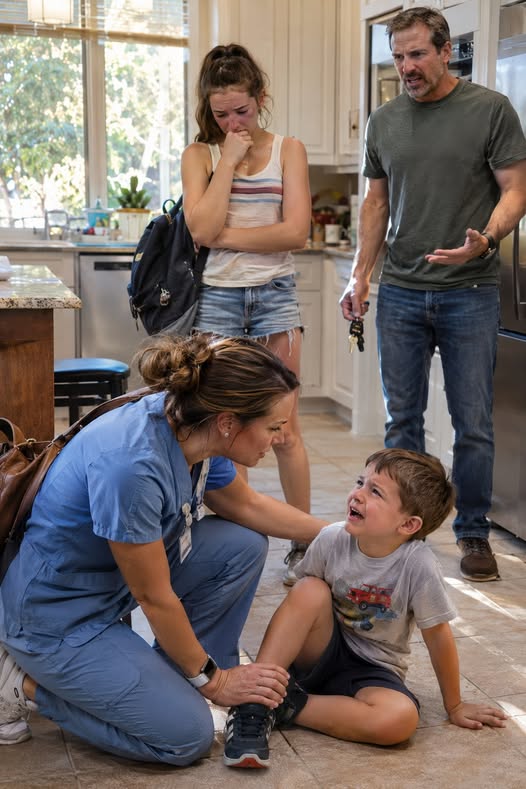
“Dad, did Mom really do something wrong?”
Thomas knelt in front of him.
“No.”
“Then why does everyone keep saying she did?”
His father’s eyes grew wet.
“Because somebody wants people to believe it.”
Everett glanced back toward the supermarket.
“Who does?”
Thomas couldn’t answer.
Instead, he drew Everett into his arms.
“Someday, people will learn the truth.
Until that happens, we have to keep going.”
Six years would pass before Everett understood what those words meant.
By then, the family responsible for destroying Elena Harlan’s reputation had become one of Connecticut’s wealthiest and most influential.
The Mercer family.
Eastbridge Preparatory Academy resembled an elite university more than an ordinary high school.
Redbrick buildings bordered enormous carefully maintained lawns.
Marble pillars supported the entrance to the library, where stained-glass windows filled the reading rooms with colored light.
In the dining hall, professional chefs prepared meals for students who often treated those privileges as ordinary.
A bronze donor plaque stood beside the main entrance.
At its top, displayed in enormous capital letters, was a single family name.
THE MERCER FAMILY.
For twenty years, Roland Mercer had been Eastbridge’s biggest financial supporter.
His construction business had built much of the athletic complex.
His charitable foundation funded scholarship programs.
His private donations helped maintain the football team.
Even the stadium carried his name.
Mercer Field.
School administrators regarded him as someone they couldn’t afford to offend.
Students treated his son Gage as though he were royalty.
Everett arrived on a wet Monday morning in September with a single backpack and an official letter confirming his transfer.
An independently administered academic scholarship program supported by the state had secured his place at Eastbridge.
Thomas had almost refused to let him accept it.
“That place means trouble,” his father said when the admission letter arrived.
Everett understood why he was worried.
Yet Eastbridge possessed science laboratories beyond anything Everett had previously seen.
Its graduating students regularly earned university scholarships.
Among its teachers were published researchers, former engineers, and recognized authors.
For someone dreaming of studying biomedical engineering, it was an extraordinary opportunity.
“Dad, I can’t spend the rest of my life avoiding places because of what happened to Mom,” Everett told him.
Thomas watched him silently.
Finally, he nodded.
“You’re right.”
He bought his son two new shirts from a discount shop and spent nearly an entire Sunday ironing them carefully.
On Everett’s first morning, Thomas drove him to the academy in an aging silver pickup truck.
Around them, other students arrived in expensive SUVs, luxury cars, and chauffeur-driven vehicles.
Everett tried not to pay attention.
His father noticed anyway.
“Hey.”
Everett turned toward him.
Thomas tapped his chest.
“Keep your head up.”
Everett smiled.
“Head up.”
“And if somebody gives you trouble, call me.”
“I will.”
But Everett never called.
Not after two seniors intentionally knocked his books from his arms.
Not when someone attached a paper sign reading SCHOLARSHIP SPECIAL to his locker.
Not when his lunch disappeared from the cafeteria table.
And not when Gage Mercer first confronted him outside the gymnasium.
Gage seemed to possess everything Everett lacked.
Height.
Confidence.
Popularity.
A muscular athletic physique, expensive clothes, and the effortless arrogance of a boy who had rarely heard the word no.
Wherever he walked, his friends followed.
Whenever teachers approached, he greeted them politely.
Once their backs were turned, his expression changed.
“New kid,” Gage called that first afternoon.
Everett stopped walking.
“Yeah?”
“What school did you come from?”
“Westhaven Public.”
One of the boys beside Gage laughed.
“You’re serious?”
Everett met his eyes.
“Yes.”
Gage examined his backpack.
“You realize the tuition here costs more than some people’s cars?”
“I received a scholarship.”
“Yeah.
Obviously.”
His friends laughed.
Gage finally moved aside.
“Just don’t forget you’re a guest.”
Everett initially assumed he was simply being warned about the school’s social hierarchy.
He didn’t know Gage was repeating attitudes he’d heard inside his own home for most of his childhood.
Two days afterward, Everett noticed something unusual.
His identification badge wouldn’t unlock the eastern entrance to the science building.
Other students passed through without difficulty.
His card never worked.
When he reported the problem, the school secretary described it as a clerical error.
The following morning, a teacher informed him that his enrollment documents were being reviewed again.
Soon afterward, the system stopped displaying his scholarship confirmation.
Principal Margaret Delaney promised the issue would be corrected.
She smiled reassuringly as she spoke.
But when Everett mentioned his mother, the principal’s fingers stopped moving across her keyboard.
“Elena Harlan?” she asked.
Everett nodded.
“She was my mom.”
Delaney glanced toward the office door.
“Your father never mentioned that.”
“Was he supposed to?”
“No.
Certainly not.”
She folded her hands together.