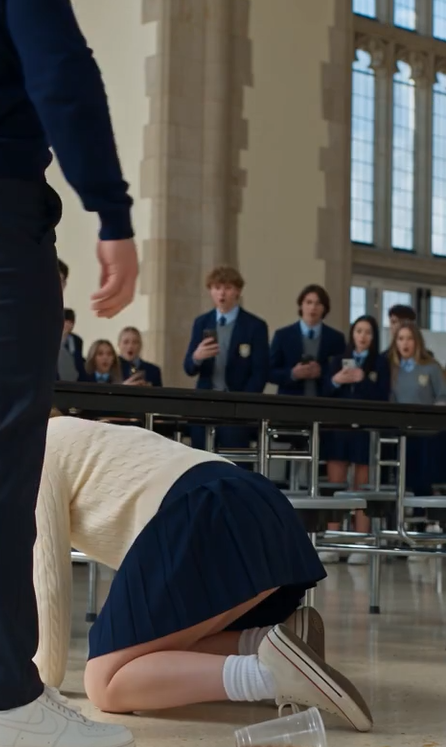
The chair swung through the air.
But before it could connect with Tristan, a deafening crash echoed through the cafeteria.
The metal frame struck the edge of the long dining table beside him, sending trays, plastic cups, and silverware scattering across the floor.
Tristan stumbled backward.
His smug expression disappeared.
For the first time since I’d known him, Tristan Vance looked genuinely frightened.
“What the hell is wrong with you?!” he shouted.
I stood frozen, still gripping the chair.
My arms were shaking. My heart was hammering so violently that I could barely hear the hundreds of whispers surrounding me.
I hadn’t hit him.
I hadn’t even touched him.
But I had done something that, until thirty seconds earlier, I never believed I was capable of doing.
I’d refused to be his victim.
Tristan glanced at the scattered plates, then at the students recording him.
His face turned crimson.
“Are you insane?” he barked. “You could have seriously hurt me!”
I stared at him.
“You hit me first.”
My voice wasn’t loud.
It didn’t need to be.
Every student in the cafeteria heard it.
Tristan opened his mouth, but no words came out immediately.
I continued.
“I apologized when I bumped into you. I tried to walk away. You slapped me in front of everyone because coffee touched your shoes.”
I pointed toward my bleeding lip.
“Does this look like an accident to you?”
Nobody laughed.
Nobody giggled.
For the first time, the audience Tristan had always depended on wasn’t giving him the reaction he wanted.
Then someone clapped.
One single clap.
I turned toward the sound.
It was a boy sitting near the windows. He was a quiet student named Ethan Miller, someone I’d occasionally seen studying in the library.
He looked nervous, but he kept his hands together.
Then another student stood.
And another.
Not everyone.
Not even close.
But enough.
Tristan noticed.
His expression hardened.
“You think this is funny?” he demanded, looking around. “You all better remember who you’re dealing with.”
Nobody answered.
He pointed at me.
“You’re finished, Reynolds.”
I lowered the chair.
“Maybe,” I replied. “But at least I’m not pretending that what you did was normal.”
A whistle suddenly pierced the room.
“EVERYONE, STEP BACK!”
Mr. Henderson, the cafeteria supervisor, pushed through the crowd with two teachers behind him.
His eyes moved from the overturned chair to Tristan, then finally to my face.
“What happened here?”
Tristan immediately straightened his sweater.
“She attacked me.”
I almost laughed.
Of course.
He’d already begun rewriting the story.
“She went crazy and tried to hit me with a chair!”
Mr. Henderson looked at me.
“Is that true, Maya?”
Before I could respond, Chloe stepped forward.
“That’s not what happened.”
Her voice trembled.
Everyone turned toward her.
Tristan narrowed his eyes.
“Excuse me?”
Chloe swallowed.
“I saw everything.”
For a moment, she looked as though she might retreat.
Then she glanced at my bleeding lip.
And something changed in her expression.
“Tristan slapped Maya. She didn’t attack him. She was trying to defend herself.”
“Shut up, Chloe,” Tristan snapped.
“No.”
It was barely more than a whisper.
But it was the second time that afternoon someone had said no to him.
And Tristan Vance clearly wasn’t accustomed to hearing it.
The next twenty minutes were a blur.
I was escorted to the nurse’s office.
A cold compress was pressed against my cheek, and the school nurse examined the cut inside my lip.
She asked whether I felt dizzy.
I told her my head hurt, but I was otherwise okay.
Then she asked the question that made my stomach tighten.
“Would you like me to contact your mother?”
I stared at the ceiling.
My mother was working at the diner.
It was Wednesday, which meant she had picked up an additional shift because our electricity bill was overdue.
I imagined her receiving a phone call from Oakridge Prep.
I imagined the panic in her voice.
And I imagined her asking the question I’d dreaded for years.
Maya, what did you do?
“Please,” I whispered. “Can we wait a little?”
The nurse looked at me carefully.
“Sweetheart, you haven’t done anything wrong by asking for help.”
I turned my face toward the wall.
I wanted to believe her.
But at Oakridge Prep, being right didn’t necessarily mean being safe.
Tristan’s father had donated millions to the school.
His name appeared on the entrance hall’s scholarship wing, the new athletic center, and a plaque outside the principal’s office.
My mother’s name appeared nowhere.
And I knew exactly how much that difference mattered.
A few minutes later, the principal arrived.
Dr. Whitmore was a tall woman in her late fifties with silver hair and an expression that rarely revealed what she was thinking.



