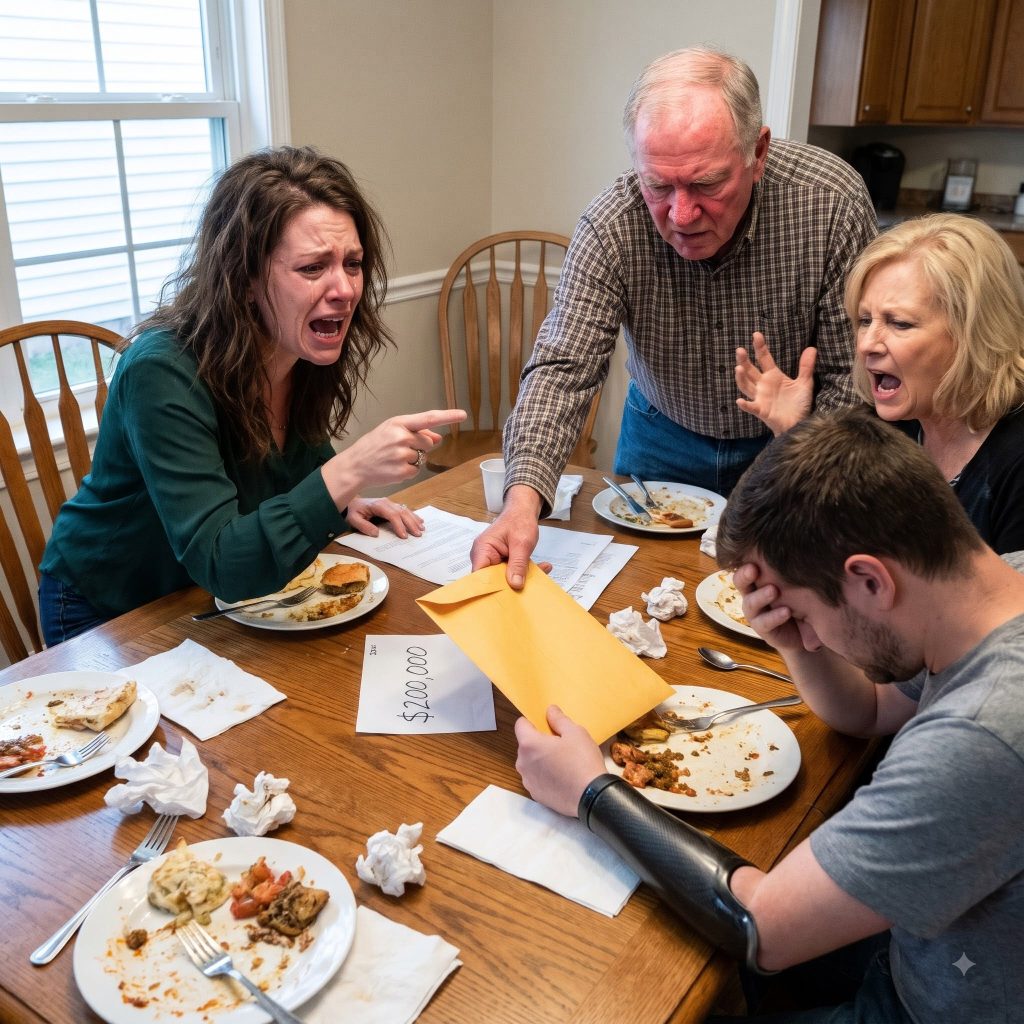
He brought the settlement paperwork, bank statements, and messages from Dad.
The attorney explained that recovering the money would depend on the account documents, the promises Dad made, and how the withdrawals occurred.
There was no guarantee.
Tyler understood.
For once, nobody promised him an easy miracle.
Then he turned toward me.
“There’s something I haven’t told you.”
My stomach tightened.
“What?”
“I’ve been putting off another prosthetic fitting.”
“Why?”
“Because I couldn’t afford my share of the costs.”
I stared at him.
My brother had spent months struggling with an uncomfortable prosthesis while Dad used his settlement money to keep trucks running.
I reached across the table.
“Why didn’t you call me?”
Tyler began crying.
“Because I didn’t want to be another person asking you for money.”
I squeezed his hand.
“Tyler, needing help isn’t the same as demanding it.”
I offered to help him contact his rehabilitation clinic, review available insurance coverage, and arrange transportation to appointments.
He accepted.
I also offered to contribute toward necessary treatment costs once we understood the actual bills.
Not $200,000 handed to Dad.
Not $4,000 every month.
Real assistance, paid directly toward Tyler’s care.
For the first time in years, my brother smiled.
Over the following months, Dad’s company went through a difficult restructuring.
He sold several assets with the lender’s involvement.
Some employees found work with another carrier.
Others stayed during the company’s reduced operations.
I helped connect interested drivers with reputable employers I knew.
I didn’t take over Dad’s debts.
The financial dispute over Tyler’s settlement continued through attorneys.
Dad eventually signed a written repayment agreement with Tyler as part of their negotiated resolution.
It didn’t immediately restore the missing money.
It established what Dad owed and a process for repayment.
The purchasing-account dispute was handled separately.
Our business recovered part of the questionable charges through a negotiated settlement, while some expenses remained our loss.
It wasn’t a perfect victory.
But the lying stopped.
Mom didn’t speak to me for nearly four months.
Then she appeared at my front door holding a container of homemade soup.
“Can we talk?”
I invited her inside.
She sat at my kitchen table and began crying.
“Your father and I thought we were going to lose everything.”
I listened.
She wiped her eyes.
“We panicked.”
I nodded.
“Mom, being frightened doesn’t give you the right to threaten your children.”
“I know.”
“Do you?”
She looked down.
Then she whispered, “I watched Tyler suffer, and I convinced myself your father could fix it if we just got enough money.”
I didn’t rush to forgive her.
But I appreciated that she had finally stopped pretending the demands were reasonable.
“Mom, if you want a relationship with me, it can’t depend on what I pay for.”
She nodded.
“I understand.”
I wanted to believe her.
I decided time would tell.
Six months after that Sunday lunch, Tyler invited me to dinner.
Just the two of us.
He’d recently received a properly fitted replacement prosthesis.
He was attending occupational therapy and had started training for a new office-based position at a distribution company.
As we sat down, he lifted his prosthetic hand.
“Look.”
He carefully picked up his water glass.
It took concentration.
His movements were slow.
But he managed.
I grinned.
“Show-off.”
He laughed.
Then his eyes filled with tears.
“Rachel, I used to think losing my arm was the worst thing that ever happened to me.”
I reached across the table.
He continued.
“But finding out Dad cared more about his business than my recovery… that nearly destroyed me.”
I squeezed his hand.
“I’m sorry.”
He shook his head.
“You didn’t do that.”
For a while, we simply sat together.
Then he smiled.
“Thank you for not giving up on me.”
I looked at my little brother.
The person I’d spent years believing had everything.
The person who’d secretly been suffering alone.
“I never wanted to give up on you, Tyler.”
Sometimes I think about that Sunday lunch.
Dad shouting.
Mom demanding loyalty.
Tyler staring at his plate.
And me opening my phone to end their access.
I didn’t destroy my family that afternoon.
I stopped allowing my parents to make their problems everyone else’s responsibility.
The company account stayed protected.
Tyler began rebuilding his life.
And I learned something I wish I’d understood years earlier.
Helping family should never mean surrendering your savings, your boundaries, or your dignity.
My father demanded $200,000 because he believed being my parent entitled him to my money.
But my brother needed something far more important.
He needed someone to believe him.
Someone to stand beside him.
Someone who wouldn’t turn his injury into another financial transaction.
My parents kept saying, “Family helps family.”
They were right about one thing.
Real family helps you heal. It doesn’t send you the bill for someone else’s lies.



