There were only two pages.
On the first, he wrote about my childhood habit of taking apart broken radios just to see why they had stopped working.
Then came a sentence that made me read it twice.
I am giving each grandchild the same amount, but equality does not mean I expect you to make the same choices.
Dad shifted beside me.
I continued.
Grandpa wrote that he knew Ryan wanted a home.
He knew I wanted “a chance to build something nobody else could see yet.”
Then I reached the final paragraph.
My father suddenly said, “That’s enough.”
Everyone looked at him.
His face had lost its color.
And that was when I realized something.
Dad already knew what the letter said.
I looked at Dad.
“You’ve read this?”
He didn’t answer.
Mom did.
“Frank found the letter first.”
The paper suddenly felt heavier between my fingers.
“When?”
“A few months after your father died,” Mom said quietly.
Grandpa was Dad’s father.
Dad pushed back from the table.
“This is ridiculous.”
I read the final paragraph aloud.
“Emily, your father believes security means holding tightly to what you already have. You have always believed security can also come from understanding risk better than everyone else. Neither path is automatically right. But I hope you choose your own.”
Nobody moved.
Then came the line Dad apparently hadn’t wanted me to see.
Do not let anyone shame you into living their version of a responsible life.
Ryan looked at Dad.
“You knew Grandpa supported her investment?”
Dad’s face tightened.
“He supported her being careful.”
“That’s not what he wrote,” Nicole said.
Dad snapped, “Stay out of this.”
I folded the letter slowly.
For years, his criticism had bothered me less than everyone assumed.
What bothered me now was understanding that it hadn’t come from ignorance.
He had known.
He just disagreed so strongly with Grandpa that he had rewritten the story.
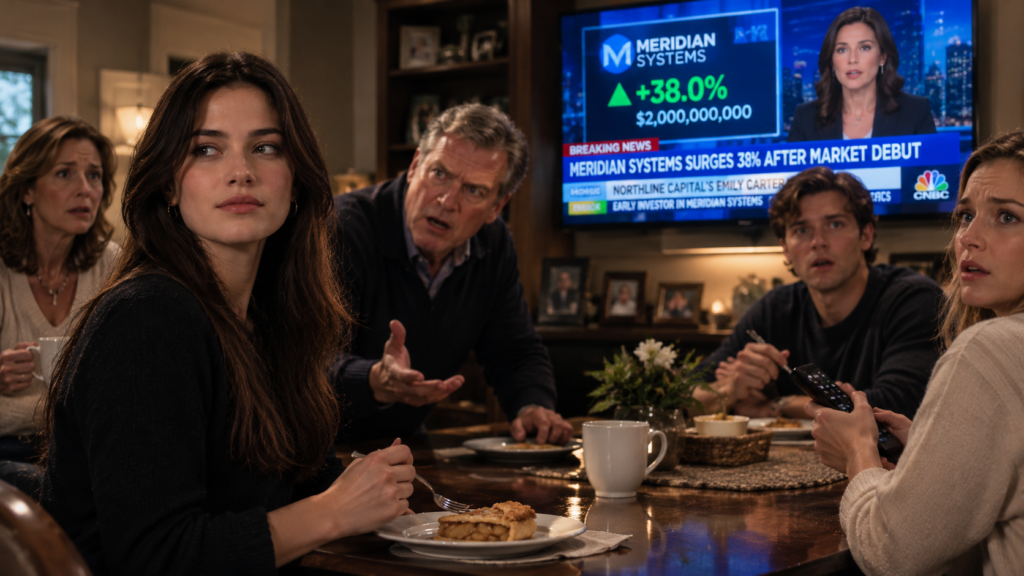
Dad pointed toward the television.
“You got lucky.”
I nodded once.
“Absolutely.”
That surprised him.
“Meridian could have failed. Most startups do. I could have lost seventy thousand dollars.”
His expression softened, almost victorious.
Then I continued.
“But one successful investment didn’t create Northline.”
I told them what the television segment hadn’t.
After Meridian, I spent six years working seventy-hour weeks analyzing small companies. Some investments failed. Others returned modest gains. I studied healthcare logistics because I understood the industry. I built relationships with founders. Two former colleagues eventually joined me.
Northline started with $8.4 million.
Not two billion.
The first institutional investor arrived three years later.
Then a university endowment.
Then a pension consultant recommended us.
The $1.87 billion on television represented twelve years of work and other people trusting us to manage their capital.
“My grandfather’s hundred thousand opened a door,” I said. “It didn’t magically become two billion dollars.”
Ryan smiled faintly.
“That sounds a lot less exciting than Dad’s version.”
Nicole laughed.
Even Mom did.
Dad didn’t.
He walked outside.
I followed him onto the back porch.
For several seconds he stared across the yard.
Finally he said, “I thought you were going to lose everything.”
“I know.”
“I wanted you to have something solid.”
“I know that too.”
He looked at me then.
The anger was gone.
What remained looked smaller.
“I shouldn’t have hidden the letter.”
“No.”
He swallowed.
“I shouldn’t have spent twelve years telling you Walter would be disappointed.”
That one cost him something.
I could hear it in his voice.
I didn’t rush to rescue him from the silence.
Finally, he said, “I was wrong.”
It wasn’t dramatic.
No tears.
No hug.
But it was the first honest sentence we had exchanged about the inheritance in years.
Three months later, Dad asked if he could visit Northline’s Chicago office.
I let him.
He expected marble floors and traders shouting into phones.
Instead he found thirty-eight people sitting behind ordinary desks, drinking bad coffee and arguing about spreadsheets.
He watched me lead an investment meeting.
Afterward, in the elevator, he said quietly:
“So this is what you built.”
“Yes.”
He nodded.
“That’s solid.”
I smiled.
Coming from my father, it was almost poetry.
I framed Grandpa’s letter, but I didn’t hang it in the office.
It sits beside my desk at home.
Sometimes I still look at the sentence Dad tried to keep from me:
Do not let anyone shame you into living their version of a responsible life.
The strange thing is, Grandpa’s greatest gift was never the $100,000.
It was permission.
And twelve years later, that turned out to be worth far more.



