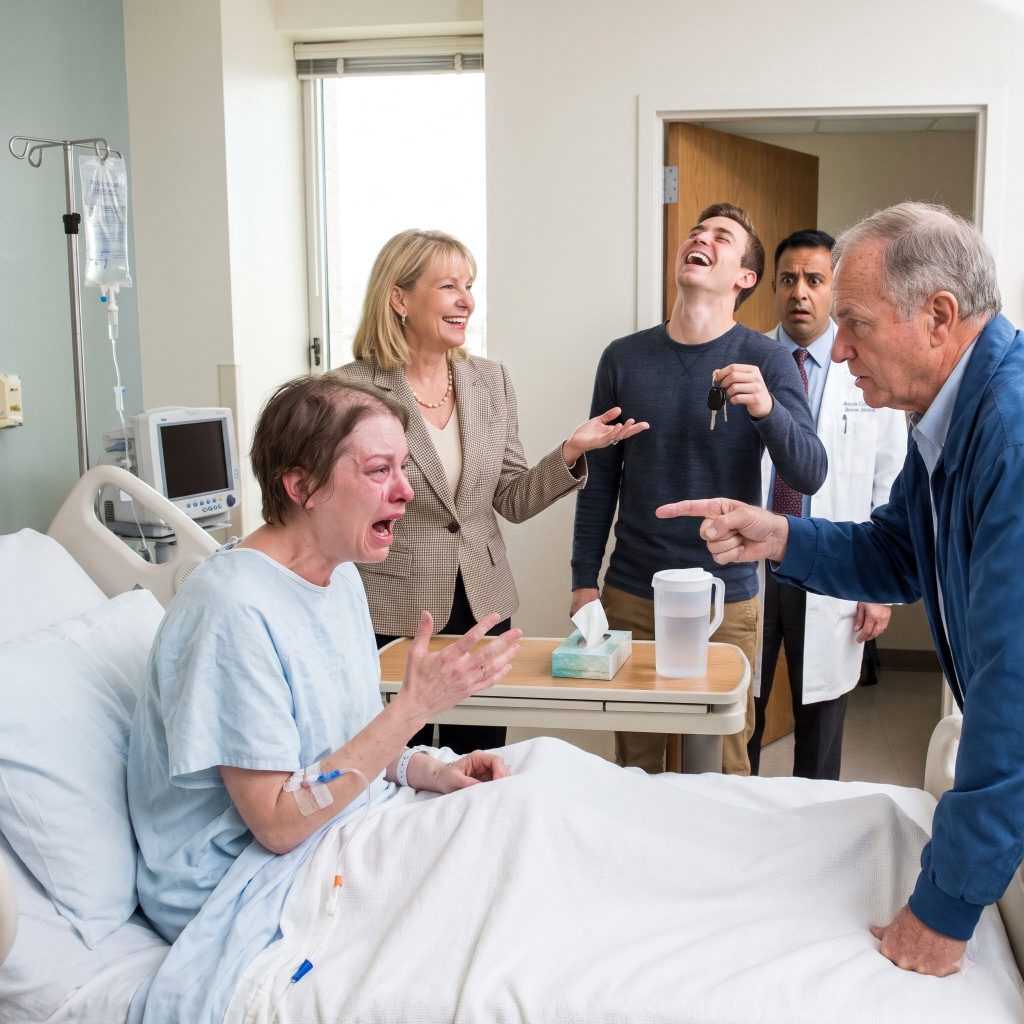
It was the same financial power of attorney Harrison had refused to witness.
And beside the signature line, someone had already written my name.
“THAT’S NOT MY SIGNATURE!”
My voice echoed through the hospital room.
Mom froze.
Dad stepped forward.
“Nora, calm down. You’re upsetting yourself.”
I lifted the document.
“Who signed my name?”
Derek rolled his eyes.
“Seriously? You’re dying, and you’re worried about paperwork?”
Harrison took the pages from my trembling hands.
“This document isn’t valid simply because someone wrote her name on it,” he said. “And Nora hasn’t authorized any of you.”
Dad’s face reddened.
“Stay out of this, Harrison!”
Harrison didn’t move.
“She’s my goddaughter.”
“She’s MY daughter!”
“Then start treating her like one.”
Mom suddenly burst into tears.
“We’re only trying to help!”
I stared at her.
“Help me? Or help yourselves?”
She wiped her cheeks angrily.
“Derek has debts! He needs that house!”
Something inside me finally snapped.
“I HAVE FIVE DAYS LEFT, MOM!”
Everyone went silent.
“FIVE DAYS! And all you can think about is Derek’s mortgage and my car?”
Dad opened his mouth.
“Don’t,” I whispered.
For the first time, I didn’t want to hear his excuses.
Harrison called my nurse.
Within an hour, a hospital social worker joined us. She asked my family to leave while we discussed my wishes privately.
I explained the documents, the pressure, and my fear that someone might make decisions against my wishes.
The hospital documented my concerns.
Harrison arranged for an independent attorney to visit.
That afternoon, I made three decisions.
First, I confirmed my healthcare choices and named Harrison as my healthcare agent if I became unable to decide for myself.
Second, I revoked any questionable permissions and asked my attorney to review my existing estate plan.
Third, I decided what would happen to Grandma’s house.
And that decision surprised even Harrison.
“Are you certain?” he asked.
“Completely.”
My grandmother had raised me whenever my parents were too busy chasing business deals.
She taught me to cook, fixed my prom dress, and sat beside me through every heartbreak.
When she died, she left me her home.
Dad called it unfair.
Mom said Derek deserved half.
But Grandma had written me a note.
Keep this house for the days when someone needs somewhere safe to land.
For years, I thought she meant me.
Now I understood something bigger.
During chemotherapy, I’d met patients whose families slept in cars because nearby hotels were too expensive.
One woman missed her husband’s final night because she couldn’t afford another room.
I never forgot her.
So I asked Harrison to contact the local nonprofit we’d previously discussed supporting.
I wanted Grandma’s house to become temporary lodging for families visiting seriously ill loved ones.
I wanted the Porsche sold after my death, with its proceeds helping furnish the house and support its operating costs.
Harrison listened, tears filling his eyes.
“Your grandmother would be proud.”
I smiled.
“Then let’s make sure it’s done properly.”
My attorney reviewed the ownership records, my existing documents, and the steps required to carry out my wishes.
Nothing happened by magic.
There were signatures, witnesses, financial details, and arrangements that would still need attention after my death.
But I had made my choice while I was alive and capable of making it.
The next morning, Derek called.
I almost ignored him.
Then I answered.
“Did you get the car keys?” he asked.
Not hello.
Not how are you feeling.
The keys.
“No.”
He cursed.
“You promised Grandma’s Porsche would stay in the family!”
“I never promised that.”
“Dad says you’re giving everything to some charity!”
“Yes.”
He screamed.
“YOU’RE PUNISHING US BECAUSE WE TOLD THE TRUTH!”
I felt strangely calm.
“What truth, Derek?”
“That you’re dying!”
I closed my eyes.
“Yes. I am.”
His breathing became uneven.
Then he said something I’d never expected.
“I thought you’d always bail me out.”
There it was.
Not grief.
Not love.
Fear of losing the person who kept rescuing him.
“I know,” I said.
And ended the call.
On the third day, I went home.
Not because I’d recovered.
Because I wanted my final days somewhere familiar.
The hospice team arranged a bed in my downstairs bedroom.
Harrison stayed.
My best friend, Rachel, brought flowers.
Two neighbors left casseroles on the porch.
That evening, I sat beside the window overlooking Grandma’s garden.
For the first time in weeks, I felt peaceful.
Then Dad appeared at the front door.
He was alone.
Harrison answered.
“I need to see Nora,” Dad said.
I heard him from the hallway.
“Let him in.”
Dad entered slowly.
He looked older than I remembered.
“Your mother isn’t sleeping,” he began.
I almost laughed.
“Neither am I.”
He lowered his eyes.
“Derek’s furious.”
“I know.”
“Your mother says you’re tearing the family apart.”



