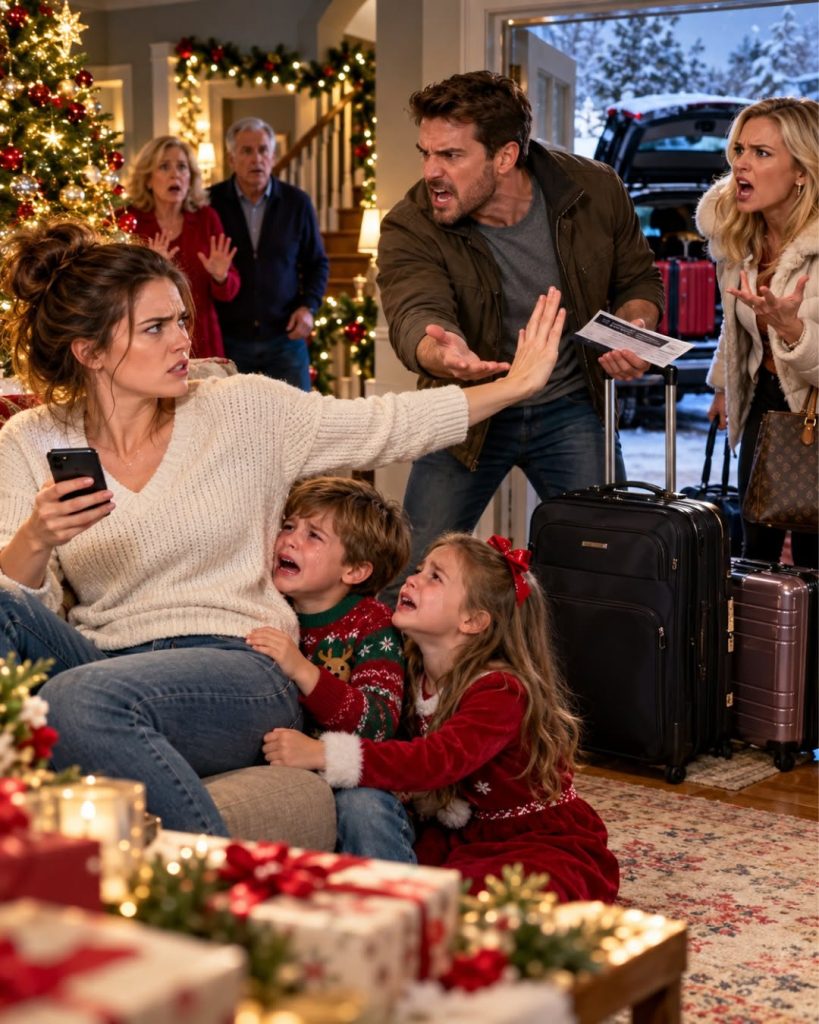
“Officer, please!” Brooke’s voice shrieked from the stairwell below.
She had run up the stairs two at a time, her designer coat flapping open, her breath coming in ragged gasps. She stopped dead on the landing, taking in the scene: her husband pinned against the wall by a cop, her two children weeping openly on the carpet, and me, watching through the crack of a chained door.
“This is a mistake!” Brooke pleaded, her polished exterior disintegrating into pure panic. “We’re not abandoning them! We love our children! We’re going on a trip! This is just a miscommunication!”
“Ma’am, quiet down,” the female officer ordered, kneeling down beside Ella and Noah and speaking to them in a soft, soothing murmur while keeping one eye on Brooke. “Nothing about this looks like a miscommunication. It looks like you brought two seven-year-olds into an apartment building where you are not welcome, attempting to leave them unattended.”
“We weren’t leaving them unattended!” Ryan shouted, his face turning an ugly, mottled scarlet. “Claire was going to take them! She always takes them!”
“She said no,” the officer said simply. “A person is allowed to say no.”
Those six words hung in the narrow, carpeted hallway like an iron anvil.
*A person is allowed to say no.*
Ryan stared at the officer as if she were speaking an ancient, unintelligible dialect. In Ryan’s world, Claire was never allowed to say no. The universe existed to grease his wheels. The idea that a municipal employee with a badge and a gun was enforcing my autonomy was an existential crisis he was completely unequipped to process.
“Here is what is going to happen,” the male officer said, his voice hard and brook-no-argument. “You two are going to take your children, take your bags, and walk down those stairs. You are going to get into your vehicle and leave this property. If we receive another call to this address tonight, Mr. Miller, you will spend the night in the Franklin County jail on trespassing and child endangerment charges, and your children will be placed in emergency temporary protective custody.”
Brooke gasped, clapping both hands over her mouth.
The word *protective custody* did what five days of my polite refusals could never do: it terrified them.
“Okay,” Brooke whimpered, grabbing Ella’s hand and hauling Noah toward her by his backpack strap. “Okay, we’re going. Ryan, pick up the bags! Pick up the bags right now!”
Ryan didn’t move for three seconds. He glared at the gap in my door, his eyes burning with a hatred so pure, so unvarnished, that it completely stripped away the last lingering illusion of brotherhood.
“You’re dead to me, Claire,” he whispered, loud enough for the officers to hear. “You hear me? You don’t have a brother anymore.”
“Sir, move,” the male officer commanded, stepping directly between Ryan and my door.
Ryan grabbed the duffel bags, his knuckles white, and stumbled down the stairs behind his wife and crying children.
I closed my door.
I locked the deadbolt.
I leaned my back against the solid wood and slid slowly down to the floor, pulling my knees up to my chest. Outside, through the thin hallway window, I heard the heavy exterior door slam shut once more, followed by the fading wail of a child in the snowy night.
I was shaking violently. But as the silence of my apartment closed around me again, the trembling stopped.
I had done it.
The line had held.
—
Chapter 9 – The Morning After the Collapse
Tuesday morning arrived with absolute, freezing stillness.
By 6:00 AM, the flight to Miami had departed from John Glenn International Airport without Ryan and Brooke on board.
I made an omelet, toasted two slices of sourdough bread, and ate breakfast at my kitchen table while listening to the radio. The local news reported eight inches of snow across Central Ohio, hazardous road conditions, and dozens of flight delays. Ryan and Brooke would have had a miserable drive to the airport even if they hadn’t spent their evening being threatened with arrest by the Columbus police.
At 7:30 AM, my phone began to chime again.
I had unblocked only one number: my father’s.
My father was a retired civil engineer who had spent forty years avoiding family conflict by retreating into his basement workshop. He rarely spoke during family dinners, rarely weighed in on holiday disputes, and allowed my mother to run domestic foreign policy with an iron, erratic fist.
When his name appeared on the caller ID, I hesitated for a moment before picking up.
“Hello, Dad.”
There was a long sigh on the other end, followed by the faint rustle of a newspaper.
“Claire,” he said, his voice gravelly with age and fatigue. “Are you alright?”
“I’m fine, Dad. Are you?”



