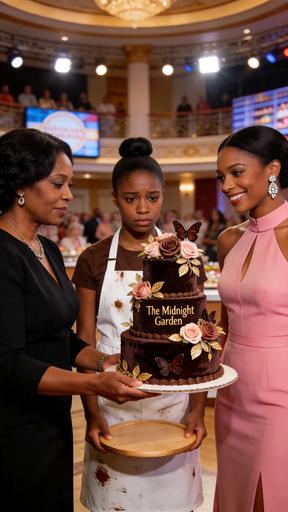
 “Give the cake to Tessa. She’s the one who knows how to make our family look good.””
My mother’s words echoed through the competition hall just seconds before she lifted the cake I had spent fourteen hours making and placed it in my sister’s hands.
I stood there holding an empty cake board, wearing an apron stained with chocolate, while three hundred people watched my mother steal the one thing I had worked so hard to create.
My name is Aaliyah Brooks. I was twenty-four years old, and for most of my life, I had learned that being talented in my family meant nothing if you weren’t the favorite daughter.
My younger sister, Tessa, had always been that favorite.
She was beautiful, charming, and knew exactly when to smile. My mother, Gloria, treated her like she had been born with a golden spoon in her mouth.
I, on the other hand, was the daughter who helped clean up after dinner, paid her own bills, and heard the words “Why can’t you be more like your sister?”” at least once a week.
But baking was different.
Baking was the one place where I didn’t feel invisible.
It started when I was twelve, standing beside my grandmother in a tiny kitchen in Ohio. She taught me how to fold egg whites, temper chocolate, and recognize the exact moment buttercream became smooth enough to spread.
“Baby girl,” Grandma Ruth used to say, wiping flour from my cheek, “a cake doesn’t care who your mother loves more. It rises for whoever gives it the right ingredients.””
I had never forgotten those words.
After Grandma passed away, I inherited her handwritten recipe notebook. Its pages smelled faintly of vanilla and old paper. Some recipes were stained with butter. Others had little notes in the margins.
One page had a sentence written in her shaky handwriting:
Make something beautiful, even when the world gives you broken pieces.
I thought it was simply about baking.
I would eventually discover that it was about much more.
The competition was called The American Sweet Masters Challenge, a televised baking event held in a grand hotel ballroom in Columbus.
The grand prize was a $100,000 cash award, a professional bakery storefront for one year, and a contract with a national food magazine.
For me, it was a chance to finally open the little bakery Grandma and I had dreamed about.
I had saved for months to buy ingredients.
I practiced after my day job, sometimes staying awake until two in the morning. I tested different cake structures, adjusted sugar ratios, and ruined enough batches of chocolate ganache to fill a swimming pool.
My entry was called The Midnight Garden.
It was a three-tier chocolate cake covered in dark chocolate velvet, decorated with edible sugar roses, delicate golden leaves, and tiny chocolate butterflies.
Inside were layers of dark chocolate sponge, salted caramel mousse, and raspberry compote.
Every flower had been made by hand.
Every detail meant something.
The golden leaves represented Grandma’s garden. The butterflies represented freedom. And the dark chocolate represented all the difficult years I had survived.
When I arrived at the competition, I saw Tessa standing near the registration table.
She wore a pink designer dress, diamond earrings, and a smile that seemed permanently attached to her face.
“Well, look at you,” she said, examining my apron.
“You actually made it.””
“I qualified fair and square,” I replied.
She laughed.
“Of course. I just mean, these events are pretty serious. I hope you don’t embarrass yourself.””
Before I could answer, my mother appeared.
Gloria Brooks was wearing a cream-colored suit and carrying a designer handbag. Her blonde hair was perfectly curled.
She kissed Tessa on the cheek.
“There’s my beautiful girl.””
Then she glanced at me.
“Oh. You’re here.””
“Good morning, Mom.””
She looked at my cake carrier.
“Is that what you’re entering?””
“Yes. The Midnight Garden.””
“Chocolate again?”” She sighed.
“Aaliyah, don’t you think you should try something more elegant?””
Tessa giggled.
“Mom, don’t discourage her. Maybe the judges like cafeteria desserts.””
I ignored them.
I had promised myself I wouldn’t let their comments ruin my day.
At ten o’clock, the competition began.
The contestants had three hours to complete their presentations and prepare their cakes for judging.
I worked carefully, checking the temperature of my chocolate glaze and adjusting one tiny sugar butterfly that had tilted during transportation.
Across the room, Tessa was assembling a white cake decorated with artificial-looking pink flowers.
Her design was pretty.
But it was ordinary.
At least, that’s what I thought.
Then I noticed something strange.
My mother kept moving between the judges’ table and Tessa’s station. She spoke quietly with a woman wearing a blue blazer.
Every few minutes, she glanced in my direction.
I tried to ignore it.



