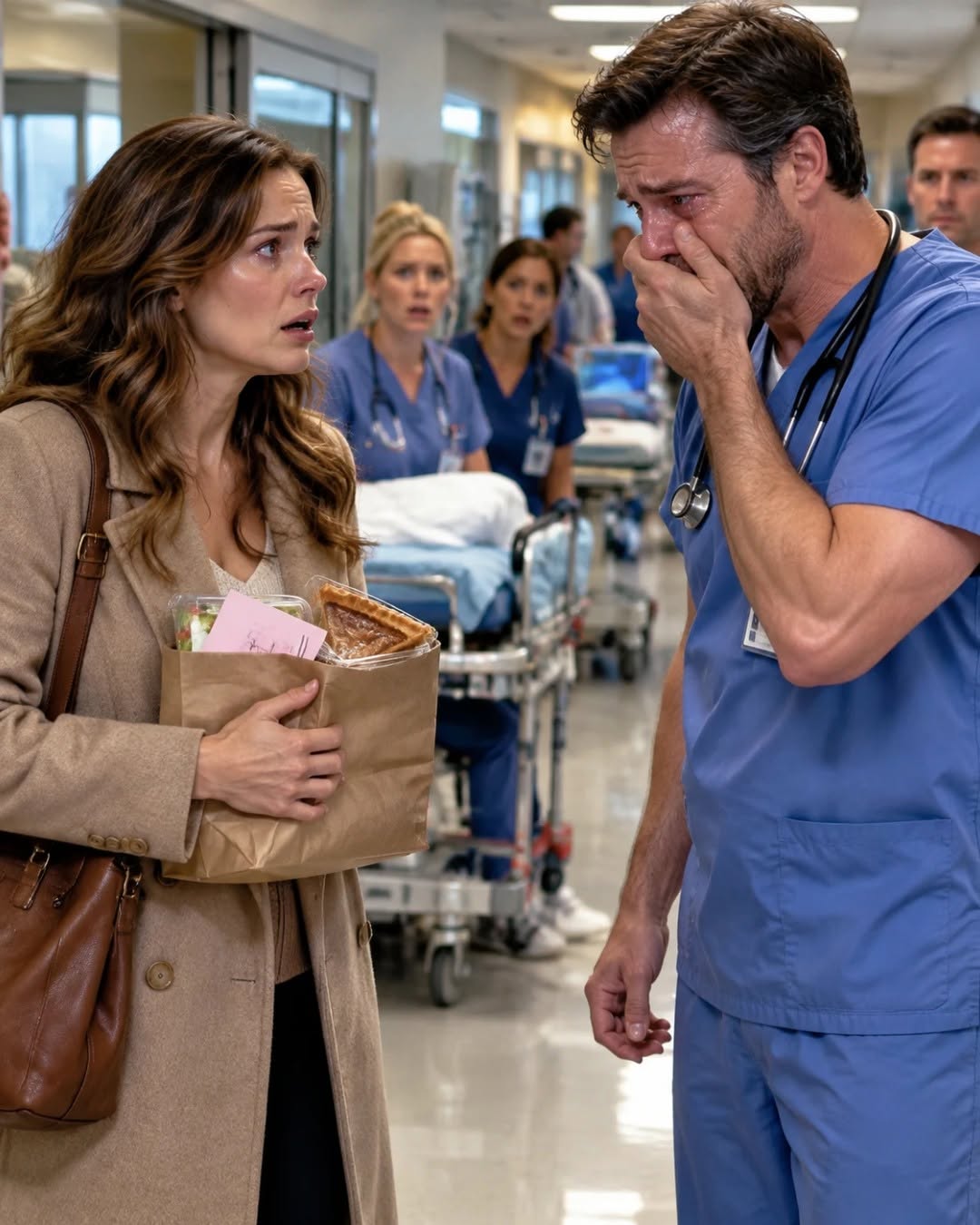
Arnold did not speak in the corridor. He placed a hand under my elbow, his grip tight enough to leave a mark, and guided me away from the nurses’ station.
Every person we passed looked at the floor. The ward clerk who always asked about our daughter Lily suddenly became intensely interested in a stack of manila folders. A senior resident turned on his heel and disappeared into a supply closet. The silence was thick, medicinal, and suffocating.
“Arnold, stop,” I said, digging my heels into the linoleum. The paper lunch bag crumpled in my fist. “Where is Ben? What room is he in? Did he get hurt in the OR?”
Arnold didn’t answer until he pulled me into an empty family consultation room at the end of the hall. He closed the heavy door, shutting out the rhythmic hum of the ICU monitors outside. When he turned to face me, he looked like a man who had aged a decade in the span of an hour.
“Clara,” Arnold whispered, his voice cracking. “Ben hasn’t operated in eight months.”
The words made no sense. They bounced off my brain like hail on glass.
“What are you talking about?” I managed a dry, hollow laugh. “He was on call two nights ago. He came home at six this morning with his scrubs in his gym bag. I washed them. I ironed his white coat yesterday.”
“He hasn’t held a scalpel here since October,” Arnold said. Tears spilled over his eyelids, running down the deep creases beside his mouth. “He couldn’t, Clara. The tremors started in his right hand last summer. By autumn, the neurological tests confirmed it. It was early-stage Amyotrophic Lateral Sclerosis—or an aggressive motor neuron variant. His career was finished the day the diagnosis came back.”
The room tilted. My lungs seized, refusing air. “No. No, that’s impossible. He’s forty-two. He’s healthy. He runs five miles every Sunday.”
“He didn’t run,” Arnold said gently, stepping closer. “He sat in his car at the park so you wouldn’t suspect anything. He’s been hiding the progression from you, Clara. He took a leave of absence from surgical duties, but he refused to file for disability. He made the board keep him on as an unlisted night triage advisor at the inner-city clinic across town. He worked twelve-hour graveyard shifts under the table just to keep your private health insurance active and pay off the research treatments he was ordering.”
“Why?” The word tore out of my throat, raw and jagged. “Why would he lie to me?”
“Because he knew what the prognosis meant, and he couldn’t bear to let you watch him fall apart before he had a solution,” Arnold said. “He told me he had one job left: to make sure you and Lily were set for life before the paralysis reached his chest. He was working himself into the dirt to pay off your mortgage.”
Arnold paused, his jaw working as if chewing on glass.
“Where is he, Arnold?” I demanded, panic rising like bile. “Take me to him right now.”
“He collapsed in the triage lobby two hours ago,” Arnold said softly. “His respiratory system went into crisis. Clara… he’s in the Medical Intensive Care Unit. Bed Four. He’s on a ventilator.”
The lunch bag slipped from my fingers. The Tupperware cracked on the floor, spilling the warm apple pie across the clean white tiles.
I didn’t look down. I lunged past Arnold, ripped the door open, and ran.
The corridors blurred into streaks of fluorescent glare. I knew the way to the MICU by heart; I had brought Ben coffee here a hundred times when we were dating during his residency. But back then, this place was where he conquered death. Now, it was a tomb.
I hit the automated doors of the unit, bursting through the double barriers.
“Ma’am, you can’t be in here—” a young nurse started, but Arnold was right behind me, raising a hand.
“Let her through,” Arnold commanded with authority. “It’s Clara.”
I stopped at the glass partition of Bed Four.
Inside, the man I had kissed goodbye that morning was unrecognizable.
Ben lay propped at a thirty-degree angle. A thick plastic endotracheal tube was taped into the corner of his mouth, connected to a mechanical bellows that hissed and groaned with every forced breath. Lines ran into both of his wrists, his neck, and beneath his hospital gown. His face was gray, his cheeks hollowed out beneath the harsh lights.
My knees buckled. Arnold caught me under the arms, lowering me onto a plastic chair beside the bed.
“Ben,” I choked out, reaching over the cold metal guardrail.



