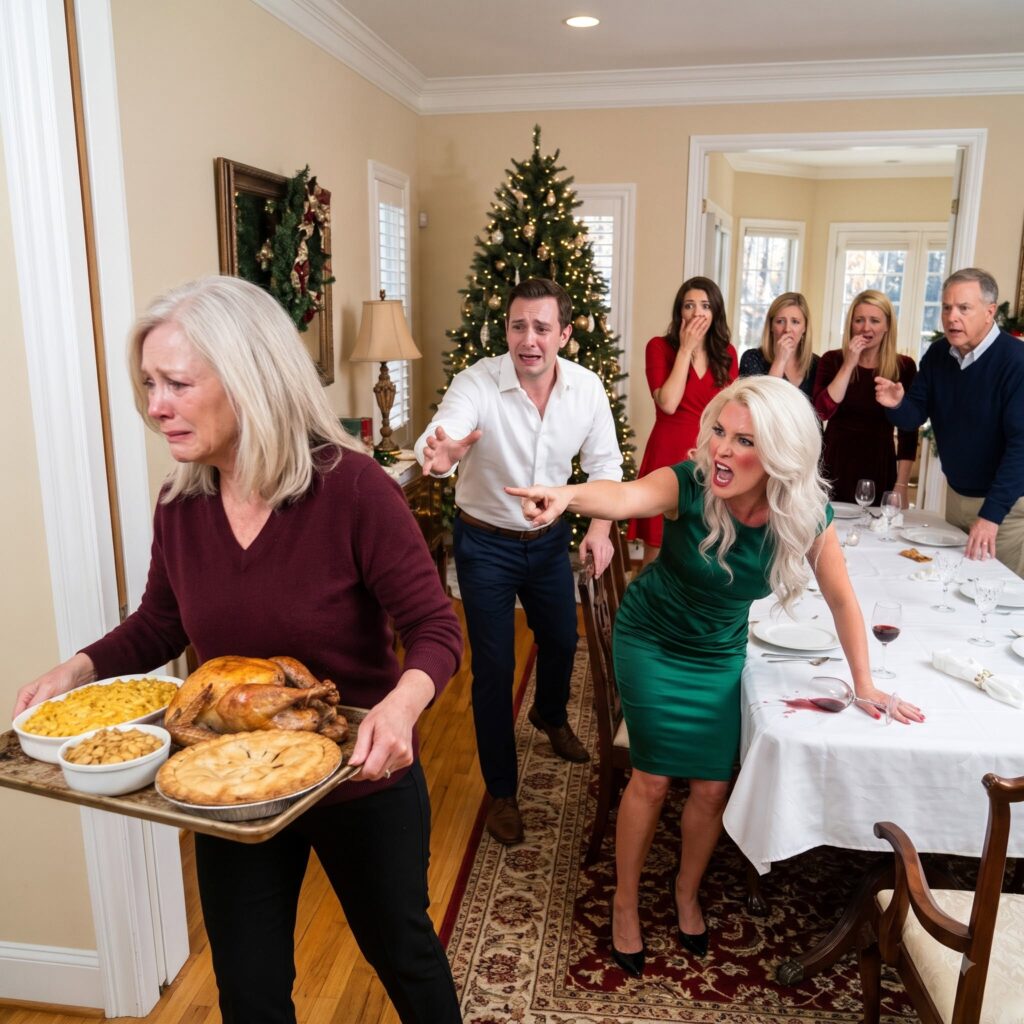
Ethan stared at the page. His hands began to shake. “I never signed that,” he whispered.
Every head turned to Brooke. She had stopped breathing.
Nobody moved. The only sound in that white, perfect room was the refrigerator humming.
Brooke’s father found his voice first. “Brooke Elaine. Did you sign your husband’s name?”
“It wasn’t forgery,” she said, thinly. “It was a formality. Ethan would have signed if I’d asked.”
“You didn’t ask,” Ethan said, “because I would have said no.”
He wasn’t shouting. That was the worst part. My son, who once apologized to a coffee table he bumped into, spoke in the flat voice of a man watching his life rearrange itself.
Raymond set the contract down. “Let me explain how I got here, Mrs. Carter. I grew up in Raleigh. Third grade, Dunbar Elementary. Free lunch kid.” He smiled, a little embarrassed. “Every Friday, a lady in a hairnet slipped extra gravy on my tray and said growing boys need seconds. It was pot roast. Nothing I’ve eaten since has come close.”
I stared at him. Thirty years of faces, and suddenly I saw one: a skinny boy with a cowlick, always last in line.
“Raymond Hale,” I whispered. “You always asked if there was any bread left.”
His eyes shone. “You remember me?”
“I remember every child who came back for seconds.”
“When Brooke’s post crossed my desk in August, I thought I was losing my mind. Same cut of meat, same pinch of mustard powder, and in the background of one photo, a card reading ‘Carter family, since 1987.’ I found the old school yearbook. There you were, Linda Carter, cafeteria manager. Hartwell’s lawyers quietly checked everything else.”
“And?” Brooke’s mother asked, barely breathing.
“None of it held up. No Charleston grandmother. No family farm. Just a recipe box that belonged to someone else.” He looked at Brooke without cruelty. “I gave her every chance. I asked three times to meet the cook behind the recipes. Three times, she changed the subject.”
Brooke slid into a chair and covered her face.
“It started with one photo,” she sobbed. “Forty likes. Then four hundred. Then a company wanted to pay me. I lost my job in March, Ethan, and I couldn’t tell you. The mortgage, the furniture, the credit cards. I kept telling myself one more post would fix everything.”
Ethan sat down very slowly. “March?”
“I was going to tell you.”
“You keep saying that.”
I should have felt triumphant. I didn’t. I felt tired, and strangely sorry for a girl I’d spent two years trying to love, who had sent me away from her door because she was afraid.
I set the pot roast on that pristine white tablecloth. Nobody stopped me. “Brooke. Look at me.”
“You could have asked. All you ever had to say was, ‘Linda, teach me.’ I would have stood at your stove at midnight and written every card out in my own hand.”
She cried harder. “But you told me my food didn’t fit your theme.” My voice shook, and I let it. “That hurt worse than the lie.”
“It wasn’t about you,” she whispered. “Everything you cooked was real. Everything I made was pretend. I couldn’t stand next to it.”
A long silence followed. Then Dennis Kowalski, Ethan’s boss, cleared his throat. “I haven’t eaten since noon, and whatever’s in that pan smells like heaven.” A few people laughed, relieved to be allowed.
So we ate. I carved the roast myself. Ethan reheated the potatoes, Brooke’s mother set out plates, and the woman with the ring light put her camera down and carried in the pie. Nobody took a single photo.
Raymond sat beside me and laid out what would happen next, plain as a ledger. “Hartwell won’t press charges tonight. The forged signature is Ethan’s decision. The company wants two things: the advance repaid within ninety days, and a public correction crediting the real source of every recipe. The cookbook contract is void.”
“I’ll pay every cent,” Brooke said quietly. “I’ll sell my car if I have to.”
“There’s one more thing.” Raymond turned to me. “Mrs. Carter, I’d like to offer the contract to you, under your name, with your husband credited on every page. A cookbook called Walt’s Table. And a share of the proceeds pays off school lunch debt for kids in Wake County.”
My fork stopped halfway to my mouth. I thought of every child I’d quietly covered at the register with my own money.
“Walt would have laughed,” I said, my throat tight. “He’d have told me I finally got a raise.”
Ethan took my hand under the table. “Mom, I should have said something at the door. I stood there like a coward. I’m sorry.”
“You were scared.”
“That’s not an excuse.”



