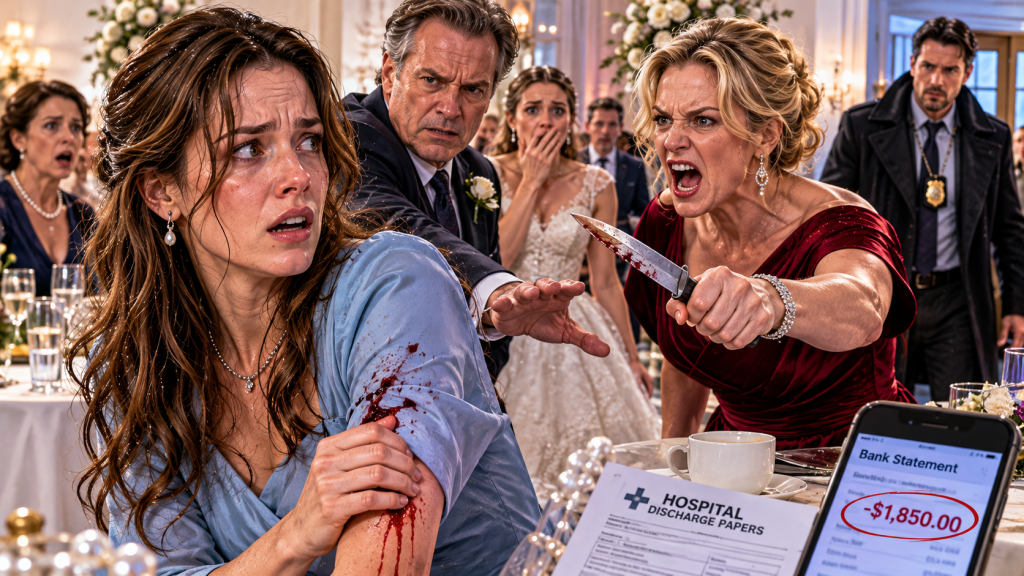
Three days earlier, Dad had contacted her office requesting paperwork to transfer an ownership interest to Vanessa.
He hadn’t told Margaret about the wedding.
He also hadn’t mentioned that I had never agreed.
“Dad,” I said carefully, “you can’t transfer something you don’t own by yourself.”
His face reddened.
“Don’t lecture me about my property.”
Vanessa leaned forward.
“You’ve always resented me. That’s why you’re trying to take his home.”
I picked up my papers.
“No. I’m trying to stop paying for people who think hurting me is acceptable.”
At that moment, the doorbell rang.
Denise, the wedding venue manager, had already supplied her security recording to investigators. I had given a statement at the hospital.
A detective stood outside.
He asked to speak with Dad and Vanessa separately about the incident.
Vanessa stopped crying.
Then my phone vibrated.
Margaret had sent the documents Dad requested.
I opened the first attachment.
And there, beneath the proposed transfer, was a signature that looked almost exactly like mine.
Except I had never signed it.
I didn’t show Dad the attachment immediately.
The detective was asking Vanessa about the knife, and for the first time that morning, she seemed unable to find the right words.
“It was an accident,” she insisted.
“Then why did you approach Rachel while holding it?” he asked.
Vanessa looked toward Dad.
He opened his mouth.
“Sir,” the detective said, “I’d like her to answer.”
Emily began crying quietly. Daniel pulled his chair closer to hers.
I stepped outside and called Margaret.
“Tell me exactly what I’m looking at.”
She explained that Dad had requested a deed transferring my ownership interest to Vanessa. Her office had prepared a draft for discussion, but the signature page attached to Dad’s return email had not been witnessed or notarized.
“Rachel, we haven’t recorded anything,” Margaret said. “We couldn’t. You never authorized this.”
“Is that supposed to be my signature?”
“Yes. And I was going to call you Monday.”
I looked through the window at Dad, sitting beneath the framed family photograph Mom had insisted on taking when Emily and I were teenagers.
“Margaret, I want my name protected. And I want out of this arrangement.”
“We can start with a formal notice. But the mortgage and ownership will need to be resolved separately.”
“Then that’s what we’ll do.”
The detective later reviewed the venue footage and interviewed several guests. Vanessa was charged in connection with the assault. The forged signature was referred for a separate investigation; no one pretended the paperwork alone proved who had written it.
Dad called me that evening.
“You’ve destroyed everything,” he said.
I sat at my kitchen table, holding a mug with both hands because my injured arm ached.
“No, Dad. I stopped protecting it.”
He went quiet.
Then came the familiar words.
“After everything I’ve done for you.”
I looked at the faded photograph on my refrigerator: Mom teaching Emily and me how to make pancakes, flour scattered across all three of us.
“You did good things for me once,” I said. “I remember them. But they don’t make this okay.”
I ended the call.
The following week, Margaret sent Dad a formal letter confirming that I had not authorized the proposed deed. She also notified the lender that I would not agree to any ownership changes or additional borrowing.
I couldn’t simply stop being responsible for a mortgage carrying my name. Instead, I stopped making voluntary contributions beyond my agreed obligations and demanded that Dad refinance to buy out my interest or cooperate with a sale.
He refused at first.
Vanessa moved out while her criminal case proceeded. Dad’s refinancing application failed because his income couldn’t support the loan alone.
Eventually, through our attorneys, he agreed to sell.
The house closed four months later. After the mortgage and expenses were paid, the remaining proceeds were divided according to our documented ownership agreement.
Dad moved into a smaller rental. Vanessa later accepted a plea agreement that included probation, counseling, and a no-contact condition.
Emily visited me the afternoon the sale closed.
She brought two slices of lemon cake from the same bakery that had made her wedding cake.
“I should’ve stood up sooner,” she said.
“You stood beside me when it mattered.”
She touched the thin scar on my forearm.
“Does it still hurt?”
“Sometimes.”
She didn’t ask whether I would forgive Dad.
Instead, she handed me a small envelope.
Inside was an old photograph of him kneeling beside me when I was seven, carefully bandaging my scraped knee.
“I found it while packing the house,” she said. “I thought you might want it.”
I held the photograph for a long time.
The man in it had loved me. I believed that.



