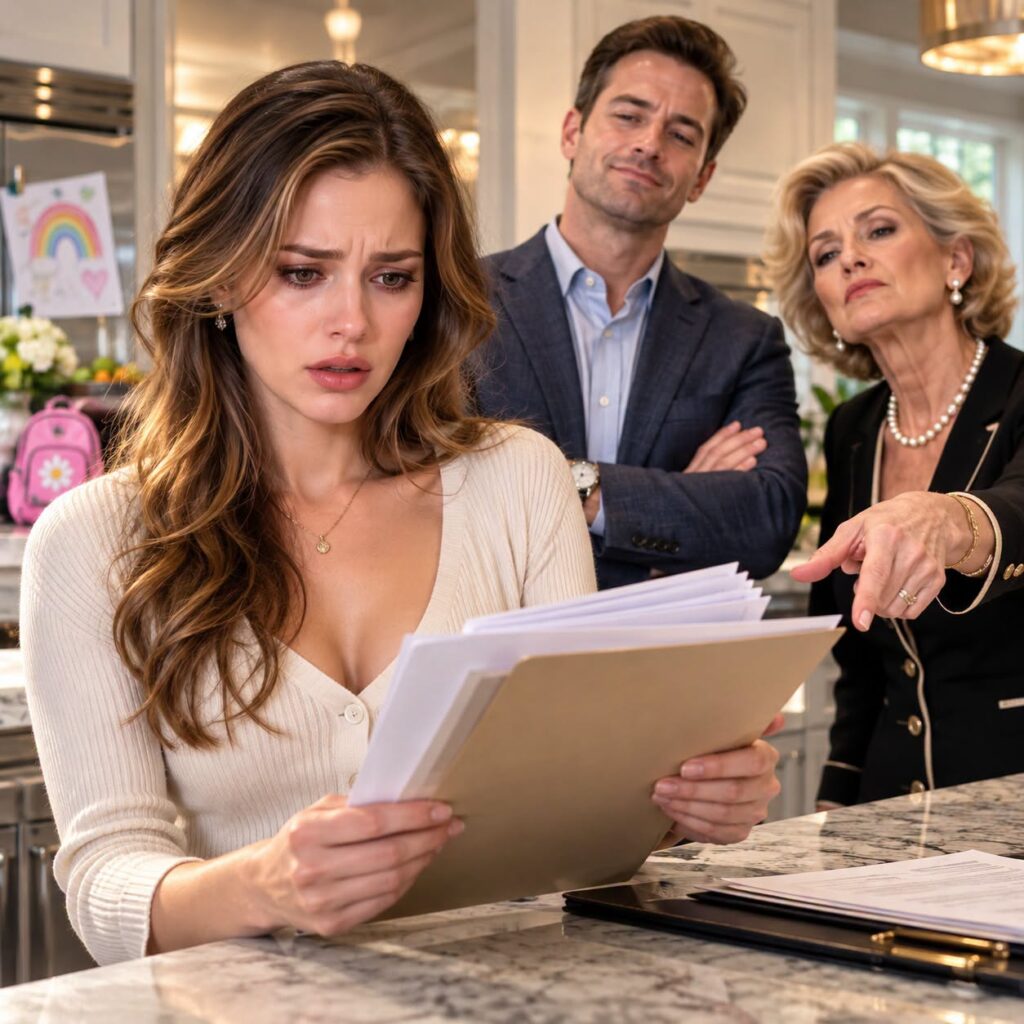
Don’t make Mom look bad.
You’re embarrassing us.
Tell your lawyer to back off.
I replied once: Talk to my attorney.
When I picked Ellie up from school, she climbed into the car without her usual chatter.
“Did I do something wrong?” she whispered.
I parked before answering. “Nothing you tell me will get you in trouble.”
She pulled a folded sheet from her backpack. It was a practice copy of the statement Bell had sent me. Under certain words, Diane had written little pronunciation marks.
“Grandma told me to copy it,” Ellie said. “She said Daddy would lose his company if I didn’t.”
I swallowed hard. “Did you sign it?”
“No. I wrote my name on the first one because she promised we could stop. Then she threw it away and wrote another.”
I took a slow breath. Someone had coerced my child and then forged the version presented to court.
Ellie caught my sleeve.
“Mom, that’s not the worst part.”
She told me Scott had made her practice answering questions about me. He’d promised that after “the judge moved her,” she’d see me on weekends.
Then she whispered the one detail that made everything fall into place.
“Daddy said the blue folder in his office was the part you could never see. He said if you found it, everything would be over.”
I called my attorney from the school parking lot.
“Don’t go looking through his office,” she warned. “Get Ellie somewhere safe. We’ll demand the records through proper channels.”
I drove straight to my sister’s house. Ellie slept with her stuffed rabbit under her chin while I gave my attorney the practice letter, the photographs, the texts, and every date I could remember.
Two days later, we appeared at an emergency hearing.
Scott sat beside Diane, refusing to look at me. Their lawyer, Martin Bell, told the judge he could no longer stand behind the documents his clients had supplied. My attorney presented the pediatrician’s written denial, my work records showing I’d been across town when my signature was supposedly notarized, and the practice letter Ellie had brought home.
The judge rejected Diane’s request for emergency authority, confirmed that Ellie’s money would remain restricted, and referred the questionable documents for investigation.
Diane stood so abruptly her chair tipped backward.
“She’s tearing this family apart!”
I wanted to scream. Instead, I held my daughter’s pink hair tie tight in my fist.
“Ellie is a child,” I said. “Not a loan you can take out.”
The judge ordered silence.
Afterward, Scott moved out of the house I’d owned before we married. I filed for divorce. My attorney instructed his counsel to preserve the business and financial records.
Weeks later, the blue folder finally appeared in the documents produced during the divorce.
It wasn’t a key to hidden millions.
It contained unpaid invoices, rejected loan applications, and a spreadsheet detailing how desperate Scott had become. His remodeling company owed $174,000. Diane had guaranteed part of the debt.
The spreadsheet included a line marked ELLIE—$192,000.
Their plan was to use my daughter’s court-protected settlement to rescue the business, then repay the money from a commercial project Scott had exaggerated to his lenders.
The forged medical letter would create urgency. My fake consent would make the withdrawal look authorized. And the statement supposedly written by Ellie would help Diane argue that I shouldn’t control my child’s affairs if I objected.
They’d planned for every version of me except the one who read the paperwork.
The investigation lasted months. Scott eventually pleaded guilty to charges stemming from the forged court filings, and Diane entered a separate plea. They received probation, financial penalties, and no-contact conditions protecting Ellie. Bell cooperated with investigators after correcting the record.
At sentencing, Diane glared at me from across the courtroom.
“You ruined my son’s life,” she hissed.
I looked at the woman who had taught my daughter to fear her own home.
“No,” I said. “You tried to buy his way out with hers.”
My divorce was finalized that winter. Scott had never adopted Ellie, so he had no parental rights to assert. He left our lives, and the settlement remained untouched.
On the first warm Saturday of spring, Ellie and I planted blue hydrangeas beside the porch.
“Do I get to stay here forever?” she asked.
I knelt in the dirt and pulled her close.
“You never had to earn your place here.”
They wanted my signature to erase my daughter’s future; I used it to make sure she could write her own.




