Chief Judge Arthur Pendleton received the case. I became a witness like anyone else. Months earlier, the Justice Department had already been examining complaints against Riggins. My stop became significant because investigators finally had what the other cases lacked: independent recordings. The sealed folder contained synchronized video from my Lexus and the Crestwood Hills entrance system, along with dispatch records showing that Riggins had falsely reported his body camera as malfunctioning after manually disabling it.
At the evidentiary hearing, Pendleton watched the recording in silence. Onscreen, Riggins leaned into my window. “What kind of job gets you into Crestwood Hills?” Then came his comment about the courthouse mailroom. Then the snapping license. Then his voice: “Now we agree you don’t have a valid license.” The courtroom was so quiet I could hear Harrison’s pen touch the defense table. The final angle showed Riggins pulling open my door and gripping my arm seconds before Bradley arrived.
Harrison asked for a recess.
Ten minutes later, I saw him in the hallway arguing with Riggins. “You told me there was no recording.”
“There wasn’t supposed to be!”
Harrison froze.
So did everyone within hearing distance.
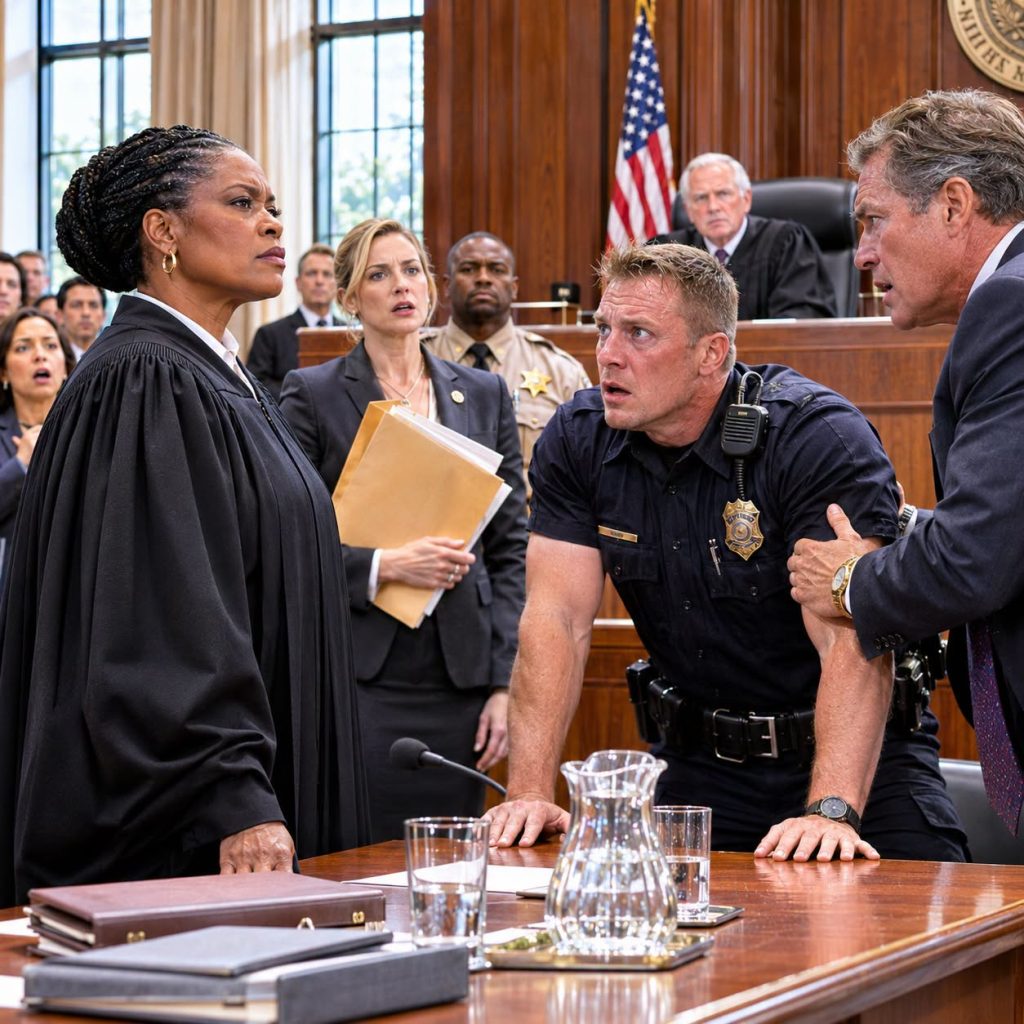
Riggins realized what he had said and lunged toward his attorney. “That’s not what I meant.” A deputy moved between them. “Back up.” Riggins shoved at the deputy’s arm. Two more officers rushed forward, turned him against the wall and restrained him. “Get off me!” he shouted. “This whole thing is a setup!” Harrison stepped away, stunned. “Do not speak to me without privilege protections in place,” he said.
The civil case continued under Judge Pendleton, and Riggins’s problems multiplied. Records showed a pattern: body cameras disabled shortly before disputed encounters, reports containing language repeated almost word-for-word across unrelated stops, and drivers from minority communities disproportionately subjected to searches after minor traffic allegations. Several former complainants returned when they learned investigators finally had corroborating evidence.
My case did not magically prove every accusation. It did something more important—it gave investigators a reliable starting point.
Federal prosecutors later brought criminal charges based on the broader evidence, including deprivation of rights under color of law, obstruction-related conduct and false statements. Faced with recordings, dispatch logs, testimony from Sergeant Bradley and evidence from other incidents, Riggins ultimately entered guilty pleas to multiple federal counts rather than take every charge to trial.
At sentencing, I sat in the back of the courtroom.
Riggins looked smaller without the uniform.
Before imposing sentence, Judge Pendleton said, “A badge grants authority. It does not grant ownership over another person’s dignity.”
Riggins received ninety-six months in federal prison. His employment had already been terminated, his law-enforcement certification was revoked, and related proceedings ended his career permanently.
As deputies approached, Riggins turned and found me sitting behind the rail.
For the first time since Route 114, neither of us had power over the other. I was not his judge. He was not the officer at my window. We were simply two people facing the consequences of what had happened.
“You could’ve told me who you were,” he said quietly.
I stood.
“You shouldn’t have needed to know.”
His face tightened.
“If treating me with dignity depended on discovering that I was a federal judge,” I continued, “then every person you stopped who wasn’t one was already in danger.”
He looked away.
Sergeant Bradley met me outside the courtroom and handed me a small evidence envelope. Inside were the four pieces of my original license, finally released after the cases concluded.
“You keeping those?” he asked.
I looked at the cracked photograph, my name split across two pieces.
“Yes.”
“To remember him?”
I shook my head.
“To remember that authority is tested most honestly when you believe the person in front of you has none.”
I slipped the pieces back into the envelope and walked out of the courthouse.
What do you think of this story? Please leave a like and share your thoughts in the comments. Your support means a lot to us and inspires us to keep writing more meaningful and powerful stories. Thank you! 👍❤️



