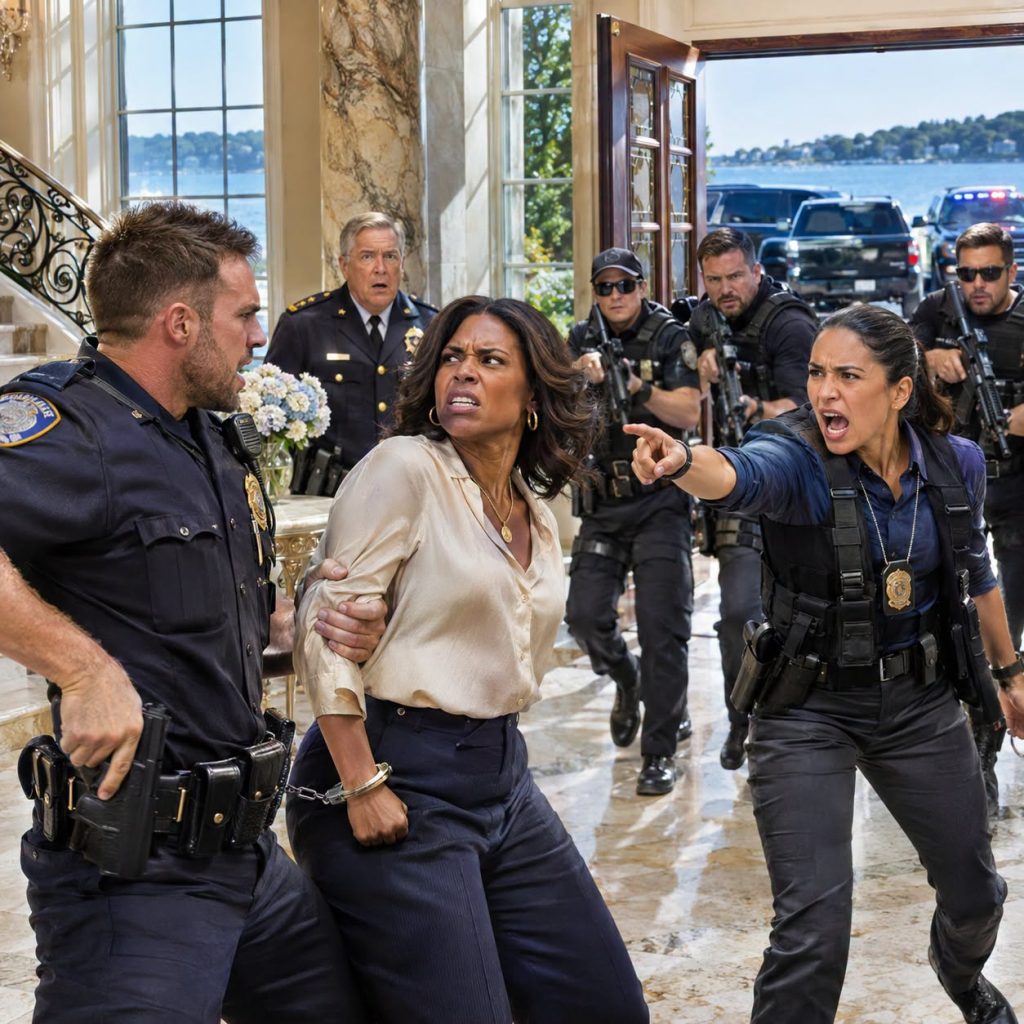
Rusk pulled out a phone, not a gun. “Nobody comes closer!” he shouted, his thumb hovering over the screen. Torres kept her weapon trained on him. “Put it down.” “You don’t understand what’s on that drive.” “Then explain it.” Rusk looked at me. “This was never supposed to happen inside your house.” “That isn’t the defense you think it is.” His face twisted. “Bellmere has donors, developers, private-security contracts—people who expect problems handled quietly.” I finally understood. The profiling complaints had been only the outer layer. Several officers had been using law-enforcement databases to collect information on residents, contractors, journalists and federal officials. Wealthy clients paid intermediaries for intelligence about lawsuits, inspections, investigations and property disputes. When federal plates began appearing near town offices months earlier, Rusk panicked. He ordered Holt and Mercer to identify the investigators. Holt had followed my vehicle that night because my plate had been flagged. He hadn’t recognized me. He only knew I was connected to the federal inquiry. “You told him to find out why I was here,” I said. Rusk shook his head. “I told him to confirm who was driving.” Holt shouted from the floor, “You told me to bring her in if she wouldn’t cooperate!” “You idiot!” Rusk screamed. “You forced your way into her house!”
Torres edged closer. “Chief, put down the phone.” Rusk looked at the screen. “One tap deletes the remote archive.” I almost laughed. “No, it doesn’t.” He stared at me. “What?” “The archive you’re trying to erase was mirrored forty minutes ago.” That was the twist he had never anticipated. Our task force had obtained a federal preservation order after a network analyst detected unusual access attempts against government vehicle records. The moment Holt ignored dispatch and entered my property, the operation moved from monitoring to seizure. Agents had already secured the police department’s servers, municipal backup facility and two private cloud accounts before Torres reached my front door. Rusk’s shoulders sagged. “You planned this.” “No,” I replied. “You did. We simply preserved what you built.” He threw the phone across the room and rushed toward the side entrance. Torres intercepted him. Rusk slammed into her, knocking both of them against the wall. I grabbed his arm when he tried to reach for Torres’s weapon. He swung at me, but an FBI agent caught him from behind. Seconds later, the police chief was on his knees beside Holt and Mercer, his hands cuffed behind him. The room fell strangely quiet. Holt looked up at me. “You ruined my life.” I met his eyes. “No. Tonight you finally stopped being protected from your own choices.”
The investigation moved fast after that. Federal warrants uncovered payments routed through a consulting company controlled by Mercer’s brother, unauthorized database searches involving hundreds of people, altered traffic-stop reports and internal messages ordering supervisors to bury complaints. Holt’s seventeen complaints were restored from backups; eleven included video or audio that contradicted official reports. Rusk resigned before the town council could remove him, but resignation did not protect him from prosecution. Mercer entered a plea agreement and testified about the surveillance operation. Holt fought the charges until prosecutors played my hallway footage in court—the security cameras he had noticed seconds before trying to arrest me. The jury saw him ignore dispatch, force open my door, disable his body camera and continue after federal verification. Months later, Bellmere entered a federal consent decree requiring independent complaint review, body-camera auditing, anti-bias training, restrictions on database access and external oversight. Several supervisors were dismissed. Others were cleared when evidence showed they had tried, unsuccessfully, to report what was happening. That distinction mattered to me. Accountability was never supposed to mean condemning everyone in a uniform. It meant making sure a badge could never become permission to ignore the law.
The night before the first oversight board meeting, I stood in the same hallway where Holt had cuffed me. The broken bowl had been replaced. The wall had been repaired. One faint scratch remained on the marble floor where agents had taken him down. I considered having it polished away, then decided against it. Torres stood beside me and noticed. “You keeping that?” she asked. “For now.” “Why?” I looked toward the front door. “Because sometimes institutions change only after somebody refuses to pretend the damage isn’t there.” She nodded. Outside, Bellmere was quiet. Months earlier, that silence had hidden something ugly. Now, for the first time, it felt different—not perfect, not healed, but exposed to daylight. And that was where real repair could finally begin.
What do you think of this story? Please leave a like and share your thoughts in the comments. Your support means a lot to us and inspires us to keep writing more meaningful and powerful stories. Thank you! 👍❤️



