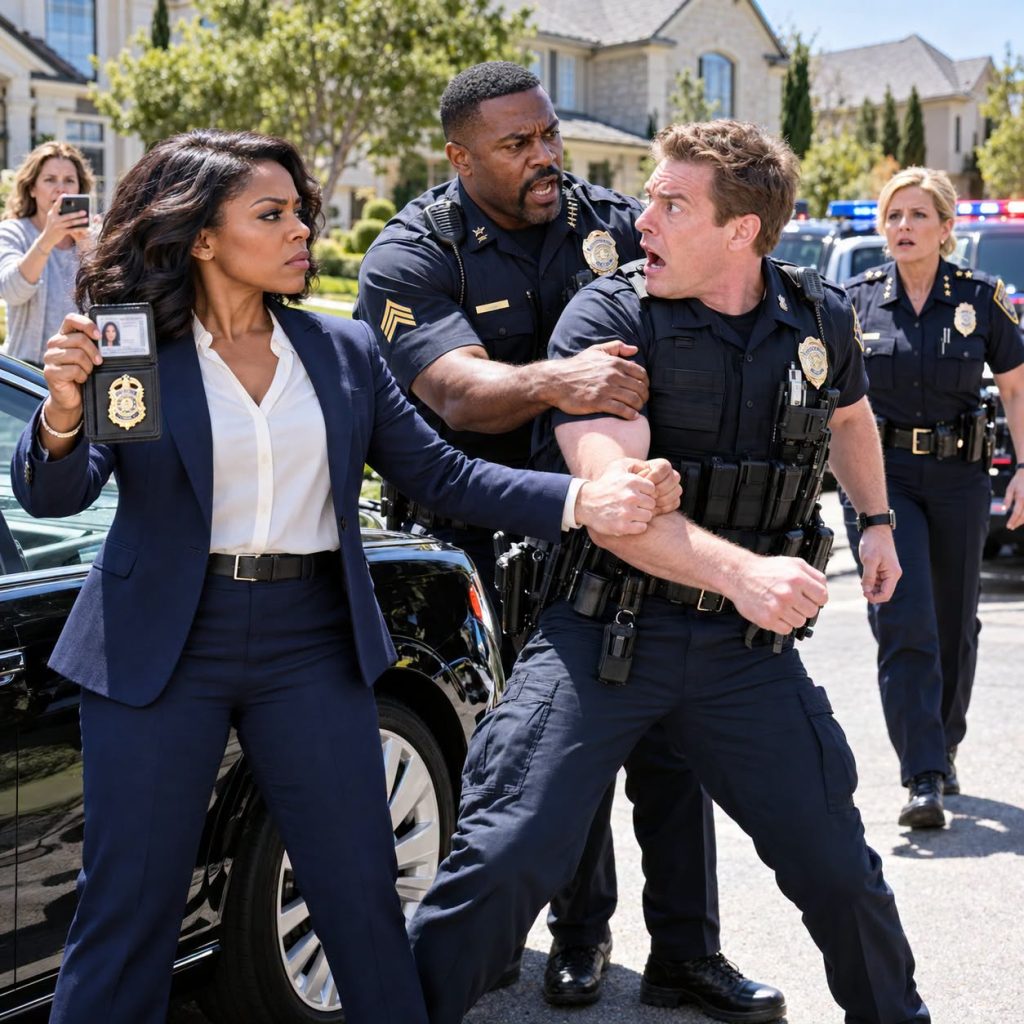
Chief Drummond didn’t answer immediately. She pulled out a chair and finally sat. “Deputy Chief Randall Voss supervised Malone’s probationary period.” She tapped the file. “He signed off on two of the three complaints. Last night, after Sergeant Okafor requested a supervisor over the radio, Voss called Malone directly instead of going through dispatch.” My stomach tightened. “What did he tell him?” “We didn’t know. Malone claimed it was routine guidance.” I pointed toward the printout. “Forty-three seconds of routine guidance while he had a federal marshal at gunpoint?” “That’s why I requested the department-issued phone this morning.” She opened another folder. “The call itself wasn’t recorded. But Voss sent Malone a text six minutes later.” She pushed the page toward me. Four words sat in the middle of the printout: HOLD YOUR GROUND. NOTHING MORE. For the first time since the confrontation, I felt genuine shock. Drummond continued. “Voss says he meant maintain scene control until Okafor arrived.” “That interpretation might work in a conference room,” I said. “It doesn’t work when Malone is holding my wrist with a Glock in his other hand.” “I agree.”
By noon, federal investigators were inside Crestmore headquarters. I didn’t ask for revenge. I asked for records. Every high-risk vehicle stop Malone had initiated. Every complaint. Every supervisory closure. Every inter-county advisory used as justification. The pattern became ugly quickly. Malone had repeatedly turned vague bulletins into aggressive stops, and supervisors had repeatedly written the incidents down as “officer safety decisions.” Voss hadn’t ordered him to target me. There was no secret conspiracy surrounding my federal position, and I was almost relieved by that. The truth was less cinematic and more disturbing: Voss had spent years protecting officers from consequences because he believed admitting mistakes weakened the department. Malone had learned exactly the lesson that system taught him—escalate first, justify later, trust your supervisors to clean up the paperwork. Sergeant Okafor broke that cycle in my driveway because he refused to lie about what he saw. When investigators asked him whether he felt pressure to protect Malone, he answered, “My oath isn’t to Officer Malone. It’s to the law.” That sentence ended up mattering far more than he knew.
Chief Drummond placed Malone on administrative leave immediately and suspended inter-county bulletin stops unless dispatch independently confirmed the vehicle description and active status. Voss was removed from operational command while the review continued. The department opened every complaint he had previously closed involving Malone and several other officers. Forty-one days after the night in my driveway, I sat at my desk at the federal courthouse when Drummond called. “The disciplinary board finished.” I leaned back. “And?” “Cody Malone has been terminated.” I said nothing for a moment. “For what?” “Unauthorized escalation, failure to follow dispatch updates, false statements during administrative review, improper firearm deployment, and conduct unbecoming.” She paused. “Voss resigned this morning before the city could complete its disciplinary proceeding. The independent review will continue.” I looked at the faint mark still visible on my wrist. “Don’t let his resignation become the end of it.” “It won’t.” “And Sergeant Okafor?” “Promoted to acting watch commander.” That finally made me smile. “Good choice.”
Several weeks later, I came home after another long transport detail and turned onto Regency Court. For a second, seeing a patrol cruiser near the neighborhood entrance tightened something in my chest. Then the officer behind the wheel simply raised two fingers from the steering wheel and continued driving. No lights. No pursuit. No gun. Just an ordinary moment—the kind I hadn’t realized could feel like a victory. Mason was trimming a hedge across the street when I stepped out of my car. “You good, Marshal?” he called. I looked at my house, my driveway, the exact patch of concrete where Malone had pointed a weapon at me because he thought authority meant he never had to reconsider himself. “Yeah,” I said. “I’m good.” But what stayed with me wasn’t Malone losing his badge. It was what happened before that: one sergeant refusing to protect misconduct, one chief deciding embarrassment was less dangerous than denial, and a department finally being forced to examine the difference between commanding respect and deserving it. I had opened my federal credential wallet that night expecting a badge to settle the question of who I was. In the end, the more important question was what everyone else chose to do after they knew.
What do you think of this story? Please leave a like and share your thoughts in the comments. Your support means a lot to us and inspires us to keep writing more meaningful and powerful stories. Thank you! 👍❤️



