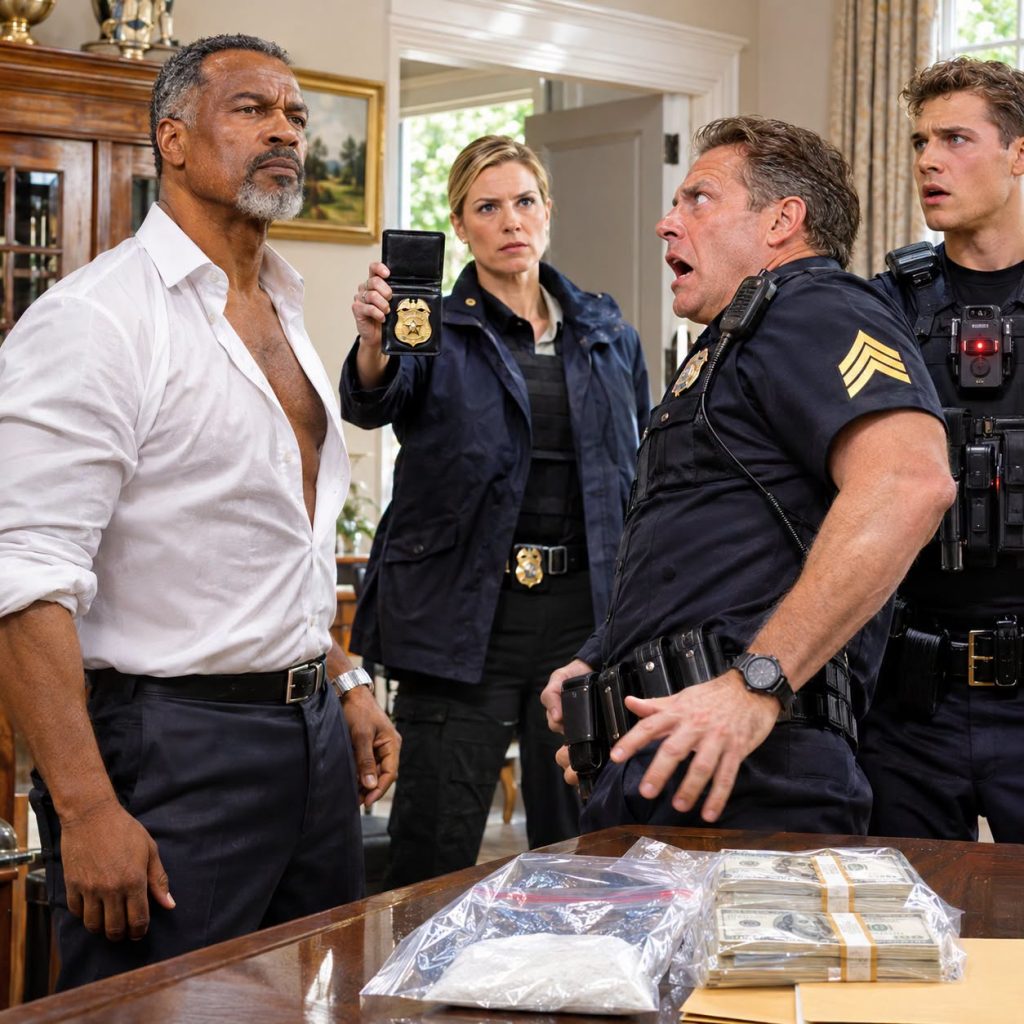
“Why would he think Denise knows?” I demanded.
“Because we let him.”
She was already moving toward an SUV. “Get in.”
As we pulled away, she explained what had been kept from me. The missing evidence-room cash was only the visible theft. Arnold had spent four years diverting seized money through fake confidential-informant payments, then laundering it through shell companies. Total exposure: nearly five million dollars.
Two months earlier, federal investigators froze the last transfer. They needed Arnold to believe someone had intercepted it, so they fed a controlled rumor into a channel they knew he monitored: a woman connected to my Lark Lane address had found the recovery account.
Denise.
“You used my wife as bait?”
“Her name was never supposed to reach him,” Rachel said. “A local task-force officer leaked the address.”
“Who?”
“Captain Mallory.”
The same captain who had publicly praised Arnold’s unit for three years.
A radio call interrupted us.
“Suspect vehicle located at the old municipal impound annex on Wheeler Road.”
We arrived behind two FBI vehicles. The annex was a low concrete building surrounded by chain-link fencing and abandoned city equipment. Arnold’s SUV sat crooked beside a loading bay.
I saw Denise through a dirty office window.
Arnold stood behind her with one arm across her shoulders and his pistol angled toward the floor.
Rachel caught my sleeve. “You are not going in.”
“He wants information.”
“He wants leverage.”
Then Denise looked through the window and saw me. She didn’t panic. She pointed slightly toward the desk beside her.
A black desk phone sat off the hook.
An agent touched his headset. “Negotiations has audio.”
Arnold dragged Denise toward the loading-bay door and shouted, “Coleman! Tell me where the account is!”
I stepped into view behind an armored vehicle.
“There is no account you can reach, Brett.”
“You think I’m stupid?”
“I think you’re scared.”
His face tightened.
“You planted evidence in my home. You forged probable cause. You kidnapped my wife. And your own officer recorded you.”
“You don’t know what he recorded.”
“I know enough.”
That did it.
Arnold started talking, not because he wanted to confess, but because he hated being told he had lost control. He shouted that the money was his, that the informants never existed, and that people above him had taken shares. He named Captain Mallory, a prosecutor, and two officers who altered property logs.
Rachel’s negotiator raised a thumb.
Every word was being recorded.
Then Denise moved.
She drove her heel onto Arnold’s foot, twisted free, and dropped behind a steel desk.
Arnold jerked the pistol upward.
Agents surged through the loading bay.
“Drop it!”
For one terrible second, he didn’t.
Then Dylan Young’s voice came from behind us.
“Sergeant, it’s over.”
Arnold looked toward him. Dylan stood outside the perimeter, bandage over his eyebrow, body camera still attached.
Arnold’s shoulders collapsed.
The pistol hit the concrete.
I reached Denise seconds later. She grabbed my shirt and pulled me against her.
“You owe me a quieter retirement,” she said, shaking.
“I’ll work on that.”
The investigation lasted eleven more months.
Dylan’s body-camera footage showed Arnold planting the cocaine and cash. The federal wiretap captured conversations about stolen evidence, false affidavits, and payoffs. The open desk phone recorded Arnold confirming the broader scheme in his own voice.
Captain Mallory was arrested two days later. Several officers resigned or were charged. A county prosecutor pleaded guilty to obstruction. Dozens of cases tied to Arnold’s unit were reopened, and convictions built on contaminated evidence were reviewed.
Arnold went to federal court for evidence tampering, conspiracy, deprivation of rights, kidnapping, and related charges. Dylan testified.
So did I.
When the jury returned guilty verdicts, Arnold never looked at me.
He looked at Dylan.
I retired for real the following spring.
On my last morning at the Department of Justice, Denise met me outside with two coffees. I asked whether she still wanted the quiet life we had planned.
She smiled. “Quiet is fine. But next time somebody kicks in our door, you’re buying the new one.”
I laughed all the way to the car.
What do you think of this story? Please leave a like and share your thoughts in the comments. Your support means a lot to us and inspires us to keep writing more meaningful and powerful stories. Thank you! 👍❤️



