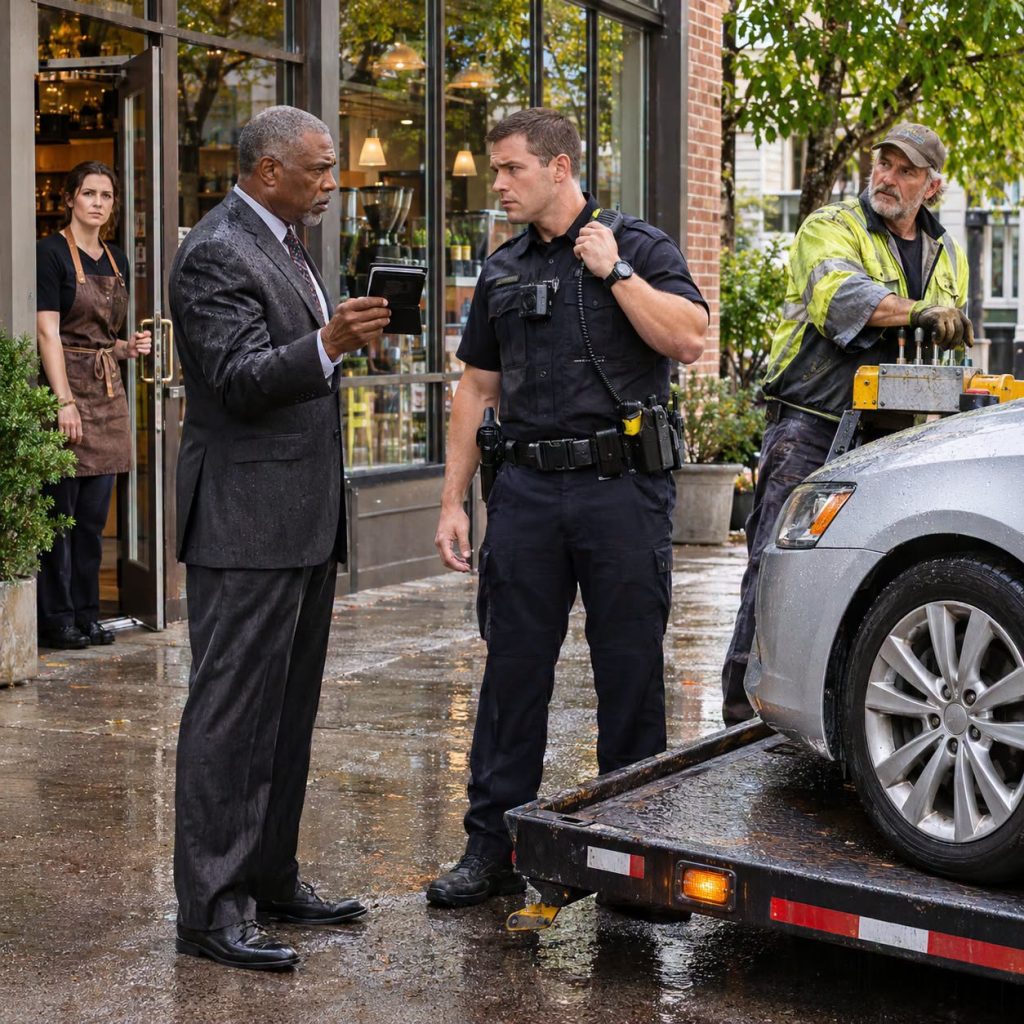
“Get that footage to the marshals,” I told Nora. “Give them the plate and the time it left. I’m coming in.” Thornton’s eyes followed me as I stepped off the curb. He started to speak, then thought better of it. I left him under the awning with my untouched coffee on the windowsill and walked three blocks to the courthouse. By the time I reached the service entrance, Nora had found a dry towel and Deputy U.S. Marshal Dana Vega had found the sedan. A county deputy had spotted it outside the Twelfth Precinct. The desk sergeant claimed nobody by the name of Elena Ruiz had been brought in.
Vega called the captain while I stood beside her. “I have video of you putting her in a city vehicle,” she said. Miller spoke long enough that I could hear the rhythm of his voice through the receiver. Vega waited him out. “Then find the room where she’s waiting voluntarily and put her on the phone.” We stood there for nearly a minute. When Ruiz finally came on, her first words were, “Can my daughter still go to school?” Vega asked if anyone had threatened her daughter. “He knew what time she gets out,” Ruiz said. Vega sent a deputy to meet Ruiz at the precinct and arranged for someone to meet her daughter at school.
I went upstairs and told Nora to get Chief Judge Evelyn Park. She came down carrying the glasses she always forgot she’d already put on. I gave her my phone, my recollection of the stop, and the exact words I’d heard on Thornton’s radio. “You’ll be a witness in this,” she said. “I know.” She took over the case and signed an emergency order requiring the city and the tow company to preserve their records, the vehicles involved, and anything taken from them. She also set a hearing for the next morning. The marshals served the order at the precinct. My car came back forty-seven minutes later, its floor mats still damp. The driver who returned it was someone I’d never seen.
Ruiz arrived through the service entrance minutes after the car. She had a crease across one cheek from leaning against the sedan window. Vega offered her a chair, but she stayed standing until her daughter called from the school office and said she was safe. Then her knees went. Nora caught her elbow and lowered her into the chair. Once she could speak, I asked what Eddie had meant about a key. Ruiz stared at me. “He told you to ask me that?” She pressed both hands against her face. “I mailed him a locker key yesterday. His daughter works at a storage place. I needed somewhere the company couldn’t get into.”
“The invoices are in that locker?” Vega asked. Ruiz said the invoices were only half of it. She’d found the other half while trying to close out a batch of disputed fees. A lieutenant had forwarded a scanned complaint and asked her to match it to a tow slip. Two days later, the complaint vanished from the shared folder. When Ruiz checked the next disputed tow, she found another missing complaint. The same names kept appearing in both sets of records. People who’d complained about officers had their cars taken days later, often near work. A home health aide lost three shifts while her car sat in the lot. Thornton had signed her tow slip, and Miller had approved the department’s response when she tried to get it back.
Vega asked for the locker number. Ruiz gave it to her, then asked if somebody could check on Eddie. He was still supposed to have the key. Vega called the tow yard and was told he’d clocked out. She called his daughter, who said he hadn’t made it to their usual lunch. Before Vega could ask anything else, the daughter said, “Hold on. I’ve got him calling me now.” A few minutes later, Vega’s phone buzzed with a photo Eddie had sent from a gas station. In it, his locker key lay next to a torn coat pocket. A second photo showed a torn paper tag that had been tied to the key. It had my license plate written on it.
I turned toward the window and looked down at my car. Eddie had stood close enough to slip something inside it before he started the winch. Someone had searched him afterward and missed what mattered. Vega enlarged the photo. On the back of the torn tag, in smaller writing, were two words. Spare inside. My car had spent forty-seven minutes at a lot controlled by the people we were trying to keep out of that locker.



