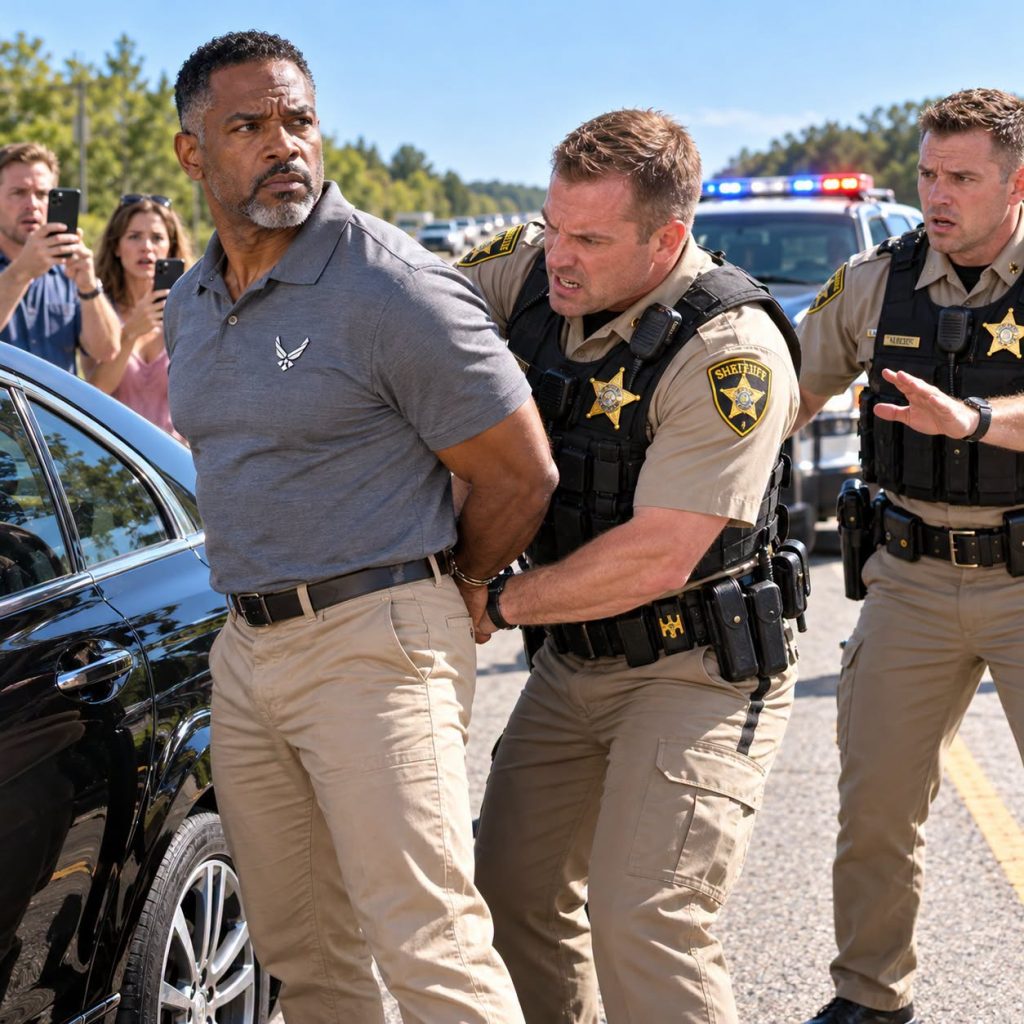
Behind us came a shout. Rusk and Hopper crashed against the hood of the county SUV. Rusk swung wildly and caught Hopper across the cheek. Hopper grabbed him around the waist, and both men fell onto the pavement. Two agents rushed over and pinned Rusk’s arms. As they cuffed him, a small gasoline container rolled from beneath his jacket. “Sheriff told me to do it!” Rusk yelled immediately. “Bost said the files couldn’t survive tonight!” Kendall looked at me. “There’s your arson witness.” Fire crews contained the blaze before it reached the basement archive. More importantly, Denise had already scanned years of citizen complaints after becoming suspicious that originals were disappearing. She had stored copies on a state records server Bost couldn’t touch. By sunrise, federal agents had what they needed: Hopper’s logs, preserved dashcam footage, Lumis’s falsified arrest report, private messages, financial records, dozens of suppressed complaints, and Rusk’s statement. My traffic stop had not created the corruption. It had simply forced the people hiding it to panic.
Eight months later, I sat in federal court and watched Lumis take the witness stand. His lawyer tried to portray the stop as a misunderstanding. Then the government played the dashcam video. The courtroom heard my voice asking permission before every movement. It heard me refuse consent. It heard Lumis claim he smelled marijuana only after I challenged the search. Most devastating of all, it heard Hopper say quietly, “Deik, I don’t smell anything.” Lumis’s face collapsed. The jury found that my constitutional rights had been violated and awarded $1.8 million in compensatory damages and $11 million in punitive damages. The civil judgment was only part of the reckoning. In the criminal case that followed, Lumis received five years in federal prison after being convicted on civil rights and obstruction-related charges. Rusk cooperated in exchange for a reduced sentence. Bost resigned and eventually pleaded guilty to a lesser federal offense after prosecutors confronted him with the messages, archived complaints, and destruction order. Briar County entered a federal consent decree requiring outside oversight, new stop-data reporting, body-camera enforcement, complaint audits, and anti-bias training.
After the final hearing, Hopper found me outside the courthouse. A faint scar remained near his eyebrow from the booking-room fight. “You know,” he said, “when Lumis cuffed you, I figured you’d explode.” “That’s what he wanted.” “You weren’t scared?” I looked at him. “Of course I was scared.” He seemed surprised. “You never looked scared.” “Courage isn’t looking fearless, Deputy. Sometimes it’s deciding fear doesn’t get to choose your next move.” He nodded toward the courthouse. “You could retire now with that verdict.” “The money was never the point.” I thought about all the names in Hopper’s spreadsheet—the drivers who hadn’t known whom to call, the people who had paid fines just to make the nightmare disappear, the families who assumed nobody would believe them. “The point,” I said, “is that the next person stopped on that highway shouldn’t need to be a colonel, a lawyer, or anybody important to be treated like an American citizen.” Hopper extended his hand. I shook it. For the first time since those red and blue lights appeared in my mirror, my wrists didn’t hurt.
What do you think of this story? Please leave a like and share your thoughts in the comments. Your support means a lot to us and inspires us to keep writing more meaningful and powerful stories. Thank you! 👍❤️



