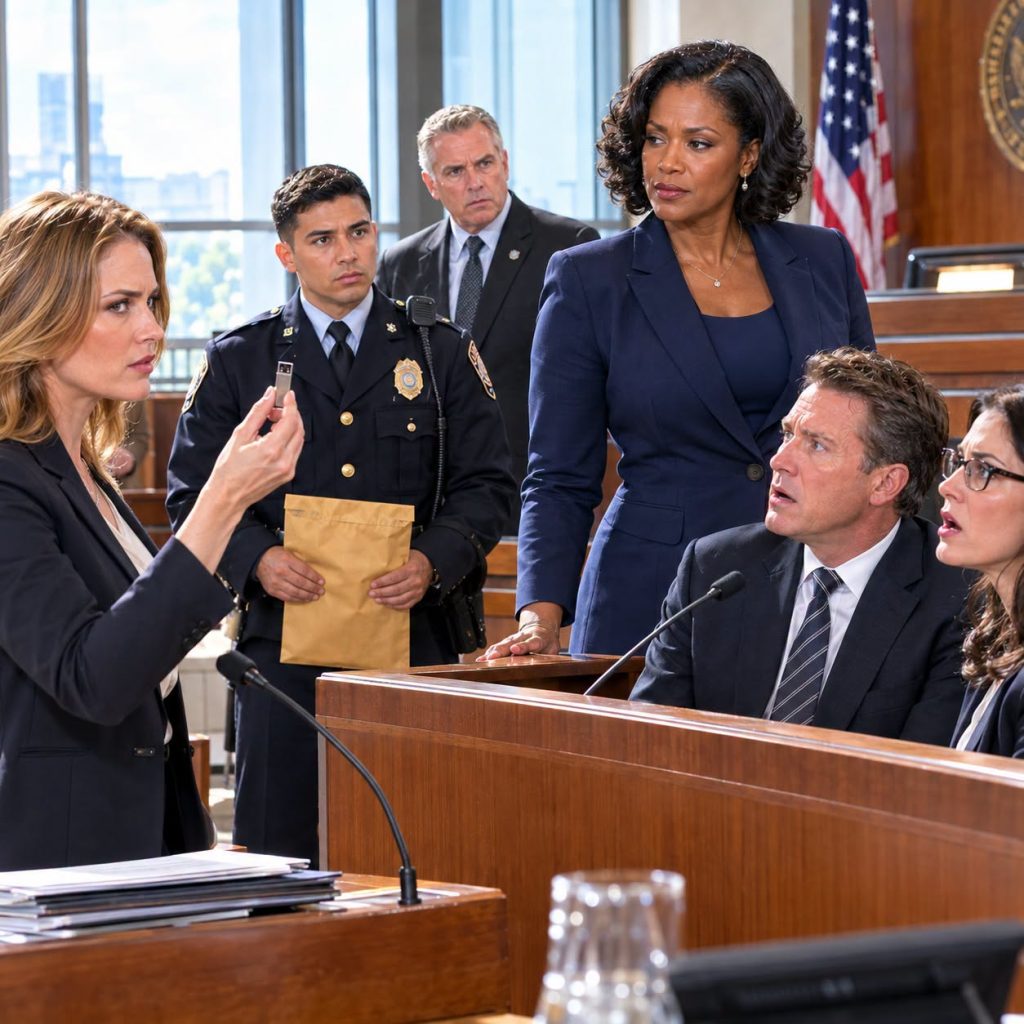
By morning, federal investigators had secured Daniel’s evidence through his attorney. I formally recused myself from all proceedings involving Maddox and became a cooperating witness. An independent judge took over the criminal case. The flash drive revealed something worse than anyone expected: seventeen altered incident reports, deliberate camera shutdowns, and messages coordinating witness intimidation. Harlan had ordered surveillance of me because the department feared the pending hearing would expose its internal practices. Maddox had been instructed to manufacture a complaint against me, hoping to discredit the judge handling his case. But the surveillance operation had spiraled beyond their control when Maddox became violent.
Three weeks later, I entered a federal courtroom as a witness rather than its presiding judge. Maddox sat beside his attorney, avoiding my eyes. Harlan sat several rows behind him, now under separate indictment. When the prosecutor asked what happened in the parking lot, I described everything. “Did you attempt to grab Officer Maddox’s weapon?” “No.” “Did you resist a lawful arrest?” “No.” Then the prosecutor played the supermarket recording. Maddox’s hand closed around my throat. His voice filled the courtroom. “Women like you need to learn some respect.” A woman in the gallery began crying. Maddox stared at the table.
Daniel Ruiz took the stand next. His attorney had negotiated protections allowing him to cooperate. “Why did you preserve the recordings?” the prosecutor asked. Daniel looked directly at Maddox. “Because I’d watched innocent people get blamed too many times.” The defense attorney stood. “You betrayed your fellow officers, didn’t you?” Daniel answered, “I refused to betray the people we swore to protect.” Then came the final revelation: a recorded conversation in which Harlan instructed Keller to change my arrest report and pressured Ruiz to confirm the fabricated allegations. Keller had subsequently agreed to cooperate with prosecutors. The evidence connected the parking-lot attack, the attempted cover-up, and the intimidation at my home.
After deliberating, the jury convicted Maddox of the federal civil-rights and obstruction charges brought against him. Harlan later pleaded guilty to conspiracy and witness intimidation, while Keller admitted falsifying records and helping threaten witnesses. All three faced prison sentences imposed in separate proceedings. Daniel’s retaliation complaint resulted in his reinstatement with back pay, and the Justice Department opened a broader civil-rights investigation into the department. The surviving complainants finally had their cases reopened. Standing outside the courthouse, I saw Daniel waiting near the steps. “Judge,” he said quietly, “I thought doing the right thing would cost me everything.” I shook his hand. “It almost did. But you gave other people a chance to be heard.” He smiled through tears.
Months later, I returned to the same supermarket. The older man with the walker recognized me. “You’re the lady from the news,” he said. “Yes, sir.” He pointed toward the accessible parking spaces. “They don’t block those anymore.” I smiled. “Good.” As I walked toward my SUV, I remembered Maddox’s words: You don’t get to decide that. He had been right about one thing. I wasn’t supposed to decide his guilt. A jury would do that after hearing the evidence. And that was precisely why his badge could never place him above the law.
What do you think of this story? Please leave a like and share your thoughts in the comments. Your support means a lot to us and inspires us to keep writing more meaningful and powerful stories. Thank you! 👍❤️



