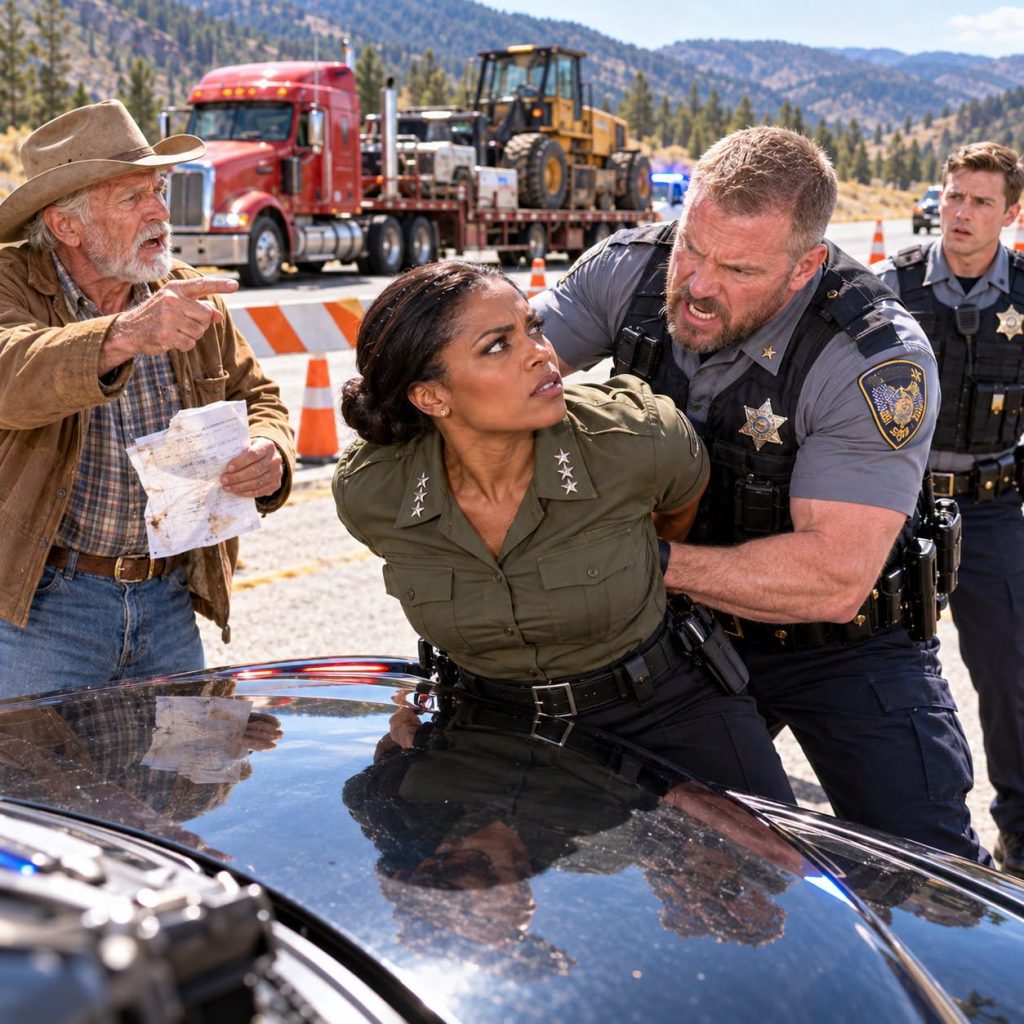
Voss never got the chance to pull the trigger. Sabrina slammed his gun arm upward as the shot exploded into the ceiling. I drove forward, hit his wrist with both hands, and the pistol clattered across the floor. Treadwell charged me from behind, but Mercer hooked his leg and sent him crashing into the metal desk. Outside, the fleeing Red Mesa truck roared toward Highway 41. “Falcon Two, block the south exit!” Sabrina shouted into her radio. Two Guard vehicles moved sideways across the access road—not to make arrests, but to seal the emergency route until state investigators arrived. The truck swerved onto the dirt shoulder, struck a drainage ditch, and stopped hard. Red Mesa workers jumped out and ran. County deputies who had arrived with the Guard medical team intercepted them. Inside the weigh station, Voss reached for his fallen pistol. I kicked it beneath the desk. “Don’t,” I warned. He looked up at me, breathing hard. “You think this changes anything?” “No,” I said. “The evidence changes everything.”
His laugh came out strained. “What evidence? Mercer’s word?” I looked toward the open doorway. “Sabrina.” She held up my phone. Treadwell’s expression collapsed. “That phone was locked.” “It was,” I said. “But my truck wasn’t.” My pickup carried a Guard-issued incident camera used during route inspections. The moment Treadwell detained me, it continued recording the checkpoint, including every Red Mesa vehicle that passed. More importantly, before I stepped away from the truck, I had activated the emergency audio relay clipped beneath my collar. Sabrina hadn’t heard every word live because wildfire communications were unstable—but once her vehicle entered range, the buffered recording uploaded automatically. Voss stared at me. “You knew?” “Not about you,” I said. “Not until you told Treadwell to take me somewhere other than county.” Sabrina opened the weigh station office safe after Mercer gave investigators the combination he had seen Treadwell use. Inside were property lists, payment records, forged emergency permits, and three years of checkpoint schedules. Beside several ranch addresses were handwritten notes: generators, horses, weapons, diesel, tools. Voss’s initials appeared at the bottom of multiple pages.
Treadwell suddenly bolted for the rear door. Mercer shouted, “Stop!” Treadwell shoulder-checked him and ran into the yard. I followed with Sabrina. He reached his cruiser, yanked open the door, and grabbed a shotgun from the rack. “Stay back!” he screamed. Guardsmen immediately took cover but did not fire. I stood behind an engine block and called out, “Treadwell! It’s finished.” “You ruined my life!” “You did that when you decided people fleeing a wildfire were opportunities.” His hands shook around the shotgun. Then Elias Morrow’s pickup appeared beyond the barricade, followed by three county sheriff vehicles and agents from the state bureau of investigation. Treadwell looked from them to us. His shoulders sagged. The shotgun slipped from his hands and hit the pavement. Agents moved in and cuffed him. Voss was arrested minutes later. Red Mesa’s owner was taken into custody that evening after financial records showed payments routed through a consulting company controlled by Voss’s brother-in-law. Mercer accepted a plea agreement in exchange for testimony. His cooperation helped investigators identify twenty-seven families whose properties had been targeted across three wildfire seasons.
Two days later, after doctors cleared me from the dehydration and bruising, I returned to my pickup. Something rested beneath the windshield wiper: a black envelope tied with a short bundle of wheat. Inside was a handwritten list of dates, highway numbers, badge numbers, and ranch names stretching back three years. At the bottom were four words: We kept our own records. I knew immediately who had left it. I found Elias at an evacuation shelter that afternoon. “The wheat?” I asked. He smiled faintly. “My family’s been growing it here for eighty-six years. Treadwell kept us from our land, but he couldn’t make us forget what we saw.” “Why didn’t you come forward sooner?” His smile disappeared. “We did. Complaints went to Voss.” That explained the final mystery. Every complaint had been routed directly to the man running the operation. The victims hadn’t been ignored by accident. They had been identifying themselves to the very people exploiting them.



