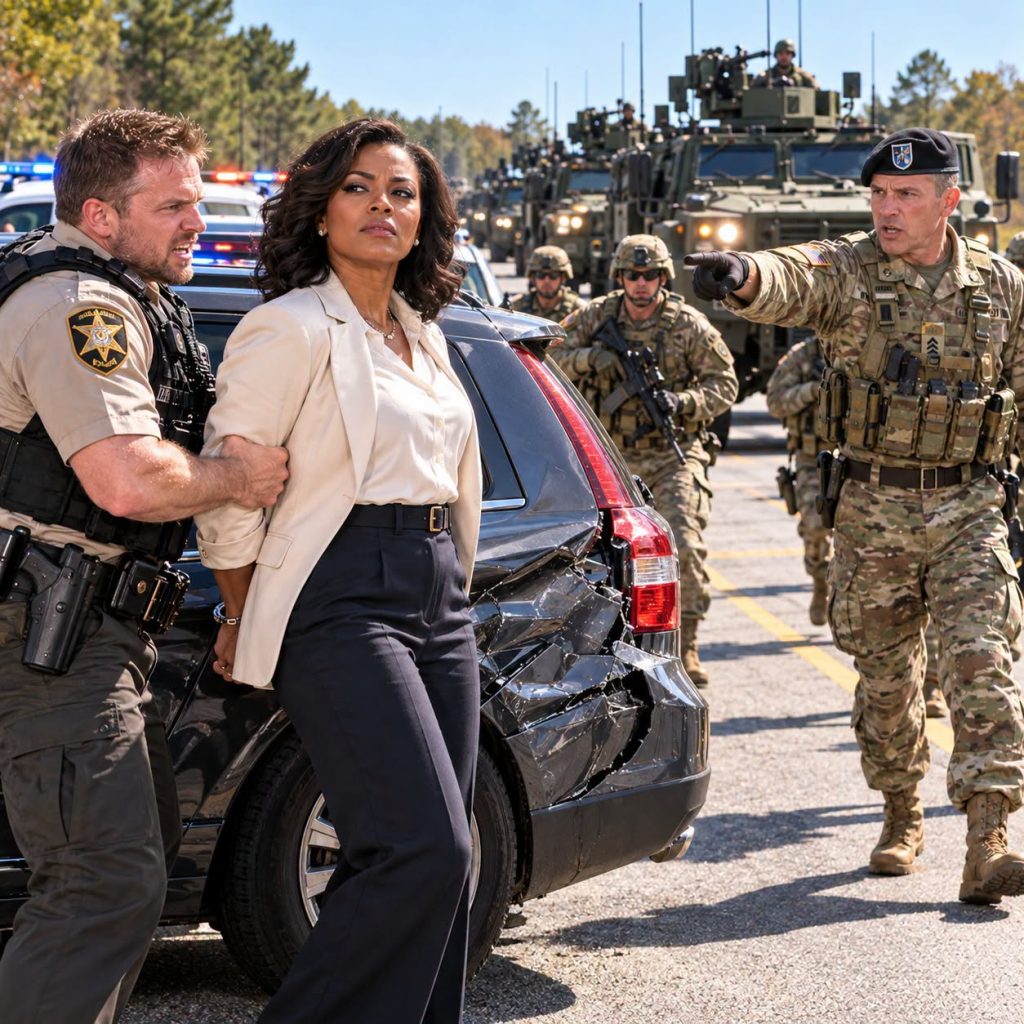
Talbot marched toward him. “That was not a request.” Mercer raised his phone. “I just received a call instructing me to destroy evidence before federal investigators arrived. The caller claimed the order came from you.” Talbot stopped. Brisco shouted from the pavement, “Don’t drag me down alone!” “Shut your mouth,” Talbot snapped. “You promised you’d protect us!” Brisco yelled. “You said complaints disappear if reports match!” Traffic had completely stopped now. Drivers stood outside their cars recording with phones. Talbot realized it too late. His own deputy had just shattered whatever defense he planned to use.
Colonel Cole leaned close to me. “Military police are three minutes out.” “Good,” I said. “But county jurisdiction stays with Mercer until state or federal authorities take over.” Talbot heard me. “You don’t command my county.” “No,” I said. “But I understand chains of command. And yours is collapsing.” He lunged toward Bennett’s laptop. Cole blocked him with his body. Talbot shoved Cole. Mercer stepped between them. “Sheriff, back away.” Talbot reached inside his jacket. Every soldier stiffened. Mercer drew his sidearm but kept it pointed at the ground. “Show me your hands!” Talbot slowly pulled out—not a gun—but a second phone. He smashed it against the pavement.
Bennett looked at me. “That was probably remote access.” She immediately disconnected the dash-camera module from every network. “Too late,” Mercer said. “State Bureau of Investigation already has my call log.” Within minutes, military police arrived to secure the brigade personnel and preserve the scene without taking over civilian jurisdiction. Then North Carolina State Highway Patrol units blocked both ends of the roadway. An SBI investigator named Elena Ruiz arrived shortly afterward. She watched the dash footage once and said, “Nobody leaves.”
The investigation that followed uncovered far more than Brisco’s traffic stop. His recovered memory module contained fragments from dozens of encounters that had been deleted from department servers but not fully erased from local storage. Several showed motorists being pressured, threatened, or falsely accused after challenging deputies. Internal complaint records revealed that Brisco had been reported repeatedly. Sheriff Talbot’s office had quietly reclassified or dismissed many of those complaints. Mercer eventually admitted that supervisors had been instructed to protect “productive deputies” from what Talbot called nuisance complaints. The shocking part wasn’t that Brisco had lost control with me. It was that he had learned, over years, that losing control carried almost no consequences.
Brisco was charged after state and federal investigators reviewed the footage, witness statements, falsified reports, and attempted evidence destruction. Talbot resigned before he could be removed and later faced his own criminal case over obstruction and records manipulation. Mercer cooperated fully, turning over emails, internal directives, and archived complaint files. Some people called him a hero. I didn’t. I told him exactly what I believed when we met months later. “Doing the right thing after years of silence doesn’t erase the silence.” He lowered his eyes. “I know.” “But telling the truth still matters.” He nodded. “I know that too.”
My shoulder healed. The Volvo didn’t. The Army offered transportation home that afternoon, but I stayed until every photograph was taken and every piece of evidence was logged. Before leaving, I stood beside the damaged SUV with Colonel Cole. He stared at the crushed rear end. “Ma’am, you realize the brigade is never going to let you drive alone again.” I laughed for the first time all day. “Raymond, if eleven Strykers follow me to the grocery store, I’m transferring you to Alaska.” He grinned. “Worth it.”
Months later, I helped establish a legal support program for service members and veterans facing civil-rights disputes in civilian jurisdictions. Not because rank made me more deserving of justice. The opposite. What stayed with me was one thought: if Brisco had treated a brigadier general that way because he didn’t know who I was, how many people without stars on their shoulders had stood on that highway completely alone? That became the question I refused to let Hoke County forget.
What do you think of this story? Please leave a like and share your thoughts in the comments. Your support means a lot to us and inspires us to keep writing more meaningful and powerful stories. Thank you! 👍❤️



