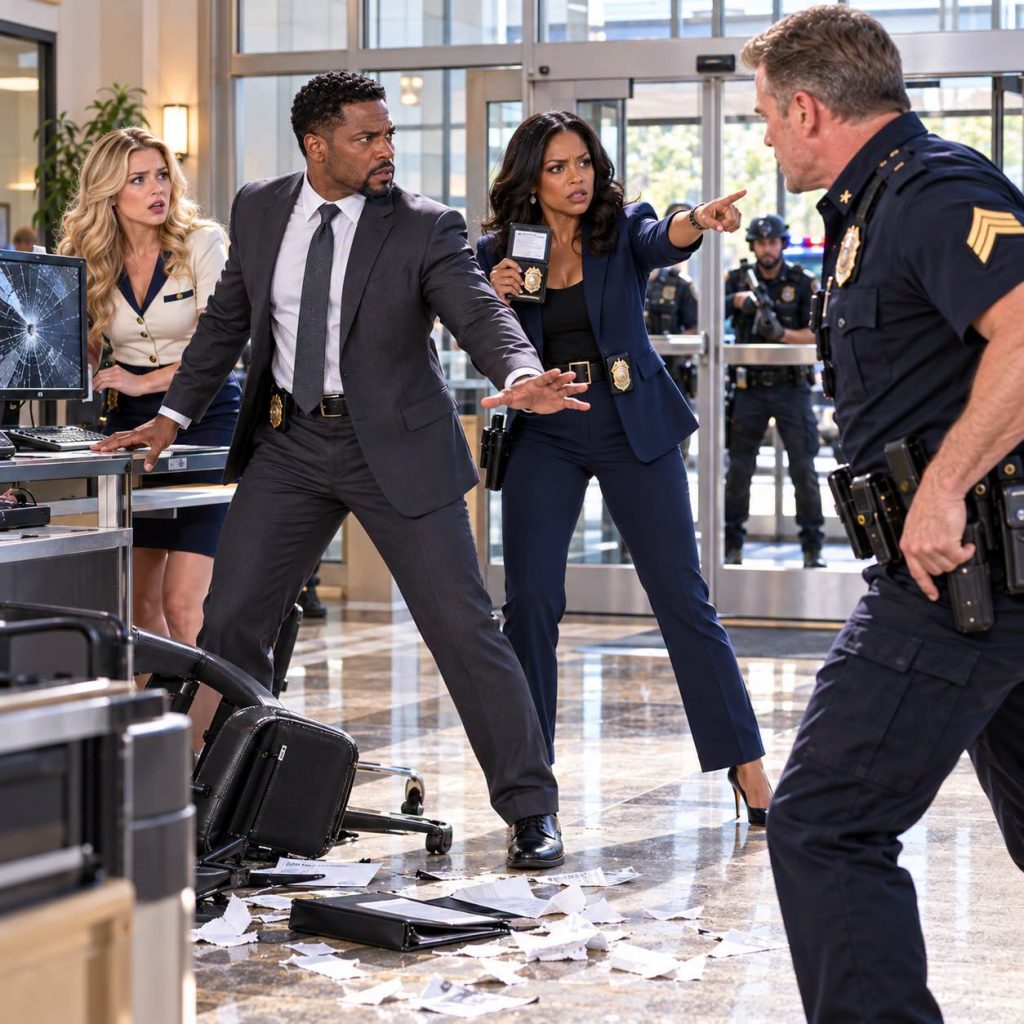
Hannah joined us through a secure call on Renee’s phone. “The purge command is bouncing through an external maintenance account. Pulling the network cable won’t stop the local overwrite.” “What will?” I asked. “There should be a hardware preservation switch inside Rack Four.” We found it behind a locked panel. Travis stared at the key slot. “Knox carries that key.” Renee swore under her breath. I looked through the narrow glass panel and saw a red lever inside. “Break it.” Renee grabbed an emergency maintenance bar from the wall and struck the panel. Once. Twice. The reinforced glass spidered but held. The timer hit 02:18. I took the bar. “Again.” I drove it into the same point. The glass broke inward. I reached through, sliced the sleeve of my jacket on the edge, and pulled the lever. Every server light changed at once. The countdown froze at 01:47. Hannah’s voice burst through the phone. “You stopped it!”
Within twenty minutes, federal cyber specialists had cloned the preserved drives. What they found explained everything. Knox had been manipulating seized-property accounts for nearly three years, routing money through two shell vendors controlled by his brother-in-law. Evidence marked for forfeiture was being quietly reclassified, transferred, and partially erased from internal ledgers. Captain Weller had discovered irregularities six weeks earlier and secretly contacted DOJ because he didn’t know how deeply the scheme reached. The warrant I carried was designed to preserve command records before Knox could destroy them. “But how did Knox know I was coming?” I asked. Weller’s face darkened. “Federal scheduling notice went to one restricted department email for operational coordination.” Renee checked the recovered audit log. Knox had illegally set that account to forward copies to a private address months earlier. He hadn’t known what the warrant contained—only that a federal visitor was arriving. So he invented a story, frightened Travis into blocking me, disabled the lobby camera, and began securing his files.
The final twist came from Hannah. While Knox had been ordering her not to verify my credentials, she had quietly photographed the torn warrant from behind the desk and activated an automatic cloud backup on the terminal. Her copy preserved the exact time of destruction. Her backup preserved Knox’s command message even after he tried deleting it. Travis’s burner phone added the rest: messages telling him to “delay the visitor,” keep me away from Weller, and make sure “no federal paper remains intact.” Travis looked sick when Renee read them aloud. “I thought I was protecting the department.” I faced him. “You were protecting an order you never questioned.” He lowered his eyes. “I know.” His decision to cooperate did not erase what he had done. He was removed from active duty and referred for investigation over the destruction of the federal document and his conduct toward me. Knox left the building in federal custody facing a far more serious case involving obstruction, evidence tampering, financial misconduct, and the attempted destruction of records.
As agents escorted Knox through the lobby, he stopped beside me. “You think you won?” I looked at the scraps of the warrant, now sealed inside clear evidence bags. “This was never about winning.” I nodded toward Hannah, Weller, Renee, and the investigators carrying cloned servers out of his department. “It was about making sure you couldn’t erase the truth.” He had no answer. Weeks later, East Ridge rewrote its federal-service procedures: outside credentials had to be independently verified, no single officer could block legal service, camera shutdowns generated external alerts, and command-account changes required dual authorization. Captain Weller stayed long enough to oversee the reforms. Hannah received formal recognition for preserving evidence. And me? I kept one photograph from that morning—not of Knox in restraints, not of Travis being escorted away, but of those torn pieces lying on the floor. Because for a few minutes, one man believed tearing up a document could destroy what it represented. He learned the hard way that paper can be shredded. Evidence can be hidden. Cameras can be switched off. But once enough people decide to tell the truth, it becomes much harder to bury.
What do you think of this story? Please leave a like and share your thoughts in the comments. Your support means a lot to us and inspires us to keep writing more meaningful and powerful stories. Thank you! 👍❤️



