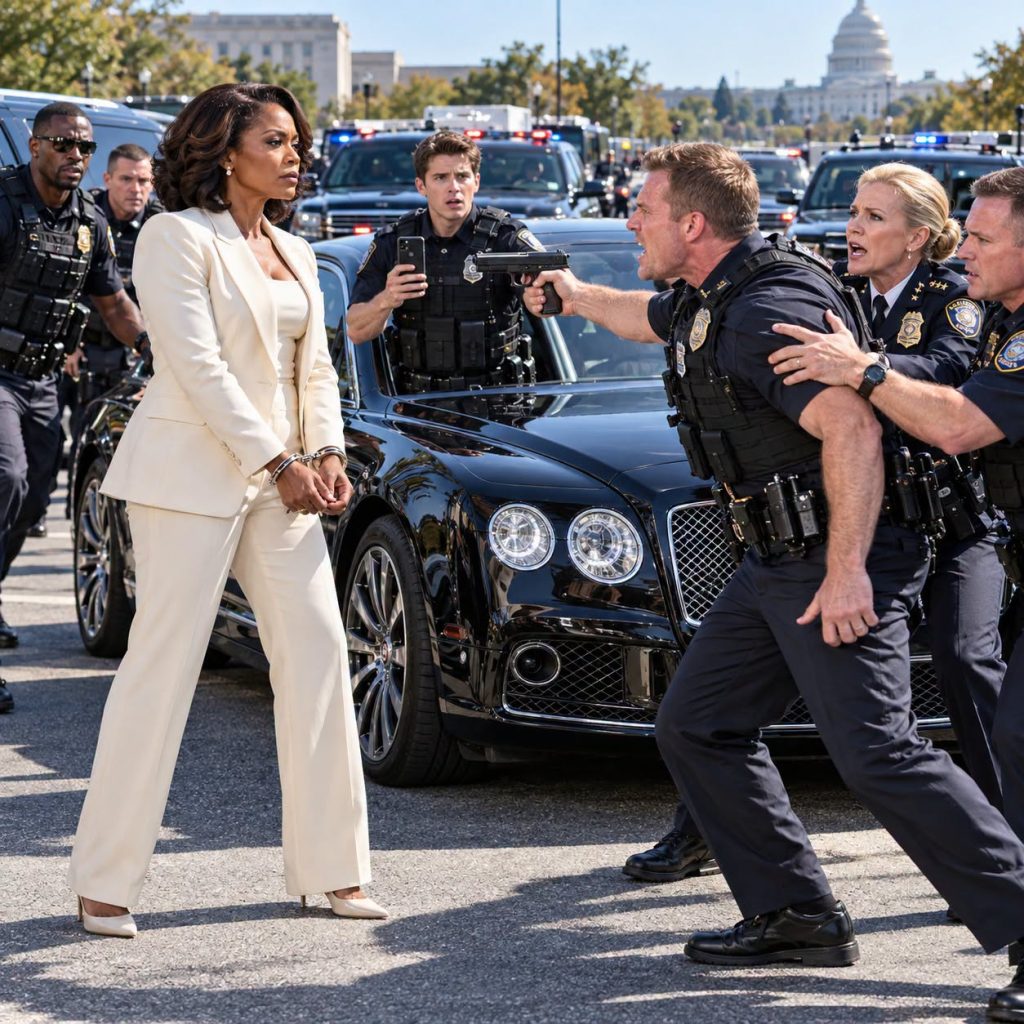
I slowly lowered the phone. Everyone was staring at Purcell, but the caller had said the person who ordered the stop was standing beside me. I looked at Chief Strickland. Her expression remained controlled—too controlled. “Chief,” I said, “who dispatched Officer Purcell to Harwell Boulevard?” “Routine patrol assignment.” “Then why did he have my plate and a restricted investigation number?” She stepped closer. “Deputy Director, I suggest we discuss this privately.” Derek shifted toward me. “Ma’am, look at the dispatch history.” Strickland snapped, “Officer Sims, hand me that tablet.” He didn’t move. She reached for his arm. I caught her wrist. “Don’t.” Her pleasant expression vanished. “You’re interfering with a local investigation.” “No, Chief. I’m protecting evidence in a federal one.” Derek turned the screen toward me. The dispatch order had been manually entered by Chief Ellen Strickland forty-three minutes before the stop. Beneath it was an encrypted payment reference matching a suspected laundering account in my investigation.
Strickland lunged for the tablet. Derek pulled it away, and she shoved him into the patrol car. Her hand went toward her holster. “Everybody back off!” she shouted. I raised both hands. “Ellen, federal agents are already monitoring this incident. There’s nowhere to go.” “You don’t understand!” she snapped. “Purcell was supposed to scare you, search the vehicle, and find the drive!” Everything clicked. The classified corruption evidence in my portfolio had been duplicated onto an encrypted storage device. Someone believed I carried the original. “You wanted my investigation files,” I said. Purcell, restrained by two officers, began shouting. “She told me the woman was a courier! She never said FBI!” Strickland whirled toward him. “Shut your mouth!” His expression changed. “You set me up.” “You volunteered,” she spat. “You always volunteered.” I stepped toward Derek. “Keep recording.” Strickland drew her gun. “Give me that tablet!” Before she could advance, the intersection erupted with flashing lights. Three black SUVs stopped behind the police cruisers. Federal agents emerged, weapons drawn. “FEDERAL AGENTS! DROP YOUR WEAPON!” Strickland hesitated, then lowered her pistol. Derek immediately moved away from her. Two agents secured her arms and placed her in handcuffs.
As they led her toward an SUV, Strickland looked back at me. “You have no idea how many people are involved.” “Then you’ll have plenty to tell prosecutors,” I replied. The subsequent investigation revealed the full operation. Strickland had been protecting a network that diverted seized property and manipulated evidence records. Purcell had spent seventeen years intimidating motorists, conducting unlawful searches, and filing misleading reports. His supervisors had repeatedly dismissed complaints. Strickland exploited that history because she knew he would aggressively stop me without asking questions. The intended plan was simple: seize my portfolio, remove the encrypted drive, and accuse me of carrying illegal material before I could expose the network. Purcell’s arrogance ruined it. When he discovered my credentials, he panicked. When Derek refused to cooperate, he escalated. The supposed federal extension that called me belonged to a compromised communications contractor acting for Strickland. Investigators traced the call through the device Purcell activated, which was linked to the contractor’s signaling system.
Months later, I sat inside a federal courtroom as the verdicts were delivered. Purcell was convicted of civil rights violations, obstruction, and offenses arising from falsified evidence. The judge imposed a sixteen-year federal sentence. Strickland received a separate lengthy sentence for conspiracy, obstruction, and corruption-related crimes. Additional officers and the contractor faced criminal charges. Neither defendant could erase the recordings, the dispatch records, or the evidence Derek had preserved. Outside the courthouse, Derek approached me in his dress uniform. “Ma’am, I thought my career was over.” I smiled. “You protected someone when it could have cost you everything. That’s what the badge is supposed to mean.” He shook my hand. I had already recommended him for a federal civil rights liaison program. “Thank you,” he said quietly. “Don’t thank me,” I answered. “Just remember why you became an officer.” As he walked away, I looked at the faint marks the handcuffs had left on my wrists. They reminded me of something I would never forget: justice cannot depend on who someone knows or what title they carry. It must protect the person nobody recognizes, too. That was the victory worth fighting for.
What do you think of this story? Please leave a like and share your thoughts in the comments. Your support means a lot to us and inspires us to keep writing more meaningful and powerful stories. Thank you! 👍❤️



