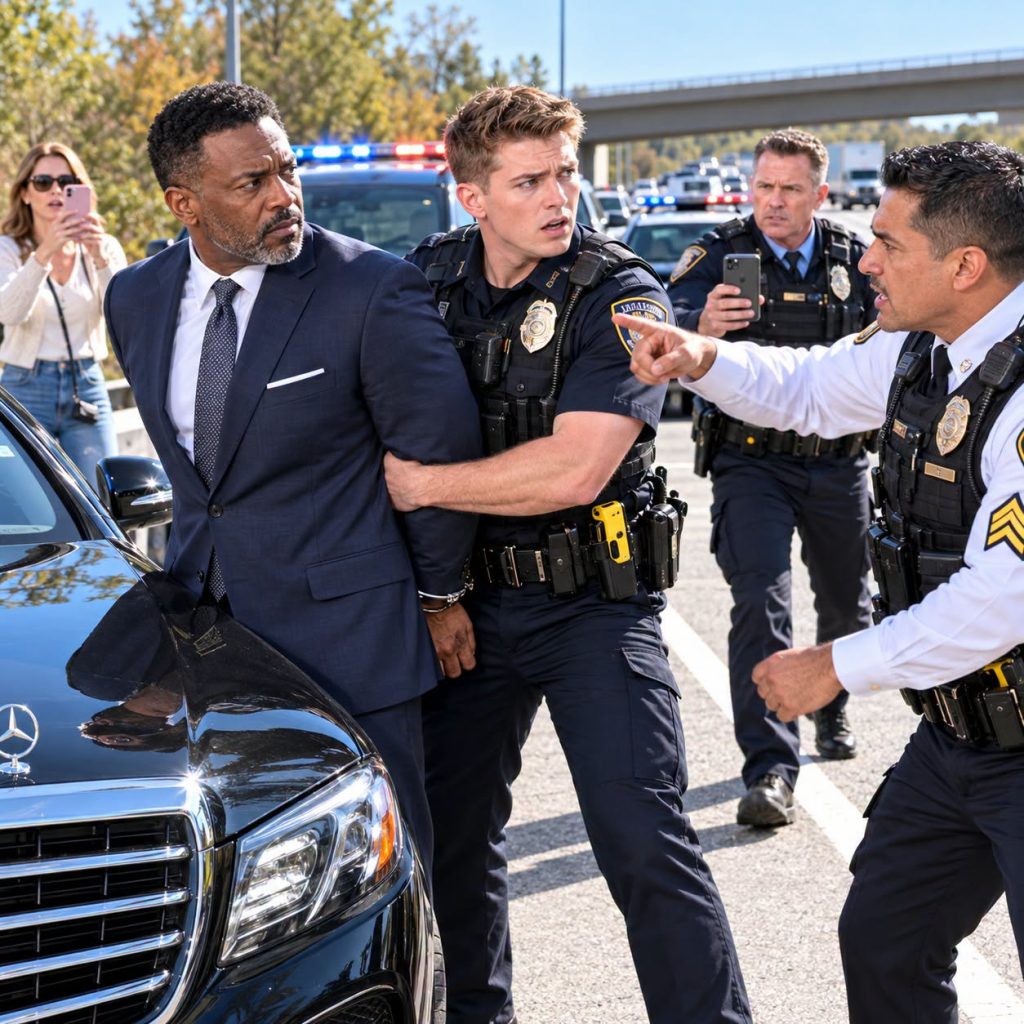
Four cruisers arrived. Officers stepped out behind open doors. “Hands visible!” someone yelled. Williams immediately raised both arms. “My body camera contains the entire stop! Sergeant Cole is detained! Request state police and Internal Affairs!” Cole shouted from the grass, “They assaulted me! Judge Chen stole evidence!” One of the arriving officers moved toward me. Rodriguez called out, “Do not touch that drive. Deputy Chief Harland is implicated in an active court matter.” The officer stopped. Nobody wanted to become the next name in the chain.
Then a black department SUV appeared. Deputy Chief Nathan Harland stepped out in full uniform, silver hair immaculate, expression controlled. “What a disaster,” he said. “Lieutenant, release Sergeant Cole and surrender the device.” I faced him. “You seem remarkably certain what device I have.” His eyes narrowed. “Judge Chen, this situation is beyond your jurisdiction.” “Actually, tampering with evidence connected to my courtroom is very much my concern.” “You’re emotionally compromised.” “And you’re standing beside a false detention bulletin containing my photograph.”
Harland advanced. Williams moved between us. “Sir, stop.” Harland stared at him. “Officer, you’ve already made one catastrophic mistake today. Don’t make another.” Williams swallowed. “My first mistake was assuming a man was guilty before verifying the facts. I’m not repeating it for you.”
For the first time, Harland lost control. He grabbed Williams by the vest and tried to pull him aside. Rodriguez stepped in. Harland shoved him. Two arriving officers immediately moved forward, but Williams held up a hand. “Don’t escalate!” Harland reached toward my hand. I stepped back and said loudly, “This entire interaction is being recorded.” His arm stopped in midair.
That ended it.
Not because he suddenly developed a conscience, but because he realized there were too many cameras, too many witnesses, and no longer any way to control the story.
Virginia State Police arrived eleven minutes later with Internal Affairs investigators and an assistant Commonwealth’s attorney. Aaron Bell, the evidence technician who had sent me the drive, was found safe at his sister’s home after going into hiding. The flash drive contained original body-camera recordings, audit logs showing deleted files, and internal messages connecting Cole and Harland to a two-year scheme in which damaging police footage had been altered or removed before court hearings. The false stolen-car stop had not originally been Williams’s plan. Harland’s team had inserted my vehicle into an internal watch system, expecting any patrol officer who spotted me to create enough delay for Cole to intercept my briefcase. Williams’s assumptions had made their plan easier.
That distinction mattered.
Months later, Harland and Cole faced criminal charges and were removed from the department. Several affected cases were reopened. Williams received discipline for the way he handled my stop, but the investigation concluded he had not known about the conspiracy. He did something afterward that surprised me: he requested permission to sit in my courtroom.
He came every Thursday for six weeks.
One afternoon, after watching a frightened nineteen-year-old defendant explain how one bad decision had followed another, Williams approached my bench after everyone left.
“I kept thinking about that morning,” he said. “I saw your car before I saw you. Then I saw you before I heard you.”
I closed the file in front of me. “And now?”
“Now I try to hear people before I decide who they are.”
That became the beginning of something neither of us expected. Rodriguez, Williams, and I helped develop a voluntary courtroom-observation program for new recruits. Officers sat through hearings, watched defendants, victims, families, prosecutors, and defense attorneys, then discussed how context could change what appeared obvious in the first thirty seconds.
A year after the stop, Williams stood beside me during the first academy session. He told forty recruits, “Authority makes it easier to act quickly. Character is knowing when to slow down.”
I looked at the young officers listening to him and thought about that steel cuff closing around my wrist.
I never forgot it.
Neither did Kyle Williams.
But the most important thing was that he refused to let the worst decision of his career become the final definition of who he was. And I refused to let anger become the only lesson either of us carried away.
Sometimes justice means punishment.
Sometimes it means exposing the truth.
And sometimes it begins when two people who met at the worst possible moment decide to build something better from what happened.
What do you think of this story? Please leave a like and share your thoughts in the comments. Your support means a lot to us and inspires us to keep writing more meaningful and powerful stories. Thank you! 👍❤️



