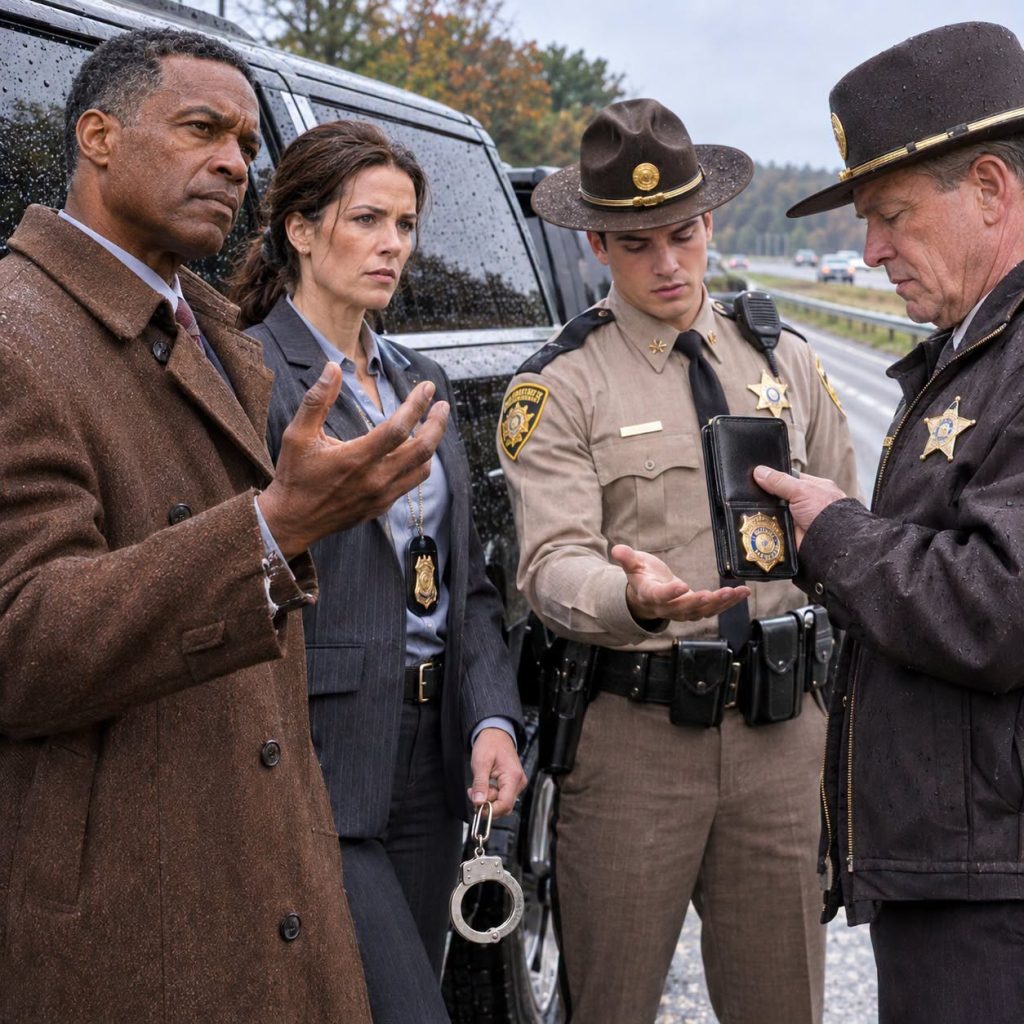
Jenkins’s thumb stopped just short of the camera. Miller held down the button on his radio. “Let that sedan through. Now.” The county cruiser backed up, and the gray car came toward us with its hazards flashing. My investigators got out before the brake lights went dark. One went straight to my Tahoe to secure the recording. The other stood beside me and asked who had the cuff key. Jenkins handed it over without a word. When the cuffs came off, I had to open and close my hands twice before I could feel my fingertips.
Miller asked Jenkins whether I’d been speeding. “Yes, sir.” Then he asked what I’d done after the stop to justify the cuffs. Jenkins stared down at the torn lining of my coat. He could have said he’d been scared. I’d seen his face in the mirror. I would have believed that much. “He asked why I pulled him over,” he said. Miller took Jenkins’s badge and duty weapon, told him he was relieved of duty, and directed him to wait in the cruiser. Jenkins looked at Hollister before he went. Hollister had picked up both coffees. He stood holding one in each hand, looking for somewhere to put them.
Miller gave his first statement before dawn. I’d notified him that afternoon that Internal Affairs would be working in Mercer County. He’d asked for our plate so his deputies could recognize the vehicle if we needed help. I’d given it to him. He passed it along to Hollister with instructions to call if he saw us, so the sheriff could get ahead of whatever we found. Hollister admitted in a later interview that he’d sent a deputy to hold the follow car and told Jenkins to stop the Tahoe. He thought he could find out how much we knew before I got to the station. He said he went for coffee so Jenkins would be the only officer visible at the start of the encounter. By the time he heard about my credentials, he was worried about what Jenkins had already said on camera.
The recordings mattered in ways I couldn’t have predicted. My dashboard microphone caught me asking why I’d been stopped. The cabin camera showed both hands on the wheel while Jenkins warned me about reaching into my jacket. His body camera caught the order to step out, the cuffs going on, and Hollister telling him to leave them there. Jenkins was arrested after federal prosecutors reviewed the evidence. At trial, I testified that I’d been speeding. Then I sat beside Luis Vega in the gallery while the jury watched the next eleven minutes. They convicted Jenkins of felony deprivation of civil rights. The judge sentenced him to twenty-four months in federal prison.
A federal consent decree put the county under independent oversight. Missing footage and disputed searches now had to be accounted for outside the sheriff’s office. Miller resigned. Hollister took early retirement. I turned over the email in which I’d given Miller the plate number and answered every question about it. Afterward, I went to see Luis at the garage where he worked. He was eating lunch at a workbench, his paper cup balanced between two sockets. I told him an independent reviewer would contact him about his complaint. He wiped his fingers on a rag and asked, “Do I have to go back to that station?” I told him he could give his statement wherever he felt comfortable. He looked around the garage. “Here, then,” he said. “My daughter can sit with me.”
She came in her grocery store uniform and dragged a second chair up to the workbench. I was there to introduce them to the reviewer. As I turned to leave, Luis asked me to stay until he got started. He picked up his cup with one hand. “I was driving home,” he said. His daughter put her phone facedown on the bench and turned her chair toward him. “I remember where I put my hands.” The reviewer waited while he set down the cup and held both hands out in front of him, exactly as he’d held them that night.
What do you think of this story? Please leave a like and share your thoughts in the comments. Your support means a lot to us and inspires us to keep writing more meaningful and powerful stories. Thank you! 👍❤️



