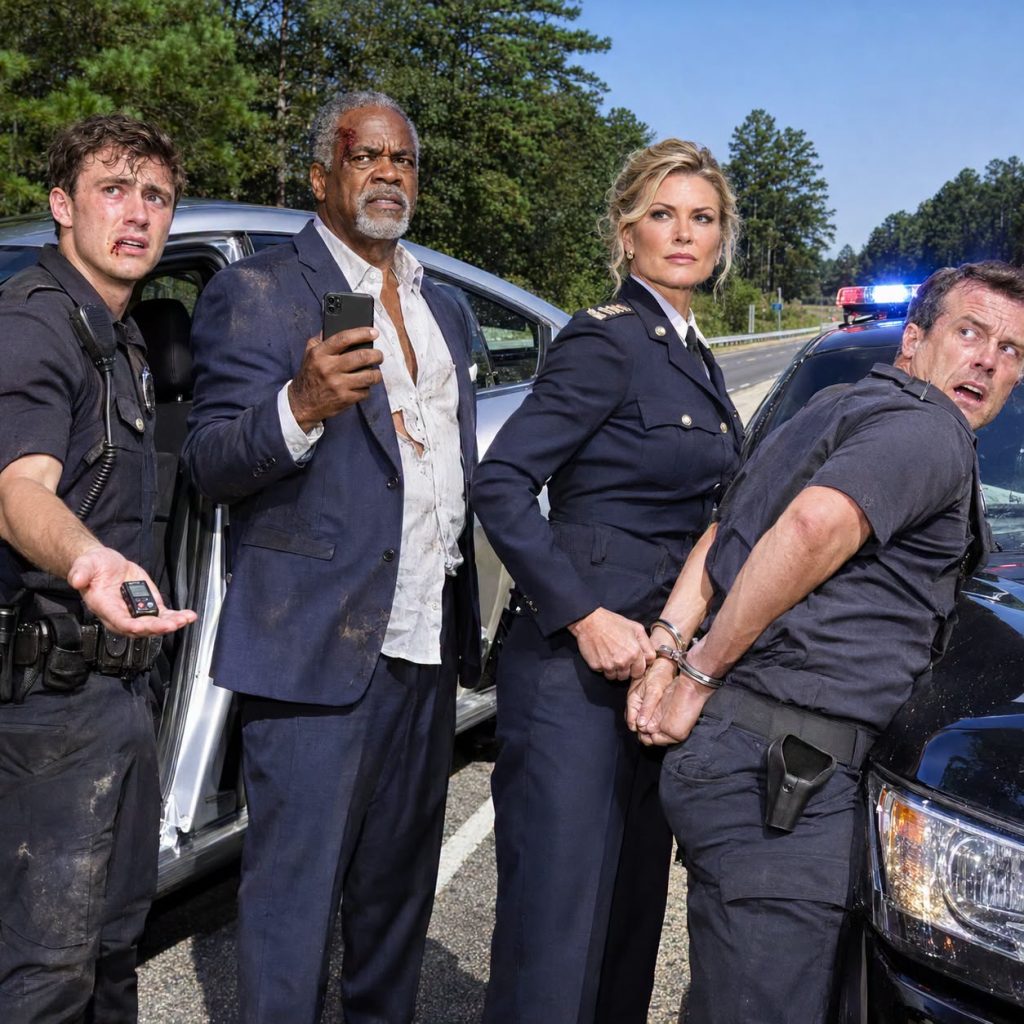
Hours later, Bennett brought news. State investigators had located Voss at his sister’s house. In the yard’s locked office, they had found Caleb’s phone and records of cash payments. A contractor listed in those records led them to an abandoned hunting cabin. Caleb was alive. Dehydrated, injured, frightened—but alive. Reed covered his mouth. The sound that escaped him was something I will never forget.
The full story came slowly, through interviews and records, rather than one convenient confession. Caleb had photographed Holt taking money from a tow operator after an unlawful vehicle seizure. His complaint threatened a business built around fabricated violations, impounded cars, and payments that never reached county accounts. Voss buried complaints and warned the officers involved. When Caleb kept asking questions, the contractor detained him.
Reed had copied records after his brother disappeared. He mailed them to the courthouse because he feared a local report would reach Voss. A clerk’s routine request to preserve related police records alerted the captain that the material had reached federal authorities. Voss then used an internal records search to identify my car. The broken taillight was an excuse. The maintenance yard was where they intended to take my phone and intimidate me into revealing who had sent the package.
I recused myself from every matter connected to the investigation. An out-of-state judge handled the criminal case. Months passed. My bruises faded faster than my reaction to flashing lights. Sometimes my wife found me sitting in the driveway after work, unable to make myself open the car door. She never said, “But you’re safe now.” She simply sat beside me until I could move.
At trial, Holt’s attorney asked whether announcing my title had escalated the encounter. “Did you expect special treatment?” he asked. I looked toward the jury. “I expected him to verify my identity. I would have deserved the same restraint if I had been coming home from a warehouse.” The prosecutor played Reed’s recording. The courtroom heard my collar tear. Then it heard the shot.
Holt testified that he had feared for his life. Under questioning, he admitted my hands had been visible. He admitted he had read my credential. Finally, confronted with messages recovered from his phone, he admitted Voss had told him to recover the package. “I didn’t know about the brother,” he said. From the gallery, Caleb answered under his breath, “You knew about me when you took my car.”
The jury convicted Holt of the charged civil-rights offenses and obstruction. Voss was convicted in a separate proceeding, along with the contractor. At Holt’s sentencing, I did not ask for the longest possible punishment. I asked the court to consider everyone whose complaint had vanished. The judge imposed ten years. Holt turned once toward the gallery. This time, nobody looked away.
Reed was not magically rewarded. Investigators examined his delay in reporting what he knew and his conduct during the stop. He cooperated, accepted discipline, and testified without immunity. Months later, he met me outside the courthouse with Caleb. “You were right,” he said. “I waited too long.” “Then keep remembering that,” I told him. “Especially when remembering costs you something.”
Caleb offered his hand. His wrist still carried a pale scar. “Thank you for making that call.” I shook it. “Your brother made the harder choice.” Reed shook his head. “After you made me.” Across the street, a patrol car slowed for a pedestrian. We all watched it pass. Then Caleb put an arm around his brother, and the three of us walked down the courthouse steps together.
What do you think of this story? Please leave a like and share your thoughts in the comments. Your support means a lot to us and inspires us to keep writing more meaningful and powerful stories. Thank you! 👍❤️



