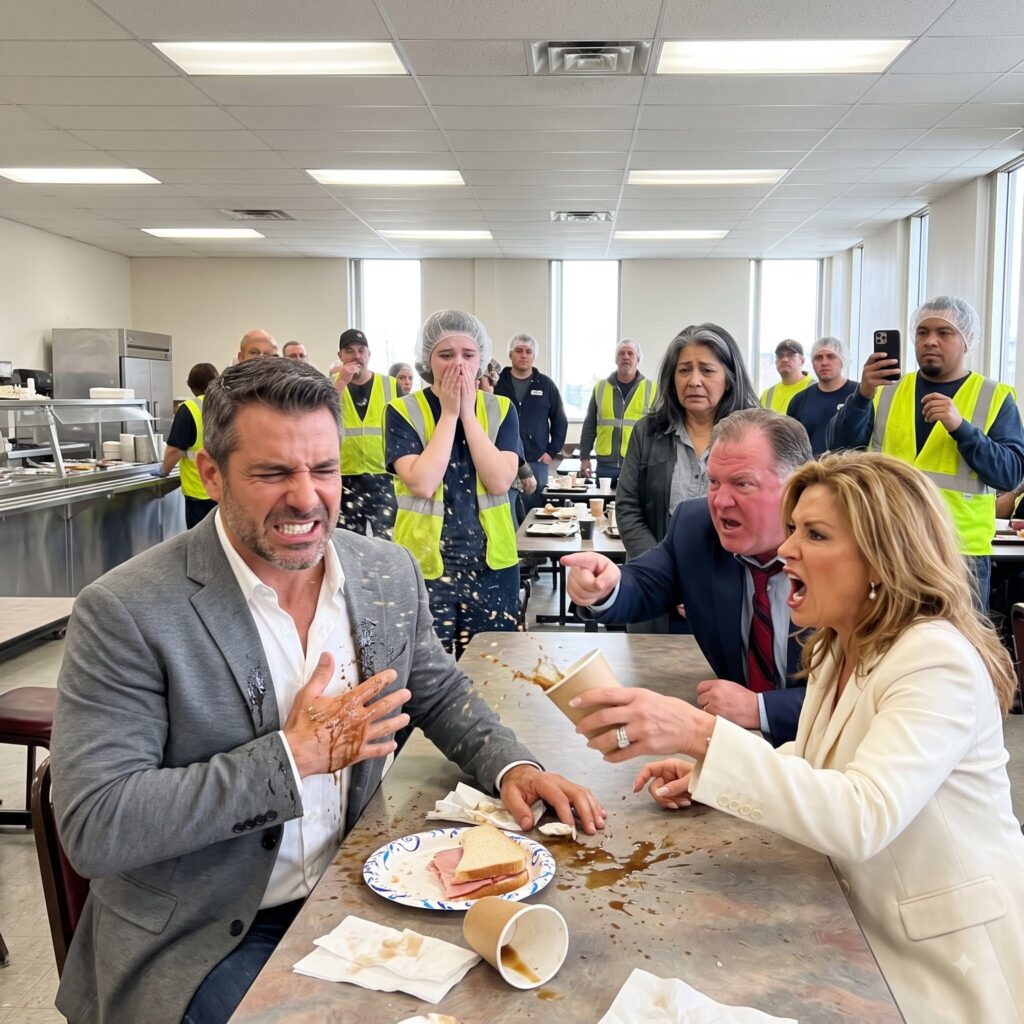
Walter turned another page. “There’s more. Gordon, our audit also found that you filed an internal report two years ago, accusing a maintenance supervisor of falsifying safety logs.”
My stomach tightened. I knew that name.
“That supervisor,” Walter said, “was fired for it. His name was Frank Brooks.”
In the third row, Tyler Brooks slowly rose to his feet, hands shaking.
“That’s my dad,” he said.
Nobody breathed.
Tyler stood in his work boots, jaw trembling, holding a half-eaten sandwich he’d forgotten about. “My dad worked here nineteen years,” he said. “Nineteen. Then one day, he’s gone, and the story is he faked safety logs. He never talked about it. He just stopped being the same man.”
Gordon opened his mouth, but I raised my bandaged hand and he closed it.
“Mr. Brooks,” I said, “I’d like you to hear the truth from someone who’ll say it plainly.”
I nodded at Walter, who handed me a single sheet. It was the proof I’d been quietly waiting two days to confirm.
“Frank Brooks didn’t falsify anything,” I said. “Two years ago, he noticed the same safety valve problem you told me about, Tyler. He documented it and sent it up the chain. Gordon was the one who received it. Fixing the valve meant opening the books on the Operations budget. So Gordon buried the report, and when Frank wouldn’t let it go, Gordon turned it around and accused Frank of forging the very logs he’d flagged.”
Tyler’s face went slack. “He knew the valve was bad.”
“He knew,” I said. “And he let your father take the fall.”
The room erupted. Rosa Delgado, who’d lost her overtime, stood up and said something in Spanish that I won’t repeat, followed by something in English that was barely politer. People rose from tables. Someone near the back started clapping, and it spread, slow and heavy, not applause exactly, but something closer to release.
Patricia Lawson sank into a chair. “Gordon,” she said, her voice hollow, “I put his name on my own company, and you let me. I came here today to sit at a table I thought we’d earned.”
Gordon didn’t answer. For the first time in his career, he had nothing to say.
Two men in dark jackets walked in from the hallway. Special Agent Ramirez of the FBI’s Cleveland field office introduced himself, calm and formal. “Mr. Lawson, we need you to come with us. You’re being arrested on charges of wire fraud, embezzlement, and obstruction. Mrs. Lawson, we’ll need to speak with you as well.”
Patricia flinched. “Am I being arrested?”
“Not at this time, ma’am. But your cooperation will matter.”
As they led Gordon away, he finally found his voice. He turned to me. “You set this up.”
“No,” I said. “You did. I just ate lunch.”
The cafeteria stayed quiet long after the doors closed. Then I did what I’d been planning to do since I’d discovered the fraud. I stood on a chair, my hand throbbing, and spoke to three hundred people.
“I’m Daniel Reyes. I’ve been your CEO for eleven days. I’m sorry I waited this long to introduce myself, but I needed to see how this place treated people when it thought nobody important was watching.”
I let that sink in.
“What I saw today wasn’t new. It’s been happening here for years. People kept quiet because they were afraid. That ends now. Every cut overtime hour will be restored and paid back. Every safety request that was ignored will be reviewed this week. And Frank Brooks will get a public apology and full reinstatement, if he’ll have us.”
Tyler wiped his eyes with the back of his hand.
The next three weeks were hard. The company’s lawyers spent days untangling Gordon’s trail. The $1.9 million recovery would take months, but the board froze the Lawsons’ assets, and Patricia signed a full cooperation agreement. She testified that she’d never read the paperwork, that she’d trusted her husband. The prosecutors believed her, mostly. She lost the house, the country club membership, and most of her friends.
On a gray Tuesday in November, she asked to see me.
She sat across my desk in a plain sweater, no diamonds, no pearls. “I don’t expect forgiveness,” she said. “I burned your hand because I thought it was acceptable to treat a stranger that way. I need you to know that it wasn’t the first time I’d been cruel to someone I thought was beneath me. It was just the first time I was caught.”
I looked at my hand. The blister had healed into a pale scar across the base of my thumb.
“The scar’s the least of what you owe,” I said. “But if you want to start, Rosa Delgado’s been running the evening shift on two hours of unpaid overtime for two years. Go apologize to her. Mean it.”



