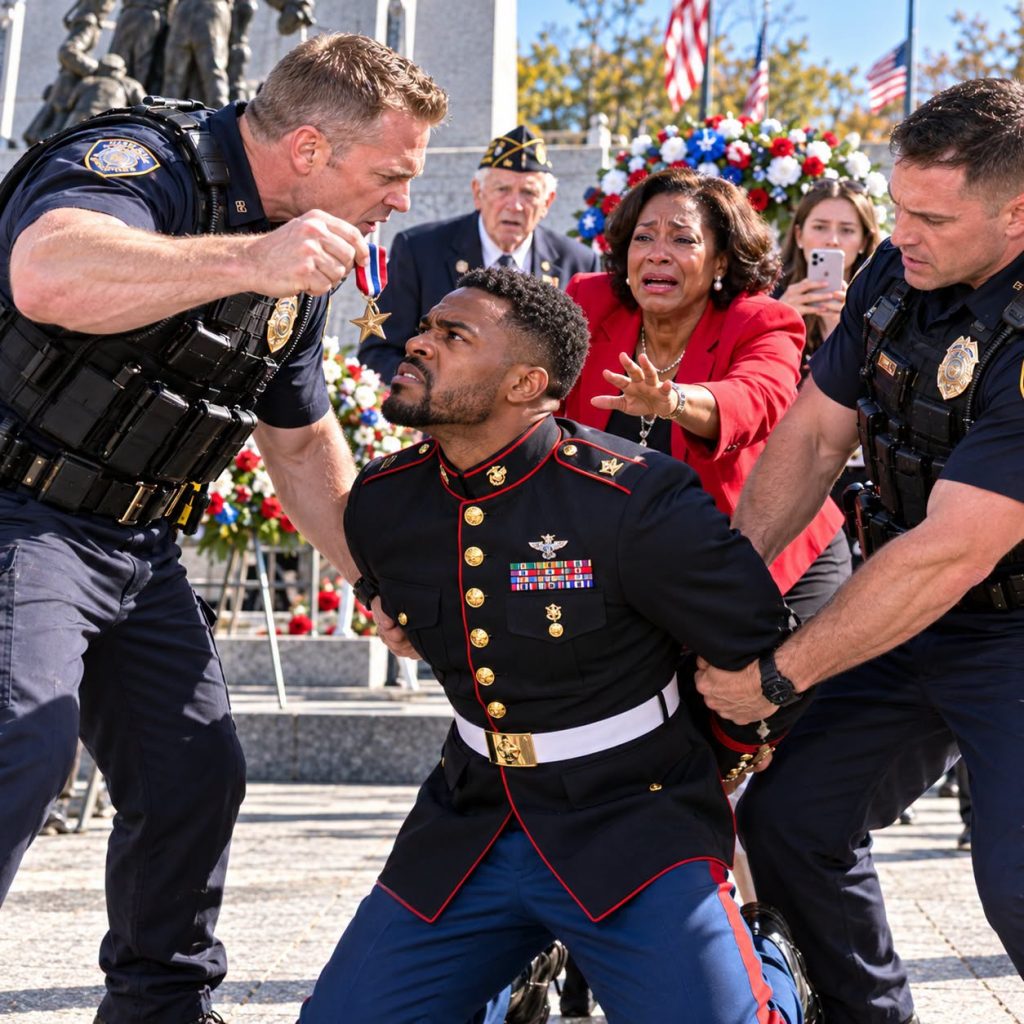
Morrison ordered Dawson and Brennan to surrender their badges and duty weapons pending investigation. Dawson exploded. “You’re taking their side because some general showed up?” Morrison stepped closer. “I’m taking action because I just watched you try to interfere with evidence, and I’ve heard multiple witnesses describe an unjustified detention.” Dawson pointed at me. “He was supposed to be investigated!” Beckett’s eyes narrowed. “Supposed to be?” Dawson realized his mistake. Brennan looked sick. “Craig, stop talking.” But the damage was done.
The woman who had filmed everything approached Sheriff Morrison. “I have another recording,” she said. “Before the ceremony, that officer met the man in the gray coat.” She played the video. On the screen, Keene handed Dawson a folded envelope beside a parked patrol car. Dawson looked around before slipping it into his jacket. Morrison watched without speaking. Then he turned to his deputies. “Preserve that video. Separate the officers. Nobody deletes anything.” Dawson’s confidence collapsed. “It’s not what it looks like.” I stepped forward. “Then tell us what it is.” He couldn’t.
Keene was identified through his vehicle registration and located later that afternoon. Investigators subsequently uncovered communications linking him to Dawson, along with evidence that Keene had paid Dawson to intimidate me before I could testify about the missing veterans’ funds. Brennan had known the accusation was questionable but claimed he hadn’t known about the payment. Neither explanation excused what happened. The recordings showed both officers ignoring my identification, mishandling my detention, and mistreating my mother. When federal investigators became involved, the case grew far beyond a confrontation at a memorial.
The following months were exhausting. I testified. My mother testified. Veterans who had lost promised assistance came forward. Prosecutors presented financial records, messages, and witness testimony connecting Keene’s retaliation scheme to Dawson’s actions. Dawson and Brennan were eventually convicted on federal civil-rights charges. Dawson received eighteen months in federal prison; Brennan received a shorter sentence. Both lost their law-enforcement careers. Keene faced separate fraud and obstruction charges. A civil case against the county ended in a $2.4 million settlement.
But the moment I remember most didn’t happen in court. It happened when General Beckett visited my mother after the settlement. He placed a small velvet box on her kitchen table. Inside was my Bronze Star, professionally restored. “Your father would have wanted you to have this back,” he told me. I stared at him. “Sir, you knew my father?” Beckett smiled sadly. “Your father saved my life during an operation overseas, long before you became a Marine. I promised him I’d always look after his family.” My mother began crying. For thirty years, she’d kept that promise secret.
I used the settlement to establish the Vance Veterans Legal Defense Fund, providing legal assistance to veterans facing discrimination and wrongful accusations. At our first public event, my mother stood beside me as I pinned the restored medal to my chest. I looked at the audience and said, “They tried to make me ashamed of the uniform I earned. Instead, they reminded me why service matters. Honor isn’t something a badge can give you, and it isn’t something cruelty can take away.”
Then I handed my mother the microphone. She smiled through tears. “My son didn’t need a general to prove who he was,” she said. “He needed people willing to see the truth.” The room rose in applause. And for the first time since that Veterans Day morning, I finally felt at peace.
What do you think of this story? Please leave a like and share your thoughts in the comments. Your support means a lot to us and inspires us to keep writing more meaningful and powerful stories. Thank you! 👍❤️



