And according to the documents Rachel obtained, someone had spent nearly a year trying to position my father as my legal financial controller before the merger payout became available.
The conservatorship petition was not about protecting me.
It was their final step.
Keene looked sick.
Then Judge Whitcomb turned to him.
“Mr. Keene, did you prepare these supporting declarations?”
“Yes, Your Honor, based on information provided by my clients.”
“Did your clients provide you with the medical evaluation attached to their petition?”
Keene hesitated.
That was when Rachel stood.
“We have reason to believe the evaluation is fabricated.”
My mother made a sound like she had been punched.
The document claimed a psychiatrist had diagnosed me with impaired judgment after examining me twice.
I had never met the doctor.
Judge Whitcomb ordered the clerk to contact the physician’s office immediately.
Five minutes later, the clerk returned and whispered into her ear.
The judge’s expression hardened.
“The physician whose name appears on this evaluation died fourteen months ago.”
Nobody spoke.
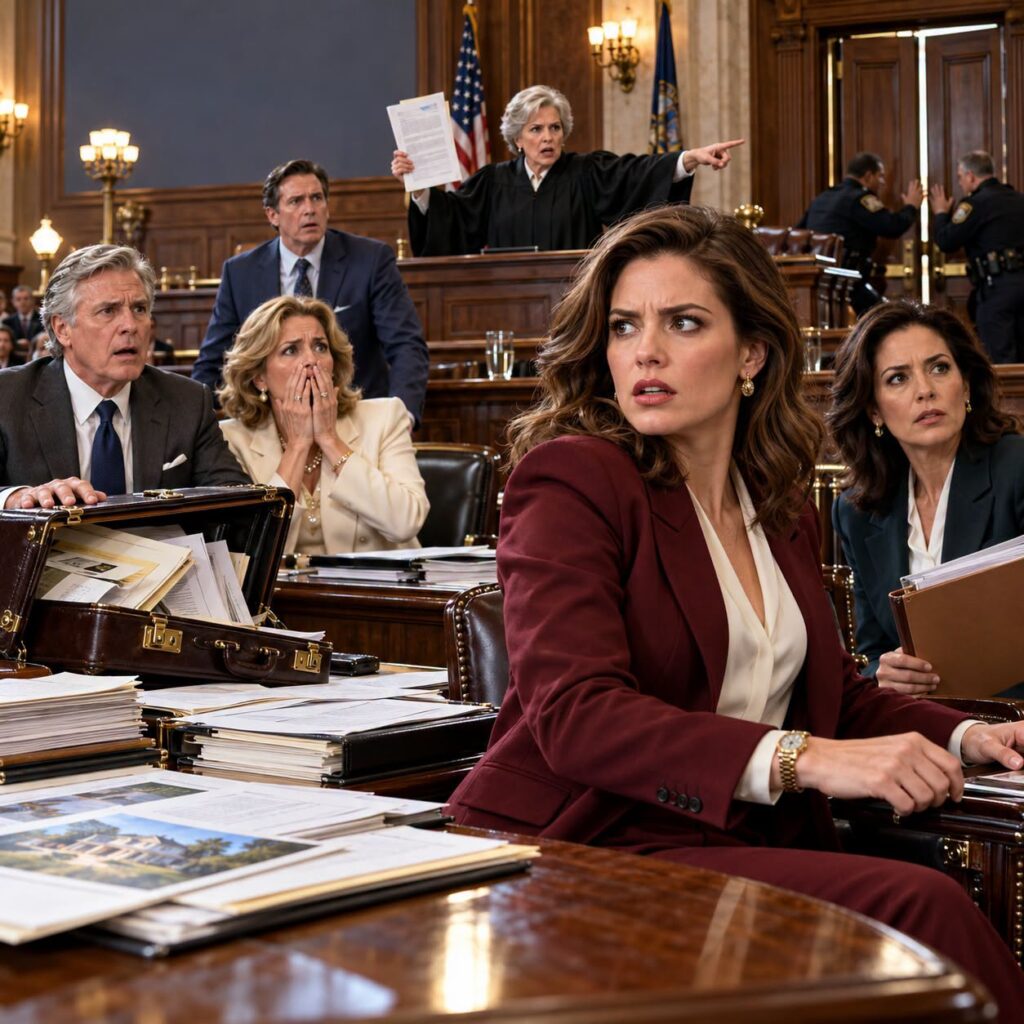
My father suddenly grabbed his briefcase.
The bailiff stepped forward.
But before security reached him, the case fell open.
A stack of papers spilled across the floor.
Rachel stared at the top page.
Then she looked at me.
“Emily,” she said quietly, “that’s not your grandmother’s signature either.”
And this time, the document was a deed.
The deed transferred my grandmother’s lake house to a company I had never heard of.
Judge Whitcomb ordered the bailiff to collect every paper that had fallen from my father’s briefcase.
My father insisted the documents were privileged.
Keene backed away from him.
“They are not my files,” he said.
That sentence ended whatever loyalty remained between them.
Rachel asked to inspect the deed. The judge allowed it under the clerk’s supervision.
The company named on it was Carter Family Holdings LLC.
Its members were my parents.
The deed had supposedly been signed six weeks before my grandmother died.
There was one problem.
My grandmother had been hospitalized that week after a stroke and could barely move her right hand.
Rachel already had her medical records.
The signature on the deed was smooth and confident.
The notary created an even bigger problem.
He told investigators that afternoon he had never met my grandmother and had never notarized the document.
By sunset, the hearing had turned into a criminal referral.
Judge Whitcomb denied the conservatorship petition with prejudice, froze disputed transfers connected to my parents, and ordered the evidence sent to the county prosecutor and state financial-crimes unit.
The police did not handcuff my parents in the courtroom.
But they escorted them into separate interview rooms.
Keene remained behind to explain how a dead doctor’s name had appeared on a filing carrying his signature.
Rachel and I left through a side hallway.
I should have felt triumphant.
Instead, I felt hollow.
My own parents had tried to convince a court I was incompetent so they could gain access to money they had already been stealing.
Two months later, investigators confirmed the scheme.
My father had used forged authorization forms to access one investment account.
My mother had supplied personal information and copies of my identification.
Together, they had attempted to borrow against my condo and transfer my grandmother’s lake house into their company.
The fake psychiatric evaluation came from an old template found on my father’s laptop.
Keene was not charged with participating in the theft, but the state bar investigated whether he had ignored obvious red flags.
My parents eventually pleaded guilty to multiple felony counts involving forgery, attempted theft, and identity fraud.
Under the restitution agreement, the lake house returned to my grandmother’s estate, the fraudulent credit line was canceled, and every dollar traced to the unauthorized account was restored.
I kept the condo.
I kept my car.
I kept control of every account.
Most importantly, I kept my name.
For months, that mattered more than the $8.2 million.
My grandmother had not left me wealth because she thought money would make me happy.
She left it because she trusted my judgment.
On the day the criminal case ended, Rachel gave me a sealed letter found in my grandmother’s safe-deposit box.
It contained one sentence:
“Emily, never let anyone confuse love with control.”
I read it twice in the courthouse hallway.
Then I folded it and put it in my purse.
My parents had entered court believing they could take my independence by calling me irresponsible.
Instead, they exposed themselves.
And for the first time in my life, I walked away without asking their permission.



