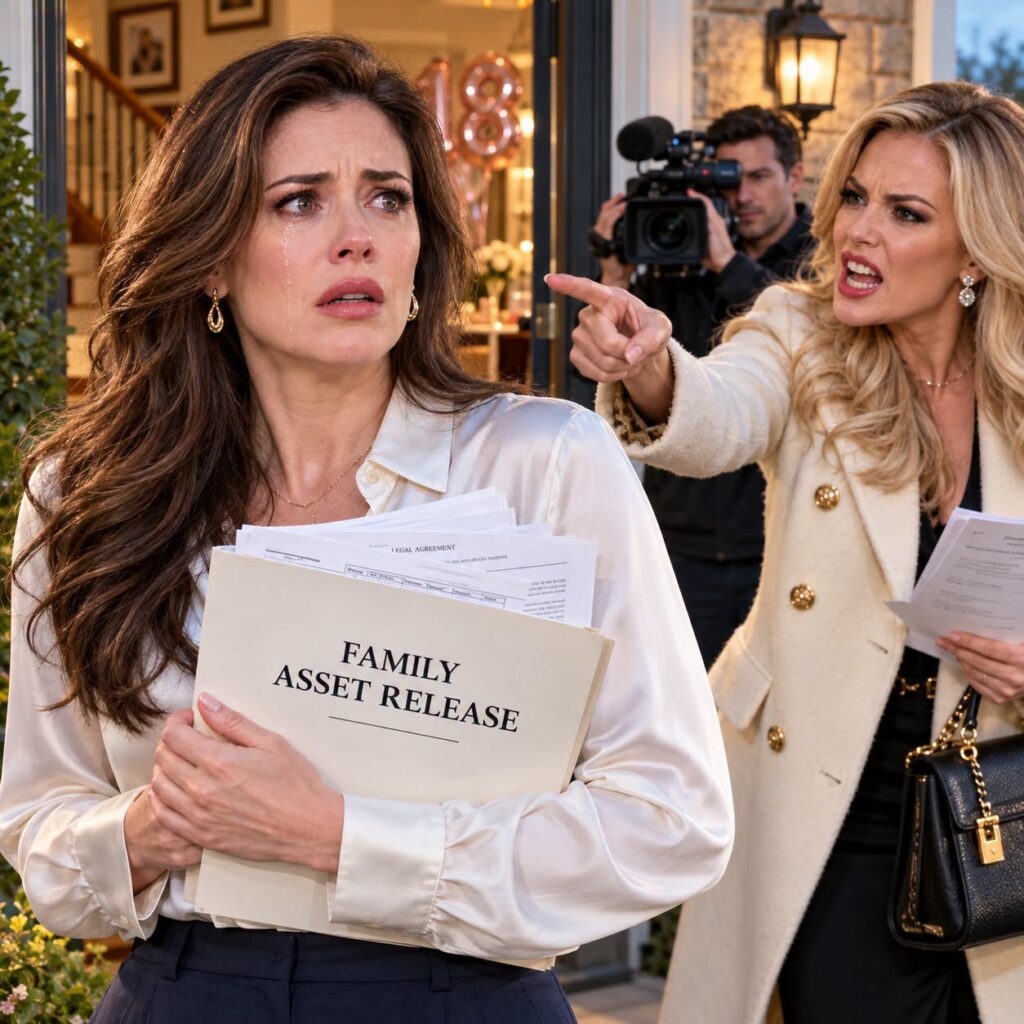
I drove to Denise’s office. She had already requested preservation of the transaction file, emailed the lender, and arranged for me to make a police report. On her desk lay an astonishing discovery.
A copy of my driver’s license had been submitted with the forged authorization.
Not my current license.
The one I’d misplaced at Dad’s house last Christmas.
“Somebody planned this,” I said.
Denise nodded. “For months.”
Then the real twist arrived.
Claire hadn’t found an outside buyer. The purchasing company was also controlled by her—through her boyfriend, Grant. They planned to transfer the house at a low stated price using the forged authorization, then resell it to an actual investor who had offered nearly $600,000.
They wanted the equity I’d spent seven years protecting.
And they’d promised Dad enough money to cover Claire’s debts.
I felt sick. Not just because of the theft.
Because Dad had looked me in the eyes while Mom’s photographs soaked in the rain, knowing what he had helped arrange.
My phone lit up with a message from an unknown number.
It was a photograph of a handwritten ledger. Beside several payments, Claire had written my name.
The next message said:
“Your sister has already been taking money from your father’s accounts. Ask him what happened to the $74,000.”
I checked the number again.
Then a third message arrived.
“I was the notary’s assistant. I have the recording. But Claire knows I kept it.”
I called the number immediately.
A woman named Rachel answered from her car. She sounded terrified. She’d worked for the notary, who operated a small office outside Columbus. Claire had brought my father there with an old copy of my license and a document already bearing my forged signature.
Rachel said she’d objected. The notary ignored her.
Then Claire handed him an envelope.
“I saved the lobby camera footage before I quit,” Rachel whispered. “It shows everything.”
“Don’t send it only to me,” I said. “Give it to the detective, too.”
By afternoon, Denise had connected Rachel with the investigator handling my report. The notary’s office received a preservation request. The title company held its file. No forged document had transferred ownership, and no sale proceeds had been released.
But there was still Dad.
I met him two days later at Denise’s office, where he couldn’t shout me out of the room.
He looked smaller than the man I’d grown up fearing.
“Claire said you were going to throw me out,” he murmured.
“You threw me out first.”
He stared at the table.
Then he admitted he’d given Claire access to his bank accounts. She’d drained $74,000 in savings and borrowed money from relatives, telling everyone I had stopped helping him. The threatened deadline wasn’t the house. It was a creditor demanding repayment on one of her loans.
He’d agreed to the forged paperwork because she promised the sale would solve it.
“You knew I hadn’t signed it,” I said.
“Yes.”
That one word finished something inside me.
The investigation took months. Bank records traced the diverted money. Rachel’s preserved footage supported her account, and the notary’s journal contained entries inconsistent with the video. Prosecutors filed fraud and forgery charges against Claire and the notary. Grant cooperated after investigators confronted him with the transaction records.
My father, who had signed his own false certification, accepted a plea agreement involving probation, community service, and testimony. Claire ultimately pleaded guilty. She received a custodial sentence, followed by supervised release and a restitution order. Dad recovered none of the money she’d already spent; the judgment didn’t magically refill his account.
I also didn’t change his locks that afternoon.
I followed the law. Through Denise, I gave proper notice ending his month-to-month tenancy. When the required period passed, Dad moved into a modest apartment near his brother. He took the furniture I’d offered and left Mom’s cedar chest behind.
I repaired its cracked lid myself.
One Sunday, months later, I carried the restored chest into the quiet living room. Rain tapped the windows. For the first time in years, nobody was waiting for me to pay a bill, swallow an insult, or rescue them from a choice they’d made.
Inside the chest, beneath Mom’s photographs, I found a birthday card in her handwriting.
“You don’t have to earn your place in this family,” she’d written. “You were born with it.”
I cried until the afternoon light faded.
Then I changed the deadbolt—on a house that was finally allowed to feel like mine.
They thought changing a lock could erase me, but all it did was teach me which doors I deserved to close.



