She’d changed her last name since then, but not her smile.
“Hello, Carol,” Sharon said softly. “It’s been a long time. I hear you’ve been getting forgetful.”
She looked past me into my house, toward my bedroom and my ensuite.
“Don’t worry. I’ll take very good care of you.”
I’d spent thirty-one years as an ICU nurse. I had faced down surgeons, drunk patients, and grieving families at three in the morning. I wasn’t going to fall apart on my own front porch.
“Matt,” I said calmly, “there’s one more thing at the bottom of that box.”
He pulled out a thick manila envelope. Inside were three documents.
The first was a six-page cognitive evaluation from a geriatric psychiatrist at UT Medical Center, done two weeks earlier. It covered memory, reasoning, and judgment, and every result was in the normal range. The last line read: No evidence of cognitive impairment.
The second was a new durable power of attorney and healthcare directive, signed and notarized, naming my younger sister Ellen and my attorney. Matt’s name was nowhere on it.
The third was a copy of my attorney’s response to their conservatorship petition, already filed with the court.
“You filed Monday,” I told Brittany. “We filed Tuesday.”
Right on cue, a silver Lexus pulled up to the curb. My attorney, Denise Washington, stepped out in a navy suit, holding a briefcase.
“Good morning,” she said pleasantly. “I believe this gentleman’s truck is blocking my client’s driveway.”
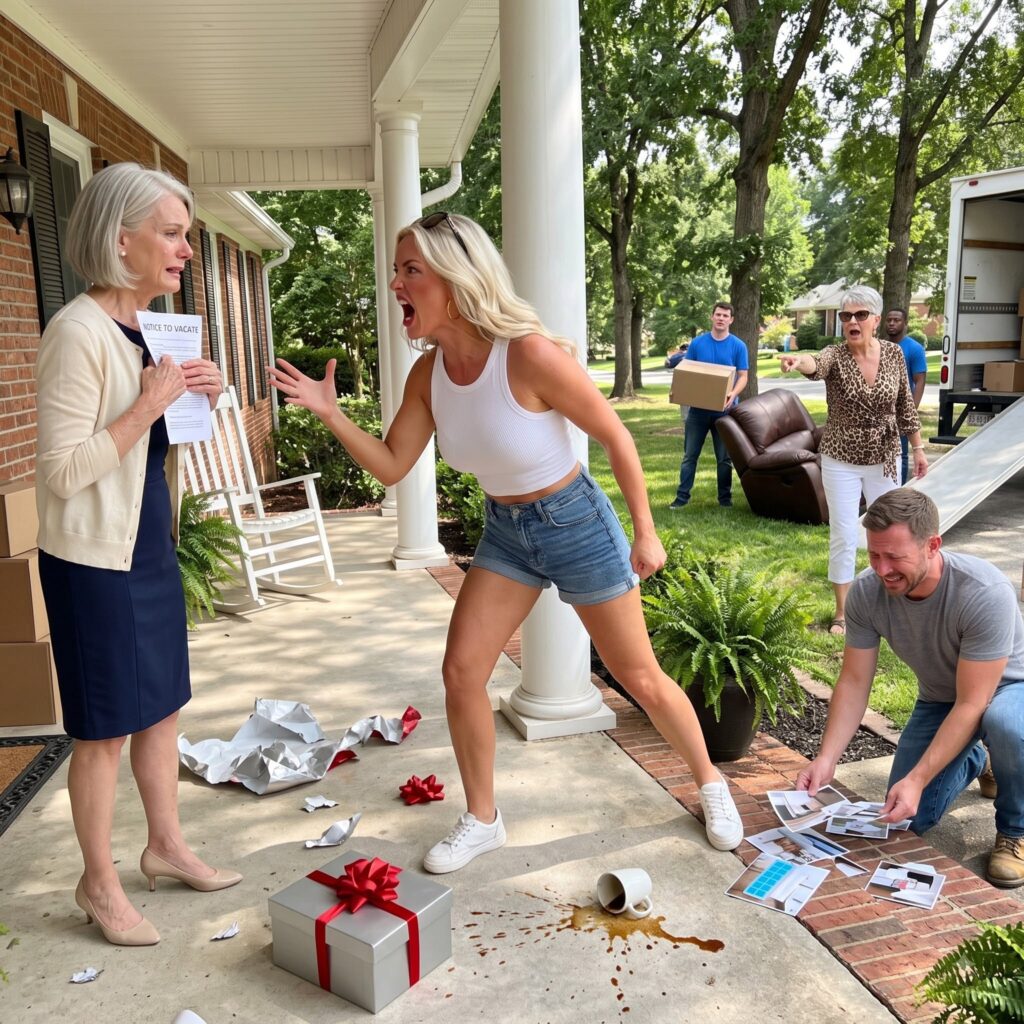
The truth came out on that porch, piece by piece, while the movers pretended to check their phones.
It started at Christmas. Brittany had FaceTimed her mother from my living room, and Sharon caught a glimpse of me in the background. Sharon had lived in Florida for twenty years and never came to the wedding. She recognized me instantly.
That was when the plan began.
If Matt became my conservator, he’d control my house, my bank accounts, and my medical care. With Sharon living in my bedroom as my live-in “caregiver,” no one would question anything she did. The house could be refinanced or sold. My savings could be “managed.” And the woman whose career I ended would finally get her revenge, along with my money.
But a judge would need evidence that I was declining. So Brittany started making some.
“I thought I had early dementia,” I told Matt, my voice finally cracking. “I cried in my car outside the doctor’s office in April. I was too scared to tell you.”
Matt’s hands were shaking. “Mom, I… she told me you were leaving the stove on. That you got lost driving to Kroger. I believed her. I never checked.”
“I know, baby.”
“You knew before the dinner?”
I nodded. Ellen was the one who told me to get a camera after the third time my keys went missing. When I saw the first footage, I sat at my kitchen table and threw up. A week later, I found a printed draft in the printer tray titled Proposed Petition for Conservatorship of Carol Ann Whitfield. That was when I called Denise.
Then came the dinner and the “guest suite.” Brittany had been testing me, to see whether I’d fight or fold.
I let her think I’d fold.
Matt turned to his wife. “You were switching her heart medication?”
“It was only a few days here and there,” Brittany snapped. “She was fine.”
“She’s sixty-eight, Brittany. She could have had a stroke.”
Brittany had no answer for that.
Matt looked at the petition with his signature on it, then at me, then at the woman he’d married. He set the papers down very carefully on the porch railing.
“Pack your things,” he said quietly. “Yours, not hers. And take your mother with you.”
Sharon climbed back into the truck without another word. Brittany screamed at Matt, at me, and at the movers, who loaded the recliner back onto the truck in record time. She was still screaming when they pulled away.
The court hearing was three weeks later.
The judge had already read my psychiatric evaluation and a report from the guardian ad litem, a court-appointed attorney who had spent two hours at my kitchen table asking me questions. Then Denise played four minutes of video from my kitchen camera.
The courtroom went silent.
The judge dismissed the petition and ordered Brittany to pay my attorney’s fees. Then she did something I hadn’t expected. She referred the footage to the Knox County District Attorney and to Adult Protective Services.
Brittany was eventually charged under Tennessee’s elder abuse laws. She took a plea deal: probation, restitution, and a no-contact order to stay away from me.



