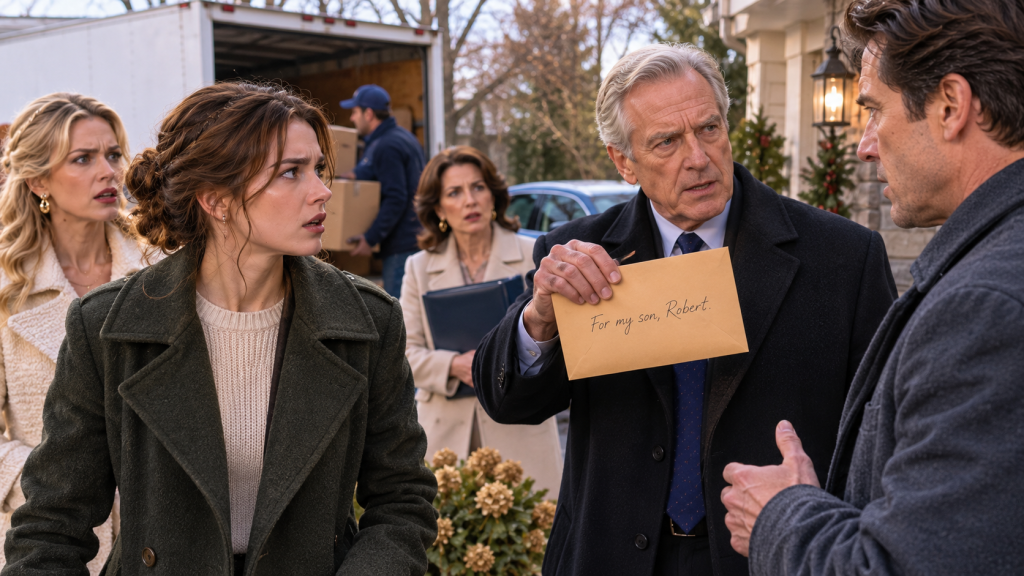
Mr. Bennett shook his head. “I met with him privately. He knew exactly what he owned and whom he wanted to receive it.”
Vanessa grabbed the listing agreement from the realtor. “Dad said Grandpa promised him the house. That he was only waiting until the hospital bills were settled.”
“No,” Mr. Bennett said. “Your grandfather refused your father’s request to sign it over. More than once.”
Vanessa turned to Dad. “You said the down payment was guaranteed.”
Dad said nothing.
“Robert,” Mr. Bennett continued, “shall I tell her what happened the last time you visited your father in the hospital?”
I watched Dad’s fingers tighten around the envelope until the paper wrinkled.
Then Mr. Bennett opened his own file and laid a single signed page on the hood of the realtor’s car.
Across the top were the words REQUEST TO TRANSFER PROPERTY.
Below them, unmistakably, was my father’s signature.
“I never signed that,” Dad said.
Mr. Bennett turned the page toward him. “You did. I was there when you brought it to the hospital.”
The form wasn’t a deed. It was a request Dad had typed asking Grandpa to transfer the house to him immediately, so he could “manage the family asset.” Attached was the email in which Dad had threatened to stop visiting unless Grandpa agreed.
Grandpa had kept both.
I remembered that week. He had been exhausted after dialysis, his feet swollen in loose slippers. Dad visited for twenty minutes. Afterward, Grandpa asked me to sit beside him without turning on the television.
“Ellie,” he’d said, “if I tell somebody no, that still means no, doesn’t it?”
I had thought he was talking about another medical procedure.
Mr. Bennett handed me a copy of Grandpa’s letter. It was written in the careful, uneven script I’d watched him use for birthday cards.
Robert, I love you. But you keep treating the house as something I owe you, when you haven’t asked what I want.
I helped you with the shop when it nearly closed. I helped Vanessa when her husband was laid off. I don’t regret helping either of you. I regret that you now speak of selling my home as if I’m already gone.
Ellie never asked me for this place. She asked whether I wanted the porch painted before winter. She asked if I needed another blanket. When she was seventeen, I opened my door to her because she needed somewhere safe. She made it safe for me when I grew old.
The house is hers because I want it to be. Please don’t make her defend that decision after I’m gone.
The last sentence stopped me. I had spent weeks wondering whether Grandpa had felt obligated to leave me something because I cared for him. His words answered a question I had been too ashamed to ask.
Vanessa read over my shoulder. Her face changed, though not in the way I expected.
“Dad,” she whispered, “you said he wanted to help me buy the place on Linden Road.”
“I thought he’d come around.”
“You told me to put down earnest money.”
Dad looked at the ground. “I was trying to help you.”
“You promised money you didn’t have,” she said.
The realtor explained that without the owner’s approval there could be no listing or sale. She left, and the movers drove away after Vanessa paid their cancellation fee. Nobody was arrested. Nobody handed over a house. My deed had already been recorded; the documents simply made the truth impossible to avoid.
That evening Dad sent one message: You’ve turned my own father against me even after he’s dead.
I didn’t reply.
Over the following month, Vanessa negotiated an extension with her seller, then let the purchase fall through. She lost part of her deposit. Dad refused to reimburse her. She stopped calling me selfish, but she never apologized for the wind chime.
I repaired it myself with a small piece of wire from Grandpa’s workshop.
By spring, the rosebushes were flowering again. I put a new stone along the driveway where the truck had broken the border. Some nights I still reached for the phone to tell Grandpa what I’d fixed.
One Sunday, I set his blue coffee mug on the porch railing and listened as the teaspoons moved in the breeze.
I’d once believed a home was somewhere you were allowed to stay until somebody changed their mind.
Grandpa had left me something better than that.
He’d made sure I could stay.



