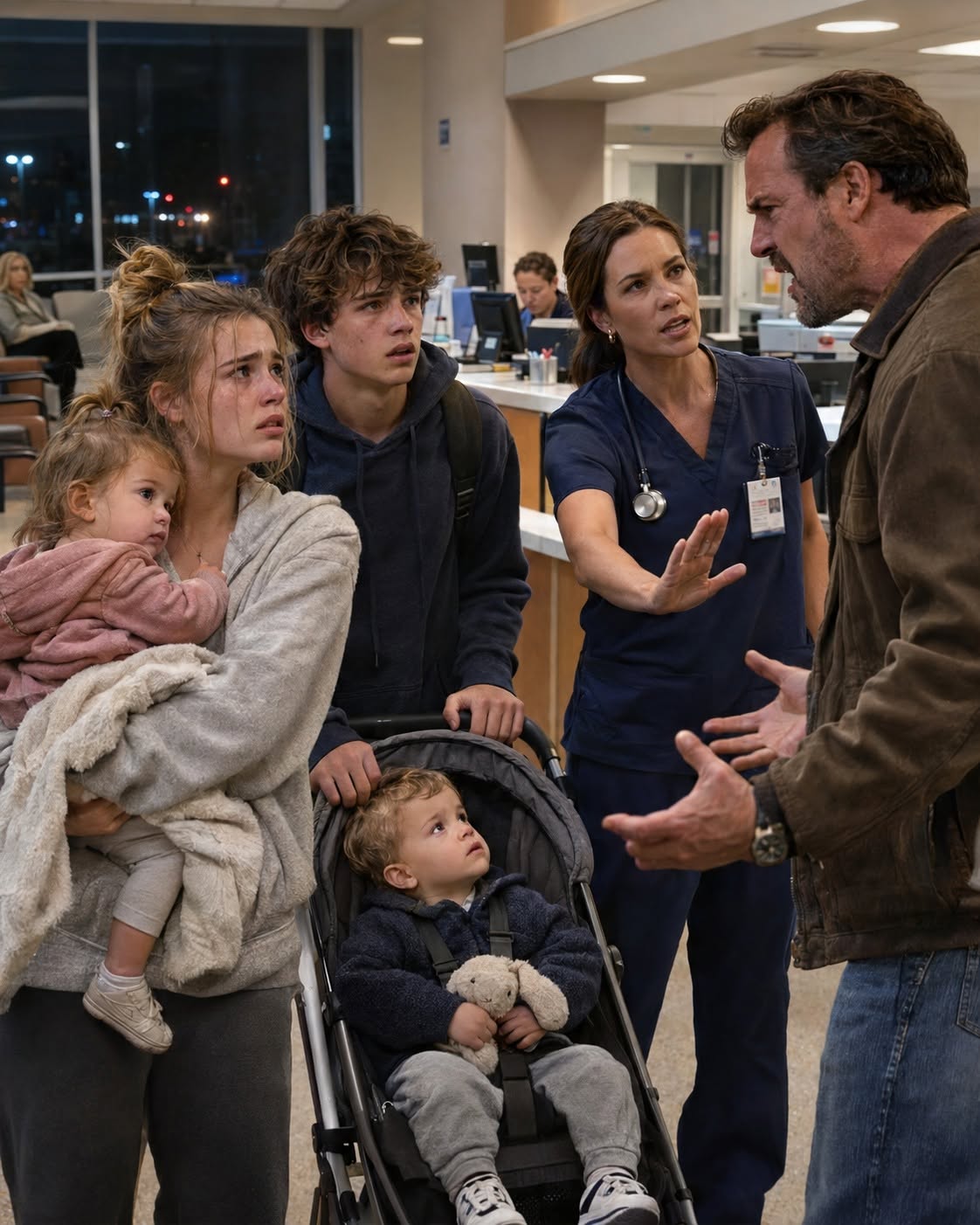
 The pediatric emergency department at Dallas Presbyterian was kept at a brisk, sterile sixty-six degrees, but Dad’s presence made the registration lobby feel suffocating.
“I asked you a direct question, Mr. Whitfield,” Nurse Rebecca Hale repeated. She hadn’t blinked. Her badge, clipped to a scrub top patterned with faded pastel giraffes, swayed slightly as she leaned forward onto the laminate counter. “Your daughter arrived in severe respiratory distress with stridor at rest. These teenagers initiated emergency protocols, monitored vitals, and contacted EMS. Meanwhile, your phone logs indicate eleven unanswered calls between eleven-twenty and midnight. So where were you?”
Dad’s neck flushed a dark, angry crimson that crept up from the open collar of his navy freight company polo. For twelve years, I had watched him use volume as a substitute for truth. Whenever the water bill was late, whenever a car payment slipped through the cracks, whenever Mom asked why there was cash missing from the checking account, Dad simply spoke louder until everyone else apologized just to stop the noise.
He tried it now.
“This is an outrageous invasion of my family’s privacy,” Dad snapped, his voice booming off the linoleum tiles and drawing the eyes of an elderly couple across the waiting room. “You are an RN, not a court-appointed inquisitor. I had an operational crisis at my facility. Equipment malfunction. Cell phones aren’t permitted on the loading floor for safety regulations. Any responsible adult knows that. What I want to know is why an ambulance was dispatched for what sounds like a common cold, run up on my insurance, while my son and daughter sat on their hands!”
He lunged his hand forward, palm flat, inches from my nose. “Give me the phones. Both of you. You don’t get to run this household into bankruptcy because you’re too delicate to handle a toddler with a stuffy nose.”
I didn’t flinch. Six months earlier, I would have dropped my chin, swallowed the lump of burning shame in my throat, and handed over my cracked iPhone. But six months earlier, Piper hadn’t been gasping behind a curtain, her small chest retracting between her ribs while her lips turned the dusky shade of a bruised plum.
Beside me, Nate moved. My sixteen-year-old brother was tall, gangly, and habitually quiet, but right now he stepped half a pace forward, placing his shoulder between Dad and me. In his left hand, clamped against his ribs like a shield, was the blue spiral notebook.
“She wasn’t stuffy, Dad,” Nate said. His voice was lower than usual, cracked with exhaustion, but completely steady. “Her temperature hit one-oh-three point one at eleven-forty. Her respiratory rate was fifty-four breaths per minute. Normal for eighteen months is twenty-four to thirty. If we’d waited another thirty minutes for you to ignore another call, she could have had an acute hypoxic event. That’s not panic. That’s clinical reality.”
Dad looked at Nate as if his own hand had suddenly bitten him. “You shut your mouth. Don’t you quote medical jargon at me, boy. Who pays the Wi-Fi you used to Google that nonsense?”
“He didn’t Google it,” I said, my voice cutting through the lobby. I didn’t raise it; I didn’t need to. “The 911 dispatcher told us. While you were busy having an ‘operational crisis.'”
“Kaylee,” Dad warned, his jaw muscles clenching into hard, knotty ridges. “You are treading on very thin ice. That college fund we set aside? The tuition matching I promised for Texas A&M? It’s gone. The minute this hospital bill lands in my mailbox, every cent of that savings account covers this circus. You hear me?”
A cold tremor rattled through my stomach. My scholarship interview was seven hours away. I had spent four years maintaining a 4.1 GPA, tutoring middle-schoolers in algebra, and scrubbing baby bottles at two in the morning so I wouldn’t have to depend entirely on him. But his matching promise had been the safety net. Without it, one bad semester could derail everything.
Nurse Hale’s pen stopped moving across her desk clipboard.
“Mr. Whitfield,” she said, her tone dropping into that terrifyingly level register that seasoned healthcare workers use right before security gets summoned. “Threatening a minor’s educational assets in an emergency triage area is inappropriate. Furthermore, Dallas County guidelines require us to file an incident review whenever a pediatric patient under two years of age is admitted through EMS without a guardian present during onset. If you continue to disrupt this triage intake, I will have hospital security escort you to the west entrance.”
Dad scoffed, though his eyes darted nervously toward the sliding glass doors where two uniformed security guards were already lingering near the metal detectors. “You’re taking the word of two children over their father?”



