They had forgotten the $35,000 SUV parked out front—the one registered in Olivia’s name that I had paid off when she claimed she couldn’t transport her kids safely. They had forgotten the $25,000 wire transfer I sent Richard eighteen months ago when he wept over the phone, claiming predatory lenders were going to seize his car and bankrupt his retirement. And most unforgivably, they had forgotten the $50,000 cashier’s check I handed Richard three days after I buried James—money taken directly from my husband’s death gratuity because Richard insisted the family home in Sacramento was facing immediate tax foreclosure.
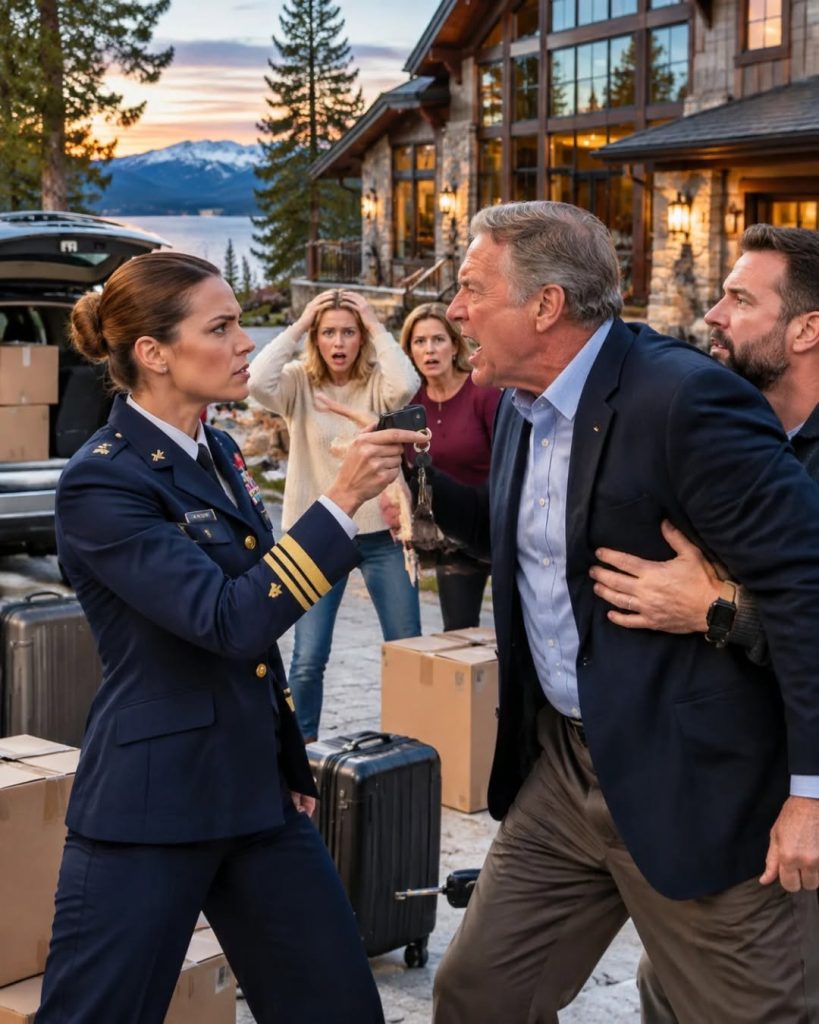
Over one hundred and ten thousand dollars handed out to keep them afloat. And now, they were standing in the home I had purchased with what little remained of James’s legacy and my savings, telling me to get out.
I did not yell. I did not reach for the phone to call the county sheriff. Doing so now would only invite an emotional scene, a messy domestic dispute where local deputies would shrug and call it a civil matter because David had already unpacked his clothes into the master closet.
“All right,” I said quietly.
Richard blinked, momentarily thrown by the absence of an argument. Olivia lowered her glass slightly, a flicker of suspicion crossing her features.
“Good,” Richard blustered, recovering his bravado. “At least you have the sense not to cause a scene in front of the neighbors. David, take the rest of the boxes from the SUV.”
I bent down, hooked my fingers through the canvas strap of my duffel bag, and slung it back over my shoulder. I turned on my heel and walked out the heavy timber front door.
Behind me, another cork popped, accompanied by David’s boisterous laughter.
By the time I reached my truck and put the key in the ignition, they had already forgotten I existed. That was the primary tactical error they had made: assuming that an officer who retreats is an officer who has yielded the field.
Chapter 2 – Fortress on Paper
The drive back down the mountain toward the coast was executed in absolute silence. The early morning sun broke over the ridge lines, painting the pine trees in amber light, but my focus remained locked on the black asphalt ahead.
By noon, I was sitting behind the gray steel desk in my assigned quarters at Naval Base Coronado.
I took off my blouse, laid out a fresh legal pad, and opened the fireproof document lockbox I kept stored in my trunk. One by one, I laid the paperwork across the blotter:
The certified grant deed to the Tahoe property, recorded with the El Dorado County Assessor’s Office.
The title insurance policy, clear of any liens, encumbrances, or secondary names.
The municipal tax statements, paid in full via automatic debit from my private credit union account.
The construction invoices detailing the $140,000 smart-home overhaul I had commissioned the previous spring.
Every single page bore one name: *Commander Claire Mercer, USN.*
My father’s name did not appear. Olivia’s name did not appear. There was no trust, no co-signatory, and no shared equity.
I picked up my secure mobile phone and dialed a ten-digit number from memory.
“Vance Legal Services,” a crisp voice answered on the second ring.
“Michael,” I said. “It’s Claire.”
A pause on the line, followed by the sound of a pen clicking. Michael Vance had served eight years as a Navy JAG officer before establishing one of the most ruthless private real estate and commercial litigation practices in Northern California. He had also been one of James’s closest friends at the Naval Academy.
“Claire. You’re supposed to be on post-exercise leave in Tahoe.”
“I was,” I said evenly. “Now I’m back in Coronado. My father, my sister, and her husband have broken into the villa, unpacked their luggage, and declared ownership.”
The silence on the line stretched for three beats. When Michael spoke again, his voice had dropped the casual familiarity and taken on the cold, analytical cadence of a courtroom prosecutor.
“Define ‘broken into.'”
“They had an emergency key I left in a lockbox two years ago for utility maintenance,” I explained. “They confronted me at the door. My father stated that the house was now Olivia’s because she has children and I do not. He ordered me off the premises. When I left, they were popping champagne and moving furniture into the master bedroom.”
“Did you engage?”
“Negative. I withdrew immediately.”
“Good girl,” Michael said, a razor edge entering his tone. “If you had engaged, local law enforcement would have written it off as a family disagreement, claimed it was an informal tenancy, and told you to file an unlawful detainer. That would have given them six to nine months of free rent while the courts slogged through backlog.”