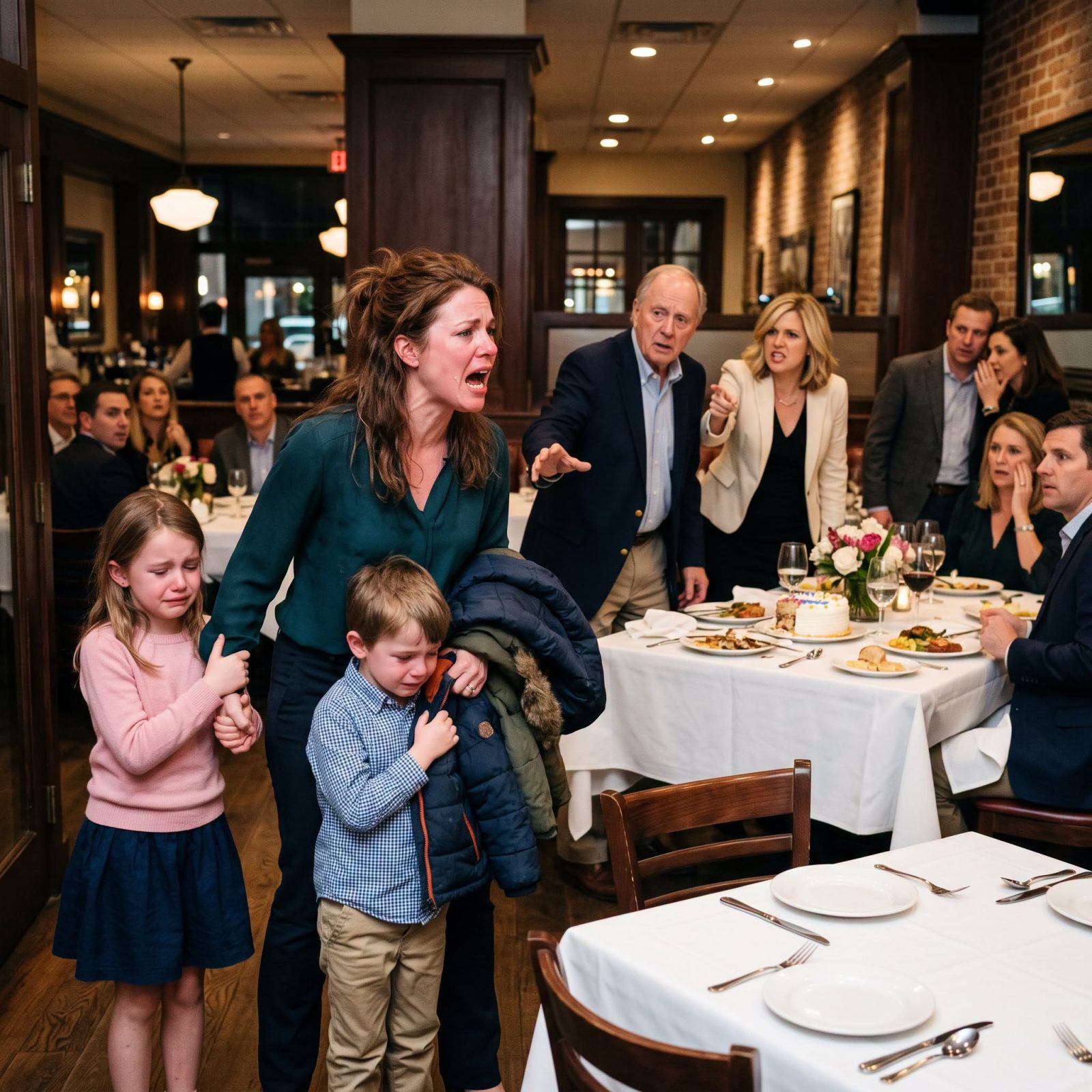
 The air inside *The Gilded Oak*, one of Columbus, Ohio’s most exclusive dining establishments, smelled of dry-aged beef, expensive red wine, and the unmistakable, suffocating perfume of my older sister, Amanda. Outside, a bitter November wind battered the reinforced glass windows, but inside, the atmosphere was a carefully choreographed symphony of wealth, status, and calculated exclusion.
It was my father’s seventieth birthday. For weeks, Amanda had taken absolute control of the planning, broadcasting every detail across our family’s group chat like a military general staging an invasion. She had secured the private back mezzanine, hired a professional photographer whose flashbulb periodically cut through the dim, amber lighting, and arranged for a five-course tasting menu curated by a chef who flew in his truffles from Italy. My father, Arthur Vance, sat at the absolute center of the long, mahogany banquet table, a man who had spent forty years building a midwestern real estate empire on handshakes, ruthless acquisitions, and an unyielding demand for absolute loyalty.
I had arrived fifteen minutes late, breathless and apologizing, holding the damp mittens of my eight-year-old daughter, Lily, and the small, trembling hand of my six-year-old son, Noah. We had fought through slushy traffic from our small, drafty duplex on the south side of town—a place where the radiator clanked like a dying engine and the floorboards groaned beneath every step. I was wearing my only good dress, a navy wool sheath I’d bought on clearance three years ago, altered with hasty needlework to hide the slight weight I’d gained after my divorce.
“Clara! You’re dragging in the cold air,” Amanda had called out the moment the hostess ushered us into the mezzanine. Her voice was a crystalline chime, perfectly pitched to carry across the room without ever sounding loud. She was draped in emerald silk that clung to her frame like melted glass, her blonde hair pulled into a severe, flawless chignon that cost more than my weekly grocery budget.
“I’m sorry, traffic on I-70 was—”
“Never mind, never mind, just take your coats off quickly,” Amanda interrupted, her manicured hand waving us away as if we were stray dogs tracking mud onto a pristine carpet. “The photographer is trying to capture the table lighting. Go on, sit down. You’re at Table Seven.”
I blinked, momentarily disoriented by the restaurant’s cavernous layout. Table Seven wasn’t part of the long, beautifully adorned banquet setup where my father sat flanked by Amanda, her impossibly smooth corporate-lawyer husband Richard, and their twin teenage daughters, Chloe and Claire, who were currently scrolling through their identical iPhones with look-of-bored-royalty expressions.
Table Seven was tucked away in the darkest, most distant corner of the mezzanine, immediately adjacent to the swinging service doors that led back to the commercial kitchens. It was a tiny, wobbly round table meant for two, hastily retrofitted with an extra folding chair. There was no linen tablecloth, no crystal glassware, no silver candlesticks. There was only a single, flickering votive candle inside a smudged glass jar and three empty, bone-white ceramic plates.
“Amanda,” I said, my voice dropping an octave as I guided Lily and Noah toward the dim corner. “There must be a mistake. We’re five. The invitation said—”
“There’s no mistake, Clara,” Amanda replied, not even turning her head as the waiter poured more vintage Bordeaux into her glass. “The main table is at maximum capacity. Fire codes, you know. You can sit there with the children.”
I froze. My pulse hammered violently against my ribs, a hot, suffocating wave of adrenaline rushing from my chest into my fingertips. “We can’t all fit at a two-person table, Amanda. And where are the menus? Where is the children’s food?”
Amanda finally turned, her thin lips curving into a smile that didn’t reach her cold, pale blue eyes. “They can eat when the guests are done.”
I thought I had misunderstood. The ambient noise of the restaurant—the low murmur of conversation, the clinking of silver against bone china, the distant jazz playing over the speakers—seemed to warp and distort around me.
“What did you just say?” I asked, my voice dangerously quiet.
She calmly adjusted her crisp linen napkin, smoothing it over her emerald lap. “The main table is for family and important guests. The kids can wait. Honestly, Clara, why do you always have to create a crisis out of nothing? Just feed them a sandwich or something when you get home. Sit down; Dad is about to give his toast.”



