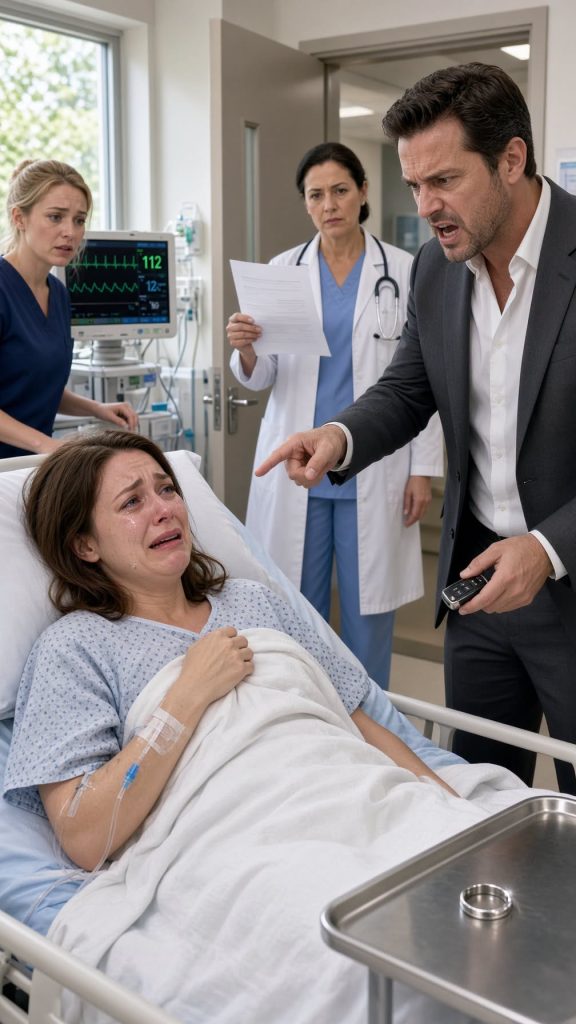
My signature appeared on that document too.
Megan had already asked Mr. Harris to preserve his original recording. He had sent a copy after learning I was alive and in the hospital.
She turned her phone toward me.
The video showed our porch at 9:41 p.m. I stepped outside holding a small trash bag. Daniel followed so closely that his shoes nearly touched mine.
He reached for my shoulder.
For one terrible second I recognized the movement. His palm pressed between my shoulder blades. He shoved.
I pitched forward, missed the first step, and disappeared below the camera’s frame.
“Stop,” I whispered.
Megan’s fingers trembled, but she let the recording continue.
Daniel stood motionless above me. Then a woman emerged from the parked car, hurried up the steps, and knelt beside my body.
I recognized her immediately.
Brooke. Daniel’s new office manager.
She wasn’t checking my breathing. She was opening my purse.
And the first thing she removed was my phone.
My phone. Of everything Brooke could have reached for, she chose my phone while I lay bleeding at the bottom of the steps.
Megan lowered the screen.
“Play it again,” I said.
“Claire—”
“Please.”
Brooke held my phone, tapped at the screen, then disappeared into our house. She came back nearly six minutes later. Daniel still hadn’t called anyone. He waited until Brooke got back into the car before pulling out his own phone.
Megan checked the recording time. “He didn’t call 911 until 9:53.”
Twelve minutes. They had left me lying there for twelve minutes.
I asked Megan to send the footage to the officers when they arrived, not to Daniel or anyone else. She had already arranged for Mr. Harris to keep the original. For the first time since waking, I felt that the truth might survive what my husband said about me.
Officer Denise Alvarez arrived with another investigator half an hour later. Dr. Patel explained my condition and asked if I could tolerate speaking. I told the officers what I remembered: Daniel’s hand against my back, the sickening drop, and his words just before he touched me.
“You weren’t supposed to find out.”
That was the sentence my mind had pushed away. I hadn’t understood it at the time. Now it made my stomach twist.
The officers didn’t promise an arrest. They took my account, photographed the form with my permission, and collected the details needed to request records from the hospital and insurer. They told Megan not to edit the video.
While they worked, Dr. Patel returned with the hospital’s patient advocate. My older health care power of attorney was still valid, naming Megan as my agent if I couldn’t speak for myself. I revoked any access Daniel had to my records, updated my portal password, and gave the staff clear instructions not to admit him to my room.
The advocate pulled a chair close. “You are the patient,” she said. “These decisions belong to you.”
I cried then, not because I was frightened, although I was, but because those were the first words in hours that made me feel like a person instead of a problem.
The next afternoon, the officer came back. The original recording had been preserved. It showed Daniel driving into our driveway with Brooke in the passenger seat, then following me onto the porch. After he shoved me, Brooke took my phone inside and returned with a blue folder. Police later recovered both from Brooke’s car. The folder contained drafts of the refusal form; insurance emails had been deleted from my phone. The camera had captured enough to make their claims of an accident impossible to accept.
Investigators also found that the requested insurance increase carried an electronic signature I hadn’t made. The broker’s records tied the request to an email address controlled by Brooke at Daniel’s office. Payment had come from our joint account.
I remembered telling Daniel we couldn’t afford to increase our coverage. He had agreed. Apparently, he’d been listening to someone else.
My husband had lost more than he admitted. His construction business was failing. There were unpaid subcontractors, a second mortgage I hadn’t authorized, and thousands of dollars spent on hotel rooms with Brooke. When the company faced a lawsuit, Daniel had begun selling things and telling friends I was too ill to understand our finances.
I wasn’t ill then. I was inconvenient.
Brooke eventually told investigators what she had done. Daniel promised her they’d move away after the insurance payment. She helped submit the forged increase, then used my tablet to upload the false transfusion refusal to my medical chart. They believed that if I died after a fall and the hospital withheld blood, no one would question them.



