I called him from Nora’s office.
“Did you give Daniel those documents?”
Silence. Then breathing.
“He said it was temporary,” Lucas whispered. “He said the bank only needed reassurance until his funding closed.”
“Did you sign my name?”
“No. I sent the files. Daniel said someone else would handle the paperwork.”
He began crying. Daniel had promised him a vice presidency at Crosspoint and a six-figure bonus after the loan. Lucas had debts I’d never known about. He’d traded my trust for an exit ramp.
Nora ended the call before I could say something unforgivable.
By late afternoon, the bank confirmed it had not advanced the funds. Its risk team had noticed that the supposed guarantee conflicted with my company’s public corporate records. That was why someone had finally asked me directly.
I thought the worst discovery was behind me.
Then HarborLine’s general counsel showed me the lender presentation. Page sixteen described a planned acquisition of HarborLine by Crosspoint. Under “Founder Approval,” it quoted a message supposedly sent from me: “I am excited to place our companies under Daniel’s leadership.”
My throat tightened.
There was one more page: an internal deal memo showing Daniel had promised Vivian a consulting fee if the acquisition closed.
At the bottom, in red, was the deadline.
BANK CREDIT COMMITTEE — 9:00 A.M. TOMORROW.
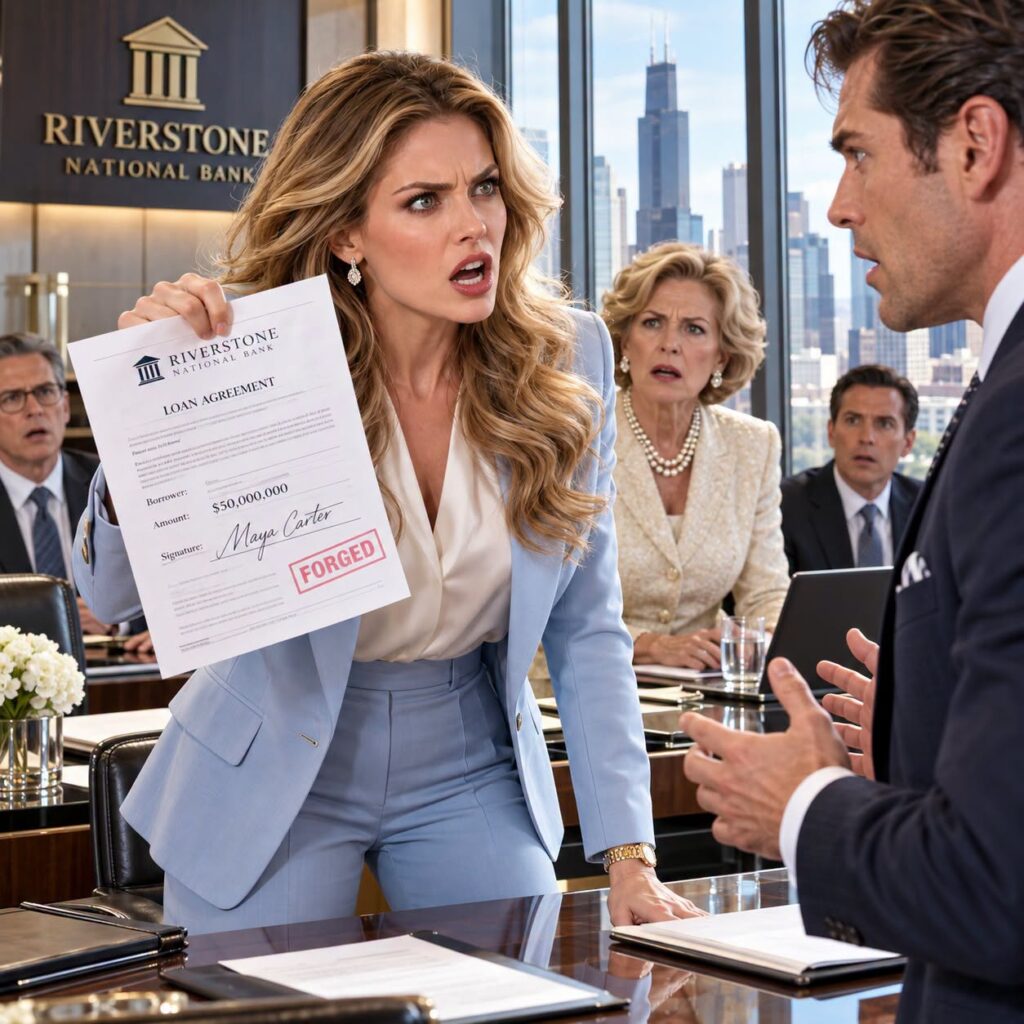
At 8:02 the next morning, I entered the bank’s emergency meeting with Nora, HarborLine’s general counsel, and a folder thick enough to make my hands ache.
Daniel sat across from us in a navy suit. Vivian wore pearls. Lucas wasn’t there.
My husband smiled when he saw me. “Maya, sweetheart. You should’ve told me you were coming.”
“I thought you wanted everything shared.”
His smile flattened.
The bank’s risk officer began by identifying everyone present. Then our general counsel handed over HarborLine’s actual board records, my sworn statement denying the signature, and the preliminary access logs. Nora made clear we were reporting suspected forgery, not negotiating an investment.
“There’s been a misunderstanding,” Daniel said.
“Then explain why you witnessed a signature I never made.”
He looked at Vivian. She looked at the table.
Daniel’s attorney, Henry Price, spoke before either could answer. “My firm did not prepare that guarantee. We first received it through the lender’s diligence package yesterday. Daniel, I advised you not to rely on it.”
Daniel pushed back his chair. “You can’t prove who signed anything.”
“I don’t have to settle that in this room,” I said. “The bank has the records. So do our attorneys.”
The risk officer announced that the loan would not proceed while the authenticity issues remained unresolved. No transfer of HarborLine stock had occurred. No guarantee had become binding simply because someone had inserted paper into a financing file.
Outside, Daniel grabbed my arm near the elevators.
“You’re destroying everything I built!”
I pulled away. “You tried to borrow against what I built.”
For one terrible second, I saw the man from the hospital floor again. Then Vivian stepped between us and hissed, “You could fix this with one signature.”
That was the moment I finally understood. They weren’t frightened of losing me. They were frightened of losing access.
I returned home with a security escort, packed one suitcase, and left my wedding ring beside the lilies Daniel had brought as an apology.
The following months were ugly, not magically satisfying. HarborLine completed an independent forensic review. Lucas admitted in a written statement that he had copied restricted files for Daniel. I suspended him immediately, then terminated his employment after our investigation. He hired his own lawyer.
Crosspoint’s board commissioned an outside investigation. Daniel stepped down as CEO while it proceeded. The bank referred the disputed documents to law enforcement; whether charges would follow wasn’t mine to decide. Vivian’s proposed consulting payment never happened.
I filed for divorce. Daniel challenged the prenup, but both of us had received separate legal advice, disclosed our finances, and signed well before the wedding. After months of litigation, we settled. My premarital stake in HarborLine remained mine.
Lucas sent a letter asking for forgiveness. I answered once: “I hope you repay what you owe. I can’t rebuild trust for you.”
One evening, I stood alone on HarborLine’s warehouse balcony, watching refrigerated trucks pull through the gates. Below me were drivers, dispatchers, engineers—people whose lives depended on decisions made upstairs.
I remembered Daniel calling me a risk in front of forty guests. I’d once thought love meant proving I was worth choosing.
Now I knew better.
My worth was never his to calculate, and my future was never his to take.



